



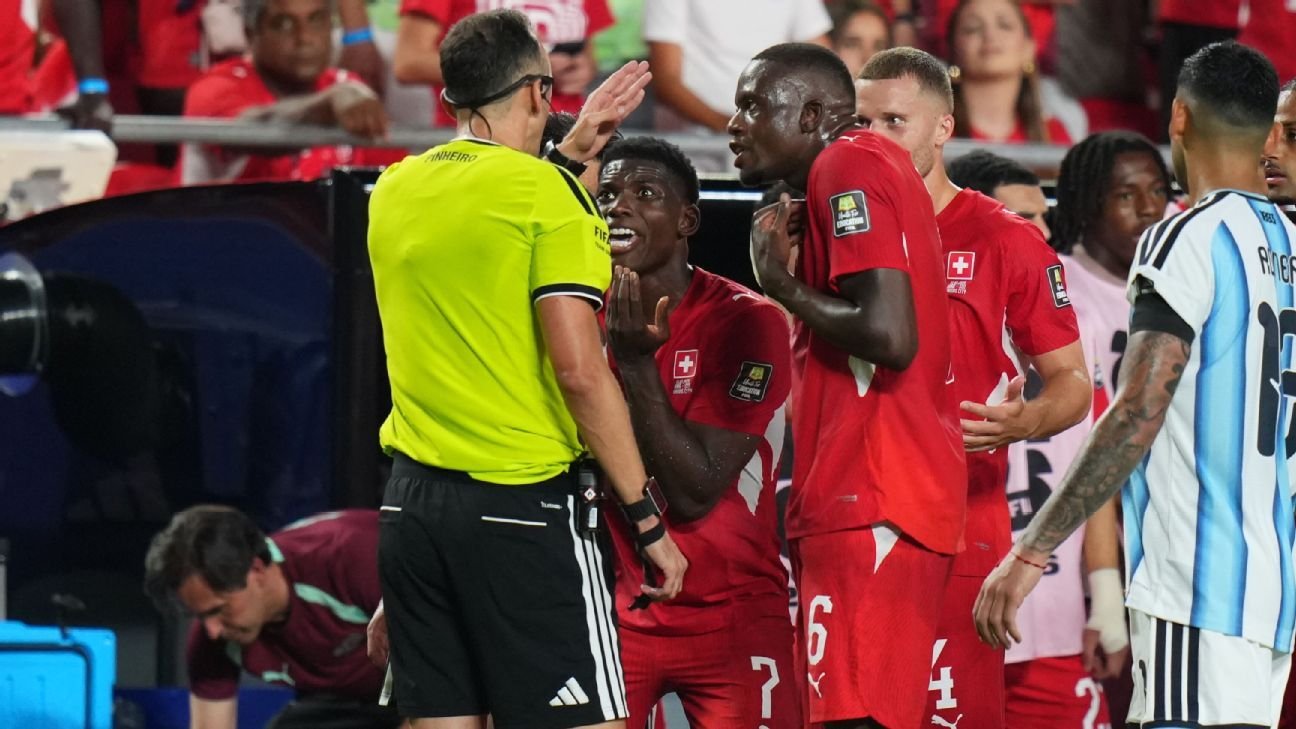
KANSAS CITY, Mo. — Switzerland’s players were left outraged following the dismissal of forward Breel Embolo during the second half of Saturday’s World Cup quarterfinal. A video review determined he had simulated a foul, contributing to his team’s 3-1 loss to Argentina in extra time.
Initially, Leandro Paredes was shown a yellow card for a challenge, but video evidence revealed that Embolo was already falling when contact was made. Because Embolo had previously been booked, he received a red card, forcing Switzerland to compete with just ten players for the remainder of the match, which was tied 1-1 at that point.
“I simply cannot comprehend how VAR arrived at that decision,” Swiss defender Nico Elvedi commented after the match.
The incident shifted the momentum dramatically after Switzerland’s Dan Ndoye had recently equalized.
“We had the momentum following the equalizer, and I intended to make substitutions to introduce fresh attacking players,” remarked Switzerland’s coach, Murat Yakin.
“We were in control of the game. The red card penalized us due to a rule that I still find utterly baffling. It is incredibly painful to be eliminated in such a manner; we didn’t deserve this outcome.”
This incident marks the second occasion at this World Cup where a yellow card has been overturned for “mistaken identity.” This rule permits the video assistant referee to correct the issuing of a yellow or red card to the wrong player.
If Paredes had not been cautioned for the challenge, VAR would not have had grounds to intervene.
“In a situation where there should have been several yellow cards previously, he issued one for what I believe was a minor foul—or potentially no foul at all,” Yakin stated. “They prioritize the referee’s protection over a rule that effectively ruined our game today. This is incredibly painful for us.”
“In my view, there was no justification for giving the Argentine player a yellow card. He should have allowed play to continue. He rectified his own mistake at our expense, and we ended up with one less player on the field.”
Embolo was visibly distressed after being shown the red card and required consolation from his teammates on the sidelines.
“You can only imagine how Breel is feeling,” Yakin said. “He had already faced multiple challenges and had several promising moments during the game. However, after that incident, he was unable to contribute further.”
“To blame him at this point is utterly ridiculous. He consistently puts in the effort for the team, and while he had good contributions in our match, he is understandably devastated that he couldn’t assist the team further.”
The match ultimately concluded in extra time with decisive goals from Julián Álvarez and Lautaro Martínez.
“I believe the red card altered the course of our game,” Swiss captain Granit Xhaka remarked. “This decision is difficult to accept now that the game is over, as the atmosphere in the locker room is very subdued and disappointed.”
Embolo is now the fourth player in the last 60 years of World Cup history to receive a second yellow card for simulation, joining the ranks of Mexico‘s Luis Pérez (2006 vs. Portugal), Ghana‘s Asamoah Gyan (2006 vs. Brazil), and Italy‘s Francesco Totti (2002 vs. South Korea).
Contributions to this report were made by ESPN’s Bill Connelly and The Associated Press.