



Tim Farrell, at 56, may not seem like a typical candidate for revolutionizing football. A lifelong passionate fan, the odds are stacked against him when it comes to instigating meaningful change in the sport.
Born and raised in Australia, Farrell is quite distant from FIFA’s headquarters in Zurich, Switzerland. He is a devoted follower of Newcastle Jets, an A-League team from his hometown, about a two-hour drive from Sydney—not the Premier League’s Newcastle United. Farrell has no professional background in sports or soccer and has dedicated his career to the fields of video and multimedia production.
Nonetheless, for the last twenty years, he has passionately advocated for a new method to resolve ties in knockout soccer matches, specifically suggesting an end to both extra time and penalty shootouts.
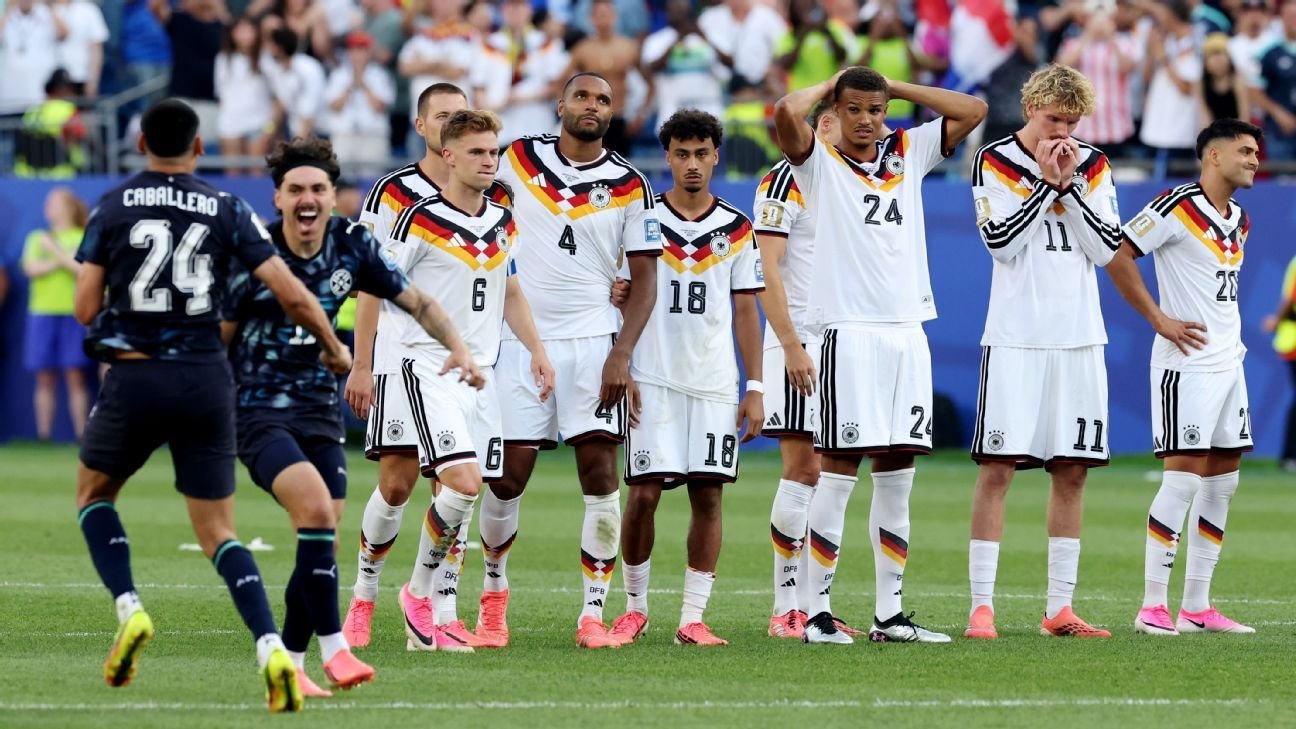
Farrell critiques the current tie-breaking format in soccer as being fundamentally flawed for several reasons: A) Extra time is often dull and physically taxing for players, B) penalty shootouts diverge too much from the fundamental nature of the game, and C) penalties spotlight individual failures, placing undue pressure on one player, particularly devastating during major tournaments like the World Cup.
Farrell does possess an innovative plan he has carefully honed over the years and even presented it in a meeting at FIFA’s headquarters.
While one might argue that suggesting an alternative to FIFA is futile, that’s how the penalty shootout was originally embraced in the first place.
The Origins of Penalty Shootouts
The quarterfinal match between Israel and Bulgaria at the 1968 Olympics in León, Mexico, is often cited as one of the most consequential matches few remember.
Penalty shootouts are actually a relatively recent addition to the sport. While penalties have existed since 1891, the concept of a shootout is much newer.
Before 1970, ties in knockout football were settled via one of three methods: play a rematch, draw lots, or toss a coin. There were eight World Cups where matches ended without shootouts, and countless domestic cup games experienced similar outcomes. The noteworthy conclusion of the 1968 Olympic quarterfinal demanded change.
When Israel and Bulgaria finished the game tied at 1-1, confusion ensued regarding the next steps. A large sombrero was brought onto the field, containing two pieces of paper. Israel’s captain, Mordechai Spiegler, drew one that read, “OUT!” Just like that, Israel’s journey in the tournament was over, while Bulgaria advanced to earn a silver medal.
This abrupt ending was met with outrage by Israeli soccer journalist Joseph Dagan, who collaborated with Israeli football federation executive Michael Almog. Together, they proposed the implementation of penalty shootouts in a formal memo to FIFA, which was eventually discussed and approved by football’s governing body, the International Football Association Board (IFAB), in 1970. Although penalty shootouts had been utilized in Soviet Union matches in the 1950s, Dagan and Almog are credited with formalizing the modern iteration of the shootout.
That same year, Manchester United and Hull City engaged in the first official penalty shootout, with United winning 4-3. Old Trafford legend George Best became the first player to miss in an official shootout.
Years later, while residing on the other side of the world, Farrell reflected on that memo as a pivotal moment for soccer. It was in May 2008, waking early to catch the Champions League final between Manchester United and Chelsea, that he first considered taking action.
“I remember how cold it was,” he shares with ESPN. “It was a freezing morning in Melbourne. Watching World Cups here usually requires late-night teas under the duvet due to the time zone. It was different this time.”
The match concluded in a 1-1 tie after extra time—Cristiano Ronaldo’s header in the 26th minute was evened out by Frank Lampard just before halftime—leading to penalties.
Among the first nine penalties, Ronaldo missed, leaving Chelsea’s John Terry with the chance to clinch their first Champions League title with his fifth shot. However, he slipped and sent it wide, overwhelmed by despair, he sat on the field with tears in his eyes. Four penalties later, Chelsea’s Nicolas Anelka missed as well, securing Manchester United’s victory.
This struck a chord with Farrell. A long-time opponent of penalty shootouts, he decided it was time for a change.
“I was just a neutral fan,” he explains. “I felt heartbroken watching John Terry. As a dedicated football fan, seeing matches resolved in a manner that emphasizes failure was frustrating. We can aim for better.”
A Revolutionary Proposal
Farrell believes shootouts are structured to amplify failure. With penalties typically easy to score, the players who miss bear the blame. Yet what if soccer approached this differently? By lowering the scoring rate, he theorizes that responsibility for the outcome shifts to those who manage to score.
He also feels that penalties stray too far from the essence of the sport, lacking the tactical nuances he treasures. Inspired by Major League Soccer’s (MLS) temporary system used between 1996 and 2000—where attackers began at the halfway line and challenged the goalkeeper—Farrell envisioned enhancing that concept by adding a defender into the mix.
data-instgrm-version="14" style=" background:#FFF; border:0; border-radius:3px; box-shadow:0 0 1px 0 rgba(0,0,0,0.5),0 1px 10px 0 rgba(0,0,0,0.15); margin: 1px; max-width:540px; min-width:326px; padding:0; width:99.375%; width:-webkit-calc(100% - 2px); width:calc(100% - 2px);" WPAuto_Base_Readability="-0.29577464788732"/>This led to the creation of the Attacker, Defender, Goalkeeper (ADG) format.
Essentially, it operates as follows: An attacker positioned 32 yards from the goal faces a defender at least 10 yards away and a goalkeeper, all within a 15-second limit. If the attacker is fouled, a penalty is awarded. Otherwise, they can either score or fail to score.
Teams alternate between attacking and defending. The first five attackers would be predetermined during regulation time. The defenders, assigned randomly, will only participate once for each cycle. This introduces a strategic element—do teams match their best defenders against the opposition’s top dribblers, or do they seek more favorable matchups?
Farrell believes ADG could ideally replace extra time and has suggested it could effectively replace penalties as well. Citing years of dull, uneventful extra time, he emphasizes that getting rid of it is essential. He suggests a systematic approach, proposing to allocate 10 minutes of rest before the ADG round—which he estimates would typically last around nine minutes—allowing broadcasters to manage programming timings effectively.
The fairness aspect also comes into play; should a team receive a red card, the other team would benefit by having chances to go one-on-one with the goalkeeper during the ADG phase.
Farrell’s concept aims to minimize individual failures. Without the intense pressure of a penalty miss, he speculates that players could face less abuse, akin to the racial attacks directed at England’s Marcus Rashford, Bukayo Saka, and Jadon Sancho after their Euro 2020 penalty misses.
Statistics show that modern penalty shootouts have scoring rates around 70%. In Farrell’s system, he anticipates the rate would be closer to 30%.
“Goals will become hard-fought achievements. Scoring won’t be the expectation, and missing won’t carry that pressure; it’s just part of the game. Scoring becomes a triumph rather than a duty,” he explains. “Players who have suffered from misses, like Italy’s Roberto Baggio, have discussed how it affected their lives for years. It’s damaging both mentally and emotionally.”
Is it Feasible?
While Farrell’s vision is bold, it remains a theoretical proposal at this stage. However, he continues to persist, repeatedly presenting his case to FIFA and IFAB in hopes they may someday consider it. “I keep knocking at their doors until they engage with the idea, and I’m determined to remain tenacious,” he states.
In 2010, for instance, he traveled to Zurich to pitch his idea directly to FIFA.
“I was living in India at the time and thought, if they’re interested, I should go see them. I covered my costs and reached out, asking if they’d meet me while I was in Switzerland,” he recalls.
“Unfortunately, FIFA brushed me off,” he admits, “but to their credit, I understand, as my concept still needed refinement despite my efforts.”
The framework shared during that meeting closely resembled his current idea, but advances in technology since have simplified the approach. He consciously avoided additional markings on the field. “The pitch should remain untouched. Adding even a small mark would be unacceptable,” he insists.
This meant revising his original proposal in which attackers would start from the halfway line, prolonging the time and reducing scoring probabilities. With the introduction of vanishing spray, however, a designated mark positioned 32 yards out could now be easily implemented.
Although FIFA acknowledged his proposal, the discussion did not go further.
Returning from that meeting, Farrell felt a sense of accomplishment despite the hurdles. “I was just relieved to have had a conversation with someone. In retrospect, I recognize the proposal could’ve been more polished,” he admits.
Since their discussion in 2010, Farrell has continued to refine the proposal. He revisits it periodically, especially during World Cups, refreshing it as the tournaments reignite his passion. Leading up to the 2022 World Cup, he used AI tools to simulate outcomes based on his proposal.
Despite his efforts, it has yet to be trialed in practical settings. While he has engaged with some A-League teams to explore running tests, none have committed to assisting him. He has had informal discussions with IFAB members who appreciated his vision, but it has yet to be tabled for serious consideration.
As Farrell succinctly puts it, “There are three methods for resolving ties: away goals, extra time, and penalties—each falling short in its way. With away goals gone and extra time likely next, we may be left with just penalties.”