



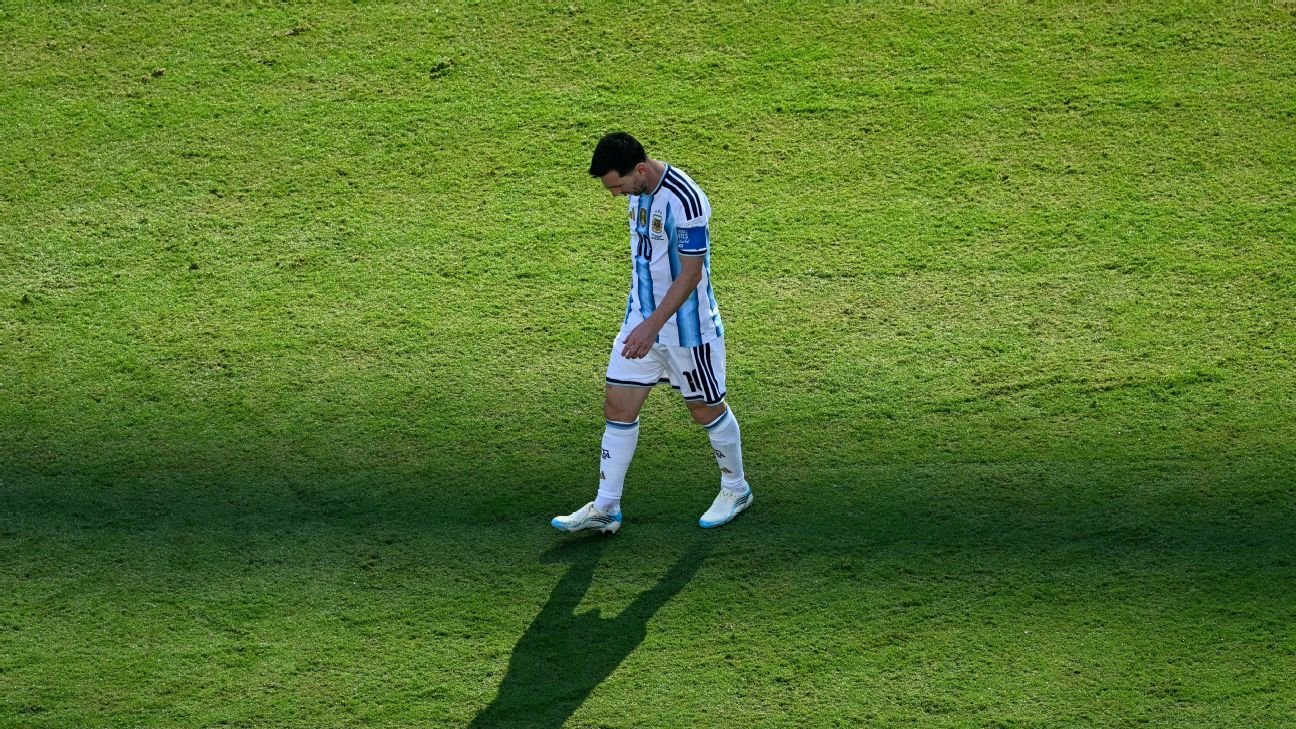
“Thank you, Scaloneta,” read the headline in Argentina’s Pagina 12 just after the conclusion of the World Cup final on Sunday, referring to the team led by coach Lionel Scaloni.
“What lingers are the joys, the memories, and now the sorrow,” the article continued. “The national team’s five years of dominance ended with a lackluster performance, relying on the remarkable saves from Dibu Martínez to stay competitive. Spain rightfully claimed the championship.”
Lionel Messi seemed to anticipate the 1-0 loss to Spain. “Regardless of the outcome, this group has created a history we will never forget,” he stated on Saturday.
This felt like the pronouncement of a boxer aware of his impending defeat against a stronger opponent. While Spain took time to secure the knockout, in a boxing context, La Roja would have accumulated an unbeatable points lead.
– Spain’s resilience pays off as Messi and Argentina exit quietly
– Ratings: Messi scores 3/10 as Spain triumphs over Argentina in the World Cup final
– VAR review: Justification for Enzo Fernández’s red card
Spain did have an extra day to recuperate, and injuries on Argentina’s side limited Scaloni’s attacking options. But following the final whistle, as a despondent Messi surveyed the sea of Argentina fans, the coach likely contemplated the substantial gulf between the two teams and how Spain had decisively outplayed Argentina’s strategy.
There’s a delicious irony surrounding the upcoming 2026 World Cup. The tournament appeared poised to celebrate celebrity—both on the field among star players and off the field with glitz in the stands. Yet, the trophy ultimately went to a team devoid of such pretensions.
Sure, Lamine Yamal is certainly a celebrity. However, this tournament did not revolve around him. He embodies the Barcelona philosophy of nurturing stars who don’t act like them. Like his teammates, he is fully committed to winning possession; everyone works hard. Spain’s semifinal win against France was a tremendous display of teamwork.
In contrast, Scaloni’s Argentina was built on a different foundation, centered around Messi and his supporters. The team was crafted to optimize its star’s capabilities— an approach that has been effective partly because of Messi’s extraordinary talent and tactical intelligence, enabling him to identify and exploit weaknesses in the opposing defense.
However, has this approach grown stale? Early signs emerged as the tournament intensified.
In the last World Cup in Qatar, Argentina dominated most of their knockout matches—against Australia (despite a late wobble), against Netherlands (with a late scare in regular time), against Croatia (maintaining control throughout), and during the first hour of the final against France.
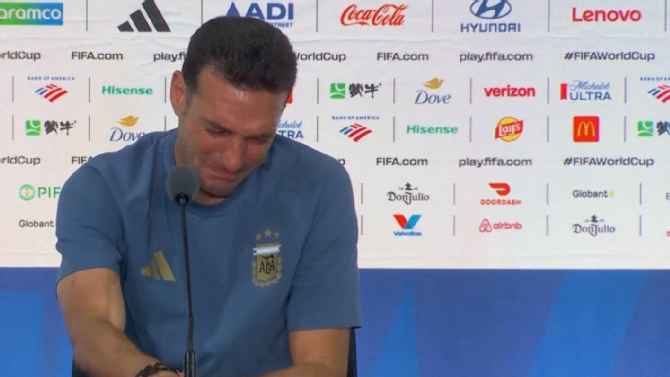
1:33
Argentina’s Scaloni exits news conference in tears: ‘It hurts my soul’
Fast forward nearly four years, and it was a vastly different scenario, with Messi and his teammates frequently needing to dig deep as Argentina fought through matches—ultimately leaving them drained.
This highlights the challenge of winning consecutive World Cups, especially considering the increased number of knockout rounds. Club teams can evolve over a season, progressively altering players and ideas, whereas national teams find it tougher to make adjustments; the successful sides stay intact until their winning streak ends.
The future of Scaloni as Argentina’s head coach remains uncertain, as he articulated in a poignant post-match conference on Sunday. As for Messi, while observing the crowd, he might be pondering how far off 2030 truly seems.
Regardless if both Lions continue together, a transition period is upon Argentina. The team fielded many veterans at this World Cup, and it’s likely that several—such as fullbacks Gonzalo Montiel and Nicolás Tagliafico, center back Nicolás Otamendi, along with midfielders Rodrigo De Paul and Leandro Paredes—won’t make the squad four years from now.
Throughout this post-Qatar period, Scaloni has been looking toward the future, introducing younger players to gain senior experience. However, only a few, like dynamic left-back Valentín Barco and talented midfielder Nico Paz, made the World Cup cut. Though they didn’t have a major impact, their time is approaching. Paz, in particular, is regarded as a promising talent. Integrating him alongside Messi has proven challenging, given that both prefer the ball played to their feet, but the future seems bright for Paz.
What about Messi? Could he play a role in this transition? Perhaps continuing until the 2028 Copa América, mentoring the new talent as they develop, would make sense. If successful, they could be just two years away from the next World Cup, with guaranteed games in Buenos Aires—an enticing prospect.
On the flip side, Messi might feel that the glory of Qatar 2022 is now distant, and moments like that may never return. Until the defeat to Spain, Messi had consistently exceeded expectations, effectively defying time’s march. However, in the age-old contest between athletes and time, there is only one winner, making this a pivotal moment for him to exit gracefully.