



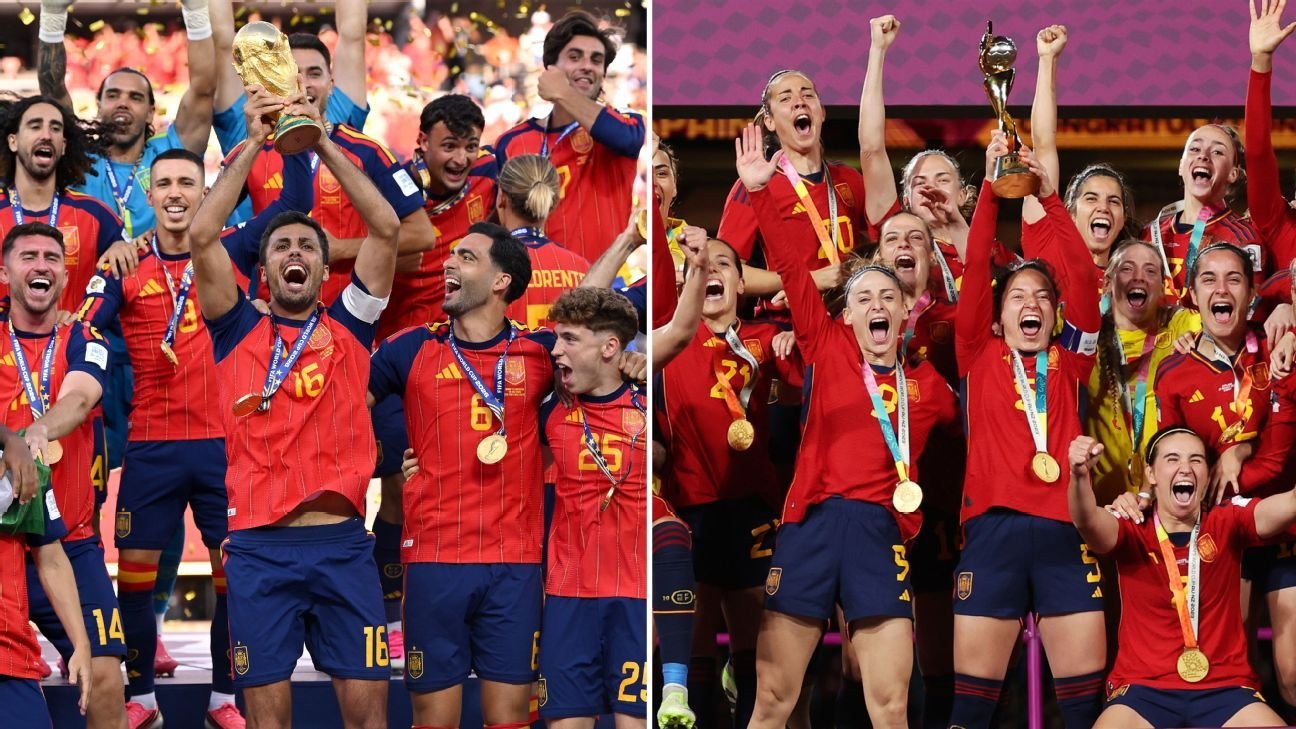
No matter the location—be it Wrexham, Sarajevo, or New Jersey—the result was identical this month: Spain claimed yet another international title.
A stunning 106th-minute goal by Ferran Torres against Argentina in Sunday’s FIFA World Cup final in the United States sealed another triumphant summer for Spanish football. This victory followed victories in both the men’s U19 European Championship in Wales and the women’s U19 European Championship in Bosnia-Herzegovina earlier in July. Perhaps more notably, Spain became the first nation ever to simultaneously hold the men’s and women’s World Cup titles.
Three years prior, Olga Carmona‘s goal in Sydney secured La Roja their first Women’s World Cup trophy with a 1-0 victory over England. Torres’ recent goal marked Spain’s second star in the men’s game.
It is no coincidence that Spain sits at the pinnacle of international football and FIFA’s World Ranking in both categories. No other nation has managed to align coaching, player development, and tactical strategies so effectively.
– Stargazing: Inside Spain’s Pursuit of a Second World Cup
– The Unique Experience of the 2026 World Cup
– 2027 Women’s World Cup: Rankings and Key Questions
“At every level, they play in a consistent manner,” former France international Thierry Henry remarked on Fox after the final. “This is why they are excelling on the international stage across disciplines; it doesn’t matter if it’s men or women, their approach remains the same.”
Spain wasn’t always viewed as an elite footballing nation. Before the 2000s, they managed to win only one men’s European Championship in 1968, often falling short in major tournaments. However, the appointment of Luis Aragonés as head coach post-Euro 2004 marked a turning point. Since then, Spain has claimed three of the last five European Championships (2008, 2012, 2024) and two World Cups (2010, 2026), alongside the Women’s World Cup in 2023.
The remarkable success of Spanish players at both senior levels stems from a concerted developmental approach. Many of these athletes grew up playing together at youth levels. World Cup Golden Ball winner Rodri, goalkeeper Unai Simón, and midfielder Mikel Merino—the match winner in the round of 16 and quarterfinal—were all part of the U19 European Championship-winning team coached by current Spain manager Luis de la Fuente in 2015. Four years later, Simón, Merino, along with Fabián Ruiz, Dani Olmo, and Mikel Oyarzabal won the U21 European Championship under the same coach.
On the women’s side, the team that triumphed in the U19 European Championships in 2017 featured players like Ona Batlle, Patri Guijarro, and Aitana Bonmatí. Under the guidance of current coach Sonia Bermúdez, this program has also seen recent success with victories in the tournament in 2023 and 2024, nurturing the next generation of players ready to step up to the senior level.
Spain’s dominance in youth competitions during this century has been remarkable. This year, they won the men’s U19 European Championship, winning all five matches, scoring an impressive 19 goals without conceding a single one. With 13 titles, they hold the record for the most victories in this tournament’s history. Similarly, they have secured the women’s U19 European Championship title eight times, winning the last five editions since 2022.
However, it’s essential to acknowledge that advancements in women’s football have been relatively recent and sometimes achieved against the backdrop of resistance from Spain’s football federation. Current players, including Irene Paredes and Alexia Putellas, have advocated for enhanced working conditions, laying the groundwork for future successes.
Despite the challenges, teams at all levels—from youth squads to current world champions—exhibit a cohesive style of play. This consistency has emerged from a shift in focus over the past two decades, with Spain investing in their inherent strengths while remaining committed to their playing philosophy.
This approach prioritizes developing technically-skilled players through exceptional coaching and fostering togetherness in player development. The decision to appoint de la Fuente and Bermúdez as coaches reflects this strategy, contrasting with other nations that often seek high-profile managers like Carlo Ancelotti (Brazil), Thomas Tuchel (England), and Mauricio Pochettino (USMNT). The former players understand the environment intimately.
No other nation has dedicated as much focus on coaching. Although UEFA ceased providing statistics on qualified coaches by nation, the last available data from 2013 illustrated Spain’s lead: they had 15,423 UEFA A and Pro-licensed coaches, vastly outnumbering Germany (6,937), France (3,308), Italy (2,281), and England (1,395). This reflects an exceptional commitment to coaching education.
This coaching excellence extends to the top levels of football, evidenced by the presence of Spanish coaches at some of the biggest clubs in the Premier League: Mikel Arteta at reigning champions Arsenal, Unai Emery at Aston Villa, and now Xabi Alonso at Chelsea and Andoni Iraola at Liverpool (notably, Pep Guardiola recently left Manchester City after a six-title tenure in ten years).
Spanish coaches are also making their mark in the Women’s Super League, with Eder Maestre at London City Lionesses and Natalia Arroyo at Aston Villa, alongside major figures like Jonatan Giráldez at OL Lyonnes and José Barcala leading Bayern Munich.
While Barcelona’s influence cannot be overstated, it’s crucial to recognize the contributions of other Spanish academies. While Spain’s footballing identity draws inspiration from Barcelona, it is solidified through a broader commitment to coaching, youth development, federation unity, and the efforts of diverse clubs. Teams like Real Betis, Villarreal, Athletic Club, and Real Sociedad excel at nurturing emerging talent as well.
This nurturing approach has resulted in players who are well-versed in their roles, allowing the team to adapt seamlessly to player absences, such as when Rodri was injured during the Euro 2024 final against England. His replacement, Martín Zubimendi, stepped in, and La Roja continued executing their game plan without disruption.
“Regardless of who plays—[Álex] Baena, Nico Williams, or anyone else,” Henry commented in his analysis on Fox. “Since childhood, they’ve understood their roles within the system, which is why philosophy and identity are crucial. When a new player enters the fold, even for their first cap, they know the system since it’s been ingrained in them from the start.”
While individual brilliance remains vital at the highest levels of play, the recent rise of talents like Yamal and Williams injects excitement into a style that faced scrutiny during the dry spell for the men’s team from 2014 to 2022, yet faith in the overarching process has persisted.
1:49
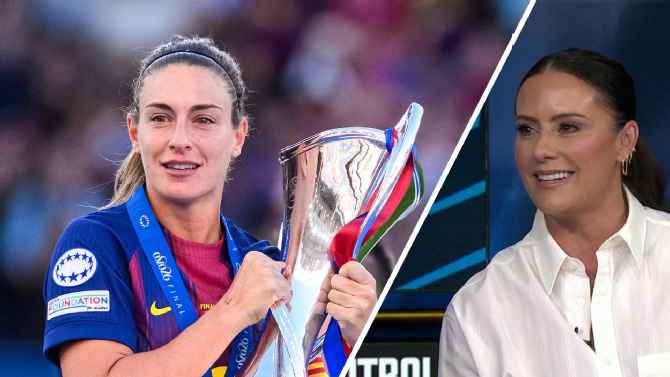
Krieger: Alexia Putellas joining the WSL would be massive
Ultimately, while Barça’s contributions are significant, it’s vital to recognize the diverse efforts of various academies throughout Spain. The country’s footballing identity, while largely influenced by Barcelona, is shaped by a collective commitment to coaching, youth development, and the shared philosophy across clubs. Teams including Real Betis, Villarreal, Athletic Club, and Real Sociedad are all key players in nurturing soccer talent.
The outcome is a cohort of players who instinctively understand their roles, evident when Rodri was sidelined during the Euro 2024 final against England. In his absence, Martín Zubimendi substituted in seamlessly, and La Roja continued to implement their game plan flawlessly.
“It doesn’t matter who plays—whether it’s [Álex] Baena, Nico Williams, or others,” Henry noted during his analysis on Fox. “They’ve known their roles since they were nine. That’s why the philosophy and identity matter. When a player steps in, even for their debut, they’re already aware of the system because they’ve been trained in it from the start.”
At the pinnacle of the sport, individual talent remains crucial. The recent rise of players like Yamal and Williams has reinvigorated a style previously scrutinized during the men’s team’s drought from 2014 to 2022. Nevertheless, trust in the process has never faltered.
Aragonés’ mantra, “stay calm, you’re the better team,” rang true against Argentina in the final. Spain relied on their technical skills, talent, and ball possession to eventually dismantle an opponent gunning for a repeat championship, which shockingly failed to register a single shot on goal in the 90 minutes. This marked only the third time in 900 World Cup matches that a team did not hit the target, as per Opta statistics.
This summer, no team posed a real challenge to Spain. The defense, spearheaded by Cubarsí, managed to neutralize Kylian Mbappé and France in the semifinals, exemplifying the squad’s outstanding defensive performance, allowing only 0.3 expected goals against (xGA) per game throughout the tournament. Spain dominated possession, with Rodri making a tournament-high 756 passes, while Cubarsí (671) and Aymeric Laporte (616) were among the top five passers, alongside Rodri and notable figures from previous tournaments like Xavi in 2010.
Amidst a tournament featuring prominent stars—like Lionel Messi with Argentina, Erling Haaland with Norway, Mbappé with France, and Jude Bellingham with England)—Spain’s collective approach triumphed. This response aligns with trends seen in club football where, despite individual talent, fabled teams like Paris Saint-Germain have thrived on team ethos.
“I take immense pride in this generation of footballers who’ve embraced our philosophy and enhanced it,” commented De la Fuente following the victory.
Though no strategy guarantees victory at every tournament, Spain’s men’s, women’s, and youth teams continuously demonstrate that their method comes remarkably close to achieving success on the international stage.
Thus, as La Roja nurtures their ambitions for consecutive Women’s World Cup victories in Brazil next summer, they possess a robust foundation that teams like the USWNT, France, Germany, or even England—despite their recent achievements—would envy.
As former Real Madrid assistant coach Ángel Cappa once articulated in 2008, “What did Greece’s Euro 2004 victory really provide them other than fleeting glory? Nothing. Spain, in contrast, has established a sustainable path forward.”