



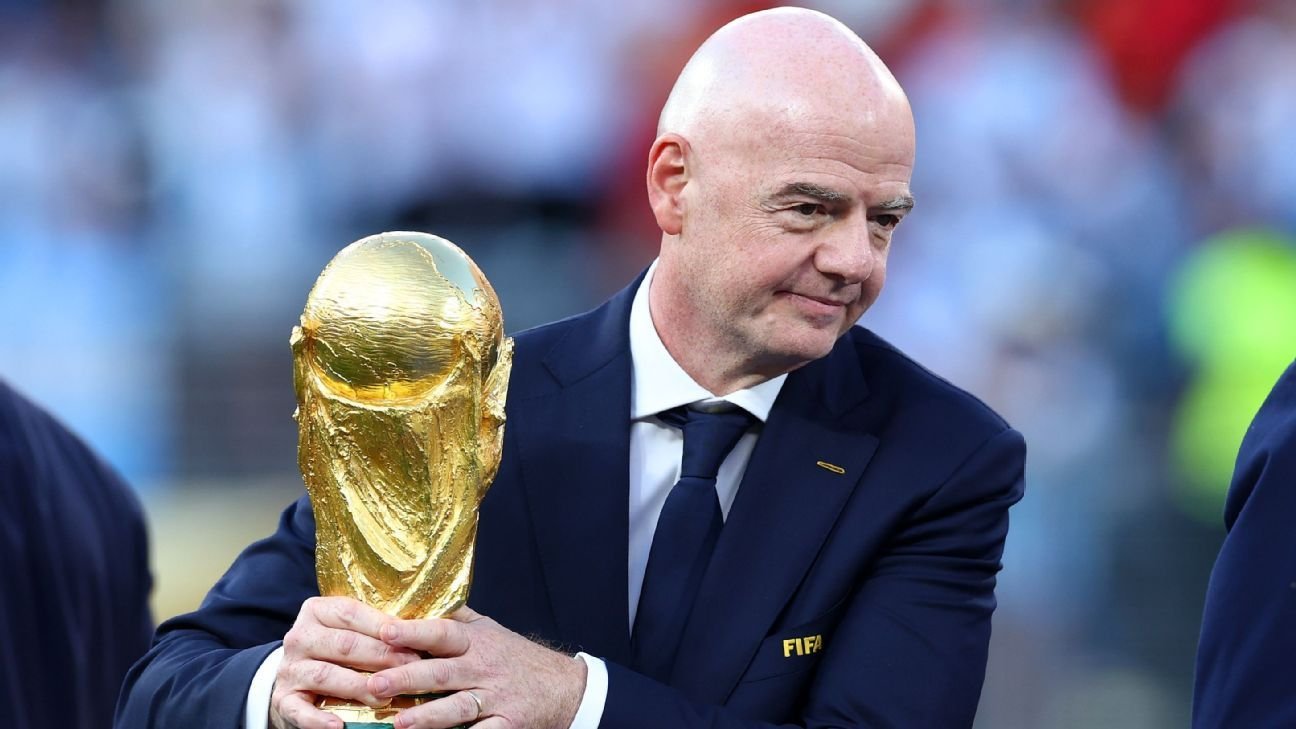
The future of the FIFA World Cup is currently uncertain, with various factions beginning to emerge amid a potential conflict that may see UEFA, the dominant confederation in Europe, sever ties with FIFA and choose to boycott upcoming tournaments.
FIFA president Gianni Infantino’s initiative to secure up to $20 billion through private investment by offering stakes in the world’s premier sporting event has raised concerns that it may instigate a transformative conflict in the soccer landscape.
In return for permitting private investors to inject billions into the organization of future World Cups, Infantino is enticing FIFA’s 211 member associations with an upfront offer of $20 million each for their votes on his proposal, along with an additional $66 million per association by 2038.
– Evaluating Infantino’s decade as FIFA president.
– Analyzing a World Cup that inspired and provoked.
– Infantino’s extensive journey across World Cup venues.
In response, UEFA has voiced strong opposition, declaring that the sport “is not FIFA’s to sell.” Sources indicate that the 55 member associations of UEFA, including current world champions Spain, plan to hold an emergency meeting this week to officially contest FIFA’s proposal, with potential discussion of a World Cup boycott—especially since the next men’s tournament is scheduled for 2030—on their agenda.
Infantino’s proposition has faced backlash from numerous parties, raising critical questions about the motives behind seeking private investment and the potential ramifications for the sport moving forward.
What is FIFA President Infantino’s Strategy?
In a recent statement from FIFA outlining Infantino’s plans, the FIFA president reiterated his goal to “unlock the commercial potential of FIFA,” emphasizing that various aspects of the game have turned its popularity into substantial commercial worth. Essentially, the plan aims to capitalize on the anticipated financial success of the 2026 World Cup, which FIFA predicts will yield around $15 billion in revenue after comprehensive audits.
FIFA, headquartered in Switzerland as a nonprofit, intends to launch a new subsidiary named FIFA Forward Enterprise, tasked with managing commercial and event operations, encompassing broadcasting, sponsorships, ticket sales, and licensing agreements for tournaments, including the World Cup. In return for selling a stake in this enterprise to external investors, FIFA pledges to share the profits among its 211 associations, contingent on the plan’s approval, with immediate cash distributions of $20 million followed by three more distributions of $20 million, $22 million, and $24 million between 2027 and 2038.
FIFA stated that a consultation process has commenced in light of a proposal meant to maximize the potential of FIFA’s broadcasting rights and sponsorships across its tournaments in men’s, women’s, and youth soccer. This proposal was put forward by Thrive Eternal, a permanent holding company led by venture capitalist Josh Kushner, who is the brother of Jared Kushner, President Trump’s son-in-law.
Unlike private equity firms seeking returns within 5 to 10 years, permanent holding companies aim for indefinite ownership and control. Therefore, any sale of FIFA assets would be with the understanding that it would entail a permanent divestment of the stake.
FIFA asserts that it would retain oversight and governance of FFE “through majority board representation and exclusive authority over football regulation, competitions, and international match scheduling.”
Why Now? Who Stands to Gain?
As FIFA president, Infantino’s foremost responsibility is to ensure the game’s future is secure, thriving, and well-funded globally—a duty he emphasized in his announcement regarding the FFE plan.
“We aim to make significant investments even in the smallest or most underprivileged areas of the footballing world, which are often overlooked,” Infantino stated. “Every FIFA Member Association, regardless of its size, resources, or geographical situation, will have a say and the chance to chart its own path.”
“Football has become a truly global phenomenon, and hence the advantages should be experienced globally.”
All 211 member nations are anticipated to receive around $8 million in “forward funding” between 2027 and 2030 due to the 2026 World Cup, making an immediate boost to $20 million a significant financial gain for FIFA’s smaller associations, such as New Caledonia, Gibraltar, and San Marino.
The timing of this proposal remains unclear. However, the financial triumph of the 2026 World Cup has provided Infantino with a unique opportunity, boosted by his connections to former President Trump and his wealthy network, enabling FIFA to leverage the sport’s global appeal through a more aggressive strategy to generate additional revenue. While every member association will vote on the proposal, the dynamics at play could influence how the voting unfolds.
“FIFA’s new tier of private equity resembles the opposite of what transpired with the proposed European Super League,” noted Pau López Gaitán, a philosophy doctor at the University of Bristol specializing in private equity in soccer and the commercialization of clubs and competitions. “This time, larger nations are apprehensive about the outcomes, whereas smaller ones are more optimistic due to FIFA’s promises of financial benefits.”
From Infantino’s perspective, he seeks reelection as FIFA president in 2027, and presenting an enticing financial windfall to so many associations may help solidify his legacy.
What Will Investors Gain for Their Investment?
While FIFA maintains that it will keep control of FFE and manage upcoming tournaments, substantial investors will likely expect a significant return on their investment, presenting various pathways to achieve that. By influencing broadcasting agreements, ticket pricing, commercial revenue, and possibly even the frequency, size, and location of events, there’s a risk that decisions could prioritize investor interests over the well-being of the sport, players, and fans alike.
For instance, this could result in more frequent tournaments or larger-scale events to meet the revenue expectations tied to any initial investments.
“The World Cup stands as the leading global sporting event in terms of popularity, reach, impact, and financial revenue,” explained Omar Chaudhuri, chief intelligence officer at London-based brand advisors Twenty First Group. “Its unparalleled stature generates significant income—evidenced by the $15 billion anticipated from this cycle. However, the fact that it occurs every four years adds to its allure, as does the experience of seeing the world’s elite players compete and the historic nature of the tournament.”
Reports suggest the previously held three-minute hydration breaks during the World Cup were worth $7-9 million each to broadcasters in commercial revenue; thus, it’s plausible that these breaks could be made frequent and highly lucrative in future tournaments.
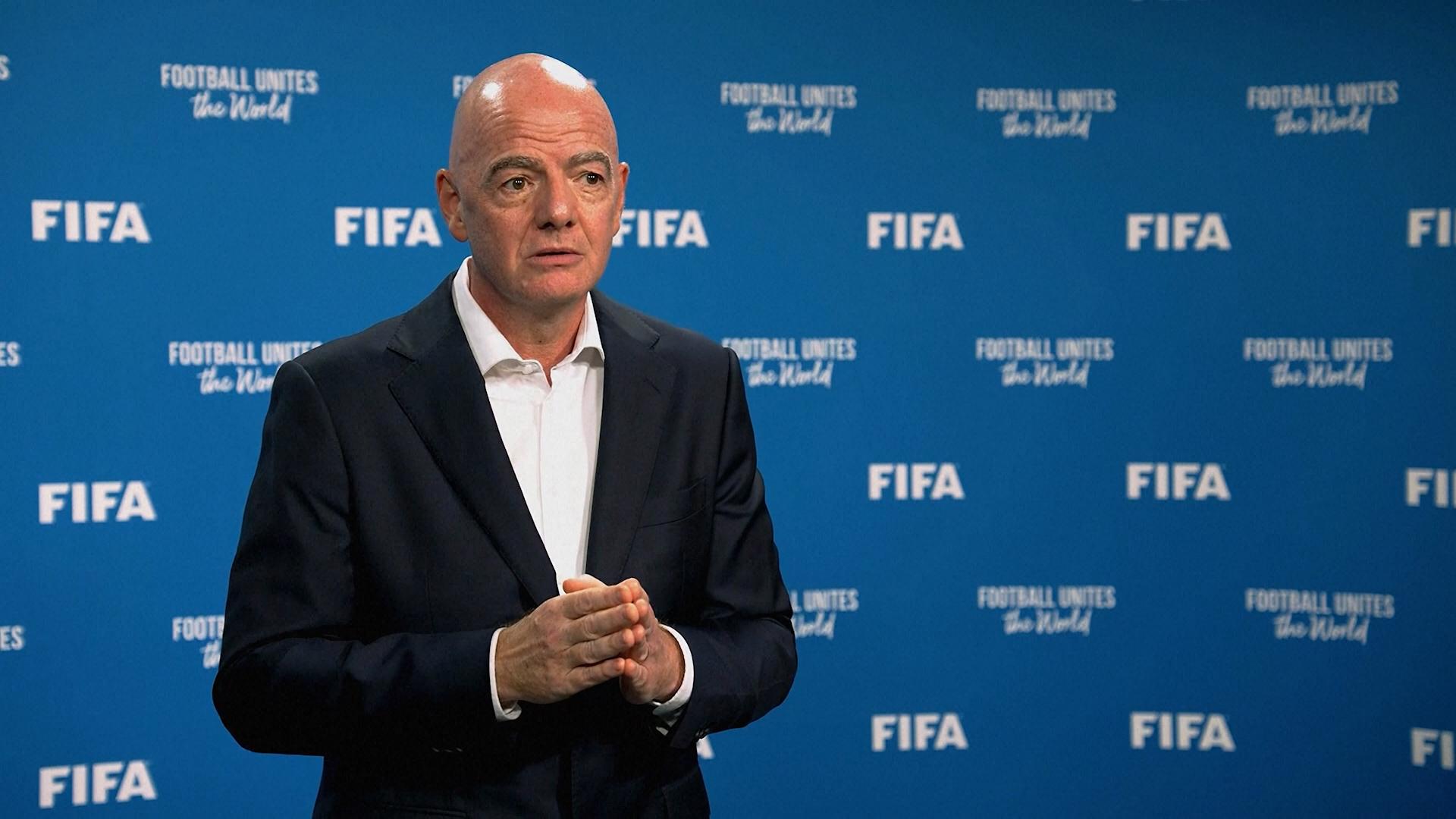
3:02
Infantino: FIFA proposal presents a golden opportunity for development
When Fox Sports acquired the English-language broadcasting rights for the 2026 men’s World Cup, the cost reached $485 million. However, FIFA has indicated that similar rights for the 2030 and 2034 editions will be valued at a minimum of $1 billion. With outside investors influencing FFE’s decisions, there’s potential for the creation of a Netflix-style direct-to-consumer model where viewers would pay directly to stream content, diverging from traditional broadcasting deals, which could result in significant revenue for FIFA and investors alike.
“D2C deals haven’t always proven to be as fruitful as anticipated, primarily due to viewers’ established consumption habits,” Chaudhuri noted. “Thus, investing more in media rights might provide greater returns than D2C propositions.
Moreover, given the World Cup’s quadrennial occurrence, many subscription models rely on continuous content availability, rendering them less effective. The current trend leans toward creating competitive tension and selling rights to the highest bidder instead.
López Gaitán echoes these concerns. “This exemplifies the consequences of financializing tournaments. The promise of ever-increasing valuations drives private equity interests, leading them to view such investments as highly desirable,” he emphasized. “Based on current valuations, it’s likely FIFA has undervalued its assets, which suggests that there could be offers from sovereign wealth funds in the Middle East.”
Audience engagement remains crucial, yet responses from fans will be significant—similar to reactions witnessed during the Super League debacle. But the challenge lies in determining how and when protests can occur, especially given the current off-season in July.
Why Does UEFA Oppose These Plans?
UEFA was quick to voice its opposition, stating that these proposals “cross a line that football’s governing bodies should never cross.” Concacaf, the confederation for North and Central America, has also expressed “serious concerns regarding the lack of due process.” Individual associations, including the English Football Association, have similarly voiced their displeasure, stating they were “entirely unaware of the proposal” prior to FIFA’s media announcement.
Given its stature, UEFA’s opposition carries significant weight since it is the strongest of FIFA’s six regional confederations. UEFA oversees the Champions League and hosts top leagues like the Premier League, LaLiga, Bundesliga, and Serie A. Notably, five of the seven men’s World Cup champions this century hail from Europe.
A World Cup devoid of UEFA nations would likely strip the tournament of its competitive value.
When Infantino proposed a biennial World Cup in 2021, the threat of a UEFA boycott compelled him to retract his proposal. The leaders of FIFA and UEFA, Infantino and Aleksander Čeferin, have been in ongoing disputes concerning the governance of global soccer. Both entities have been endeavoring to assert greater influence over the match calendar and the sport’s financial landscape.
UEFA has perceived the revamped FIFA Club World Cup—another initiative from Infantino—as a direct challenge to the Champions League, and is currently bracing itself against Infantino’s efforts to establish this as a biennial event. Sources have indicated that Infantino’s latest proposals are yet another power grab that UEFA will resolutely oppose.
“In an era defined by breakaway competitions—such as LIV Golf and Grand Slam Tennis—success is elusive even among younger audiences,” Chaudhuri remarked. “A split between FIFA and UEFA could pose significant risks for both, potentially leading to divergent competitions.”
What Makes These Plans So Controversial?
Numerous issues contribute to the controversy surrounding Infantino’s proposals, ranging from sporting disagreements to deeper political themes concerning his leadership style.
From a sporting perspective, the notion of relinquishing control and influence over the World Cup has ignited fears among supporters about an impending rise in ticket prices, beyond the steep costs witnessed at this summer’s tournament. If corporate interests supersede sports governance in determining ticket prices and broadcasting agreements, fans could find themselves priced out of attending events.
There is also the possibility that the World Cup could expand to 64 teams and be hosted in profit-centered locations, like the United States, instead of being rotated among various continents as is standard practice now.
Furthermore, a growing hostility toward Infantino has emerged due to perceptions of oligarch behavior—an impression that he is overly focused on the power of his role, disconnected from the community’s expectations. His relationships with global leaders—such as President Trump, Saudi Crown Prince Mohammed bin Salman, Russian President Vladimir Putin, and members of the Qatari royal family—have drawn criticism regarding the absence of proper procedures within tournament bidding and the recent conferring of a FIFA Peace Prize to Trump during the World Cup draw.
Ultimately, FIFA serves as the governing body for soccer, responsible for redistributing resources to all member associations rather than delegating shares of its organization to affluent private investors whose priorities center on profit rather than the sport’s best interests.
Will Other Investors Step Forward?
While the United States has increasingly become a significant source of wealth and investment in the global soccer sphere—12 Premier League clubs are owned or supported by American investors, including the reigning champions Arsenal—the Persian Gulf also continues to invest heavily in the game.
Saudi Arabia is set to host the men’s World Cup in 2034, and its Public Investment Fund holds the majority stake in Premier League club Newcastle United. Qatar hosted the 2022 men’s World Cup and frequently organizes FIFA youth tournaments, while the back-to-back Champions League champions Paris Saint-Germain is owned by Qatar Sports Investments. Similarly, Sheikh Mansour bin Zayed al Nahyan from Abu Dhabi owns Manchester City and has facilitated the club’s rise to prominence since acquiring it in 2008.
Although Chinese investments in European soccer have slowed, the opportunity to acquire a stake in FIFA could attract Chinese capital. While Thrive Eternal currently leads the funding for Infantino’s initiative, the vast wealth available in the Middle East and China could lead to an even larger influx of funds for FIFA if the plan proceeds.

1:01
Ogden: The World Cup controversy could impact Infantino’s FIFA reelection.
While Wealthy Nations May Object, Others Are Likely to Support the Proposal
This aspect is critical to Infantino’s strategical approach. He likely anticipated UEFA’s backlash but noted that the European confederation has only 55 members.
FIFA operates on a one-member, one-vote basis. Therefore, if all European nations oppose the plan, there will still be 156 associations remaining globally, and a simple majority is required for the proposal to pass.
Asia (47), Africa (54), and Oceania (13) amount to 114 votes, plus another 41 from Concacaf. Many of these national associations face financial challenges and may lack the resources European nations possess, making it less rational for them to reject Infantino’s proposal.
What’s Next? Proposed Future Developments
In a letter to member associations, Infantino indicated that a resolution must be reached by September 19—less than eight weeks away. UEFA will likely strive to consolidate its stance on a World Cup boycott, potentially contemplating withdrawing from FIFA altogether, while trying to convince other global members to oppose Infantino’s initiative.
However, this task is fraught with difficulty. Financial motivations are compelling, especially for smaller nations that may view this as a once-in-a-lifetime chance.
Nonetheless, a World Cup without European participation would dilute the competition significantly, giving UEFA leverage in negotiations. Should UEFA decide to withdraw, the possibility of an expanded European Championship incorporating teams from South America, Asia, Africa, and North & Central America could emerge as an enticing alternative tournament.
Given the considerable uproar and dissent surrounding this proposal, it may face insurmountable barriers well before Infantino’s deadline arrives.
What if Infantino’s Plan Fails? His Future as FIFA President
All politicians are aware that counting votes is the golden rule in politics. Infantino is likely confident regarding his reelection in 2027 due to the absence of a rival candidate and the expected backing from numerous nations around the world.
However, should his initiative collapse, it would be a considerable embarrassment for Infantino and may diminish his standing to the point where a contender could emerge against him. This proposal has become a critical turning point for both the World Cup’s fate and Infantino’s presidency.
If successful, Infantino’s influence will expand considerably. However, it remains to be seen how he can achieve this without further fracturing the relationship between FIFA and UEFA. The upcoming months will be pivotal for the future of football, with extremely high stakes at play.