



-

Leander Schaerlaeckens
Multiple Authors
The largest sports video game franchise of all time began as an unexpected venture—a concept that faced significant skepticism but ultimately became the cornerstone of a leading company in a burgeoning industry.
In the early 1990s, Electronic Arts expanded its gaming portfolio beyond John Madden Football, exploring other major American sports. The question arose about which sport to tackle next. Since its founding in 1983, EA had been prolific, releasing multiple titles each year. The small team in London proposed a soccer game, recognizing its vast potential and projecting impressive sales figures. At the time, while other soccer games like Sensible Soccer and Kick Off were successful, the market remained largely untapped. Soccer, being the most popular sport globally, could elevate EA onto the international stage, especially with the FIFA World Cup poised to happen in the U.S. in 1994.
However, the headquarters were far from optimistic. There was considerable doubt about the financial viability of a soccer game, especially with the U.S. lacking a professional outdoor soccer league. “It was like the world’s worst time to propose a soccer game in North America,” recalled Marc Aubanel, an EA developer at the time, noting that soccer had previously flopped in the country.
Despite the doubts, the project was approved. English contractors produced a prototype, and a small Vancouver-based team was allocated to develop what was initially seen as a low-priority job with minimal funding. It was likely to be a one-off project, yet the team persisted through various budget cuts.
“It was definitely a passion project,” said tester John Santamaria regarding the first version of the game. The team was dedicated, pouring their hearts into the project. “We wanted this game to succeed. It represented our collective effort, and it demanded substantial long hours with constant uncertainty about funding. This was a desk-side project, but we were all in,” he added.
With a devoted team of 16 assigned, expectations were low, and funding was scarce. “Back then, the idea of a game becoming a franchise was unheard of,” Aubanel remarked. “There was no concept of a game lasting forever.”
Weston McKennie may not have grown up as a soccer fan, and he still doesn’t watch extensively, yet he played more minutes than any other midfielder at Juventus last season and represented the U.S. Men’s National Team at the World Cup.
He developed his understanding of the game through playing FIFA, which later became EAFC after a rebranding in 2023.
As an outgoing personality, McKennie embraced the social element of gaming from a young age. “I’d have friends over, and we would host tournaments with goofy challenges where losing meant doing something silly,” he shared. One of those challenges involved standing bare-chested in goal while his friends took shots at him. By the time he reached the U.S. under-17 national academy in Bradenton, Florida, they were competing for snacks and their per diems.
“Playing [FIFA] definitely enhanced my understanding of players—their names, positions, and more,” he noted. Landon Donovan echoed this sentiment in his podcast “Unfiltered Soccer,” saying, “FIFA taught me about soccer players because we didn’t have TV access.”
The franchise’s development team has expanded significantly since its inception, growing from 16 members to over 1,500 working across various global offices. More than 30 titles have been released within the series, featuring about 200,000 real players from 750 clubs and national teams participating in over 120 stadiums and 35 leagues. Approximately 250 data editors and 8,000 volunteer reviewers meticulously rate the players.
Since its inception, the franchise has prioritized authenticity, striving to be the go-to simulation for realism in soccer games. “With unprecedented licensing capabilities, our brand has become exceptionally powerful,” remarked Jeff Sharma, EAFC’s vice president of brand. “We pride ourselves on being the trusted hub for football. Our overall mission is to foster a love for sports, with authenticity being a primary focus.”
As gaming technology evolved—from pixelated figures to almost indistinguishable digital replicas—FIFA’s presentation has come to mirror live broadcasts. “The franchise has transformed from just a beloved game into a central cultural hub for the sport,” reflected John Shepherd, a producer engaged with the game since 2009 and now its general manager.
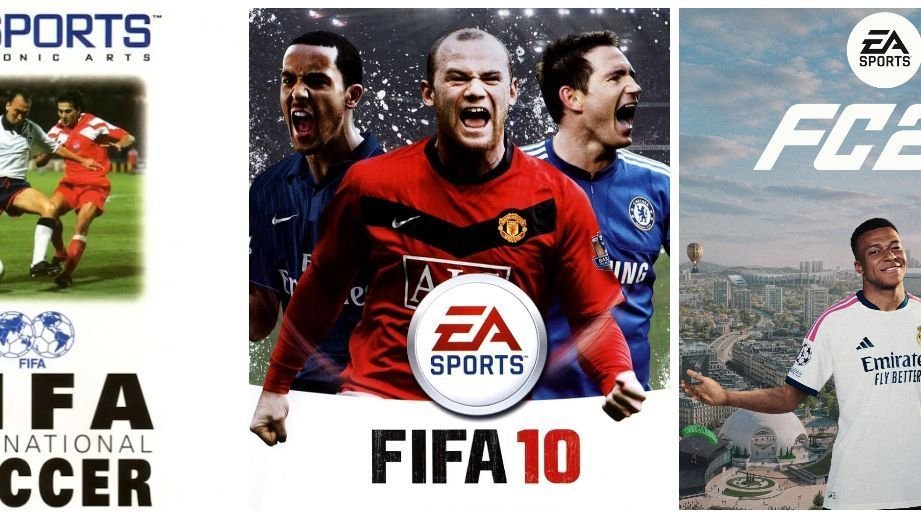
Since its initial release as FIFA International Soccer in 1993, the franchise has cemented its place as the best-selling sports video game series ever, with over 325 million units sold by 2021—more than double what Madden sold by that time.
The feature that consistently comes up in discussions with FIFA International Soccer developers is the isometric view.
Picture a cube facing you on a screen. Though it appears two-dimensional, you can twist and tilt it to reveal its sides, creating a three-dimensional illusion. This innovative perspective distinguished FIFA’s gameplay from others—like Sensible Soccer’s top-down views—making it visually resemble actual soccer broadcasts.
Jan Tian, the development lead for the initial game, faced challenges common to soccer games, like programming the ball to behave realistically and managing the movement of 22 players simultaneously without clustering around the ball. Given the limited computing power and a budget of only 1.5 megabytes for the game, this was no small task.
When he showcased the prototype, colleagues gathered with enthusiasm, prompting an executive to expedite the game’s release ahead of Christmas 1993. The team sensed they had created something exceptional. “Playing that game was fun—it felt unique and let us inhabit the pitch,” Santamaria noted. “Jan nailed the playability from day one.”
Interestingly, FIFA International Soccer’s distinguishing quality amidst its competition was its deliberate pacing. While other games like Sensible Soccer were fast-paced, FIFA’s tempo mirrored the sport’s real-life dynamics, sometimes frustratingly slow. EA Sports’s focus on realism was rooted in the belief that authenticity would maintain player engagement longer than arcade-style gameplay.
Operating from a distance from EA’s Silicon Valley headquarters provided Tian and his team creative freedom. “We had a level of independence that allowed us to experiment without constant oversight. That was our advantage,” reflected Aubanel.
When it came time to name the game, initially referred to as “EA Soccer,” aspirations to call it Team USA Soccer horrified the London team responsible for marketing in Europe. EA ultimately sought a title comparable to its Madden series, but there wasn’t a singular league name that resonated in the U.S. Eventually, they secured a five-year deal with FIFA, paying a modest royalty of about 4% to 5% of sales.
However, the deal raised questions internally. “Why are we even associating with FIFA?” Aubanel asked. “Everyone saw it as a branding effort for an organization that many Americans didn’t recognize.” Moreover, the FIFA licensing agreement offered limited benefits, lacking rights to the World Cup, previously licensed to another game. The inaugural release could only include tournament formats with generic country names.
Even before the game hit the shelves, EA Sports began reshaping soccer culture. The absence of organized licensing within the sport prompted the video game industry to establish standards for deals that had previously not been formalized.
Initially, EA worried that American indifference toward soccer would hinder interest in a soccer video game, but the FIFA/EAFC franchise effectively countered that concern.
As interest in soccer grew among Americans, the game served as a catalyst for fostering that enthusiasm. Studies have shown that 34% of American soccer fans credit the FIFA franchise for their interest, a figure that remained consistent in EA’s research in July 2025, indicating that 40% of young adults view EAFC as their introduction to soccer.
While the game’s popularity soared, certain elements also sparked controversy among dedicated players. Criticism has arisen around the expensive Ultimate Team packs, which feel less rewarding over time, leading to frustrations akin to gambling. This reflected broader trends within the sport of soccer, where consumer pressures continue to escalate.
Nonetheless, EA’s influence extends into the realm of real-life soccer as well. The company has established 22 soccer fields across 14 countries and claims to have provided access to outdoor pitches for half a million players, also offering training resources for coaches.
Young Paris Saint-Germain player Bradley Barcola dons the No. 29 to honor Alex Hunter, a fictional character from EAFC’s career mode called “The Journey.” When the creators of “Ted Lasso” expressed interest in having their fictional team, AFC Richmond, in EAFC, it was promptly included in EAFC 23.
Life has begun to reflect the game’s narrative. Initially focused on realism, the franchise has not only matched reality but also surpassed it.
“We studied broadcast techniques to replicate their look in the game, but eventually we realized we could innovate beyond what traditional broadcasts show—what if we could position the camera anywhere?” Shepherd remarked, highlighting how techniques like the spider-camera, now commonplace in elite matches, were inspired by FIFA.
In 2023, EAFC expanded its horizon to women’s soccer by introducing women’s club teams, showcasing its capacity to influence that segment as well, following a previous seven-year inclusion of women’s national teams.
In Ultimate Team, where users collect player trading cards, a surprising post-gender environment has emerged. “Some of the top Ultimate Team players, regardless of gender, include exciting young talents from the NWSL,” shared Nicole Baxter, an assistant producer at EAFC’s women’s division and former professional player. “Trinity Rodman, Sophia Wilson, Mallory Swanson—players that fans love regardless of gender. They rank among the game’s priciest and have a place on many rosters.”
Research indicates that 62% of EAFC players are also fans of women’s soccer in real life. Baxter commented, “EA Sports isn’t just including women because it’s the right thing to do; they see it as a lucrative business decision. There’s evident success in our women’s features, and we are currently using only five leagues in Ultimate Team.”
After the launch of EAFC 26, it took just 26 days for women’s player items used in online Ultimate Team matches to exceed 1 billion.
When FIFA International Soccer debuted in North America and Europe in December 1993 on Sega Genesis and Mega Drive, EA set a sales target of 300,000 copies for Europe. Within a month, half a million copies had sold, dominating the video game charts in the UK for several weeks. By June 1994, it even led Super Nintendo sales in the U.S., securing the third spot on Genesis.
This success was a game-changer, launching careers for the development team members and leading to substantial bonuses tied to sales performance. FIFA enabled EA Sports to penetrate markets that were previously inaccessible due to its focus on American sports games.
A sequel was swiftly approved, catapulting the team to new levels of influence within the company. “We were the ’mad kids’ in the organization,” recalled Aubanel. “We could pull off anything. Business class travel became the norm, and those early days were chaotic yet incredibly fun. Then, over time, it became more corporate and structured.”
Initially, doubts lingered about the potential for annual reboots of sports games. “We often questioned internally, ‘How many iterations can we produce?’ Soccer has remained fundamentally unchanged for 30 years. Would players continue to re-purchase a similar product each year?” remarked Aubanel.
Each iteration became progressively intricate. Nick Wlodyka, now senior vice president and group general manager of EAFC, first joined the project in 1995 as a summer intern. The second installment, FIFA Soccer 95, introduced club teams across eight leagues as EA began aggressively acquiring essential licenses. Nevertheless, players’ identities remained generic.
Wlodyka’s challenge for FIFA 96 involved compiling real player names and ratings without access to official rosters or footage.
To compile and verify player names and positions across lesser-known leagues, he visited embassies and relied on local newspapers. “I probably got more names wrong than right,” he admitted. “Understanding the players and clubs in leagues we weren’t familiar with was a challenge.”
Initially working solo, he later built a network of experts—coaches and scouts—whom he consulted to ensure accuracy. Ratings became a significant topic in real-life soccer discussions.
“When footballers encounter me, their first inquiry typically centers on their ratings,” Wlodyka noted. “This has immense social relevance within the football community.” McKennie confirmed this interest, mentioning how ratings can lead to playful banter or bragging among players.
“I hold a 78 rating in EAFC 26,” McKennie quipped. “While I’ve conveyed my views to EA regarding my rating, I think I can certainly improve in some areas.”
As competitors like Pro Evolution Soccer emerged, maintaining realism became the franchise’s defining feature, which consequently heightened developer expectations. “Once we reached 1,000 teams, the workload became overwhelming,” Aubanel reflected. “Minor mistakes drew scrutiny, especially since player hairstyles changed frequently. David Beckham’s hairdo seemed to flip every week, and we often faced complaints about accuracy,” he laughed.
Today, the game adjusts hairstyles almost instantaneously. Developers manage multiple game versions simultaneously to accommodate complex new features, even though some gamers express a desire for greater variation between editions.
None could have predicted such evolution over three decades ago while developing FIFA International Soccer, which was honored with induction into the Video Game Hall of Fame in May. It’s remarkable how a game aiming to replicate a sport intertwined so profoundly with its culture and remains relevant with ongoing annual releases.