



-

Emily Keogh
Multiple Authors
Manchester United are embarking on a new chapter. After a challenging five-year tenure, manager Marc Skinner has agreed to a mutual termination of his contract, ending a period marked by both impressive moments on the field and growing frustrations off it.
Skinner often expressed concerns about the club’s investment in the women’s team, while also facing criticism from fans regarding his tactical choices.
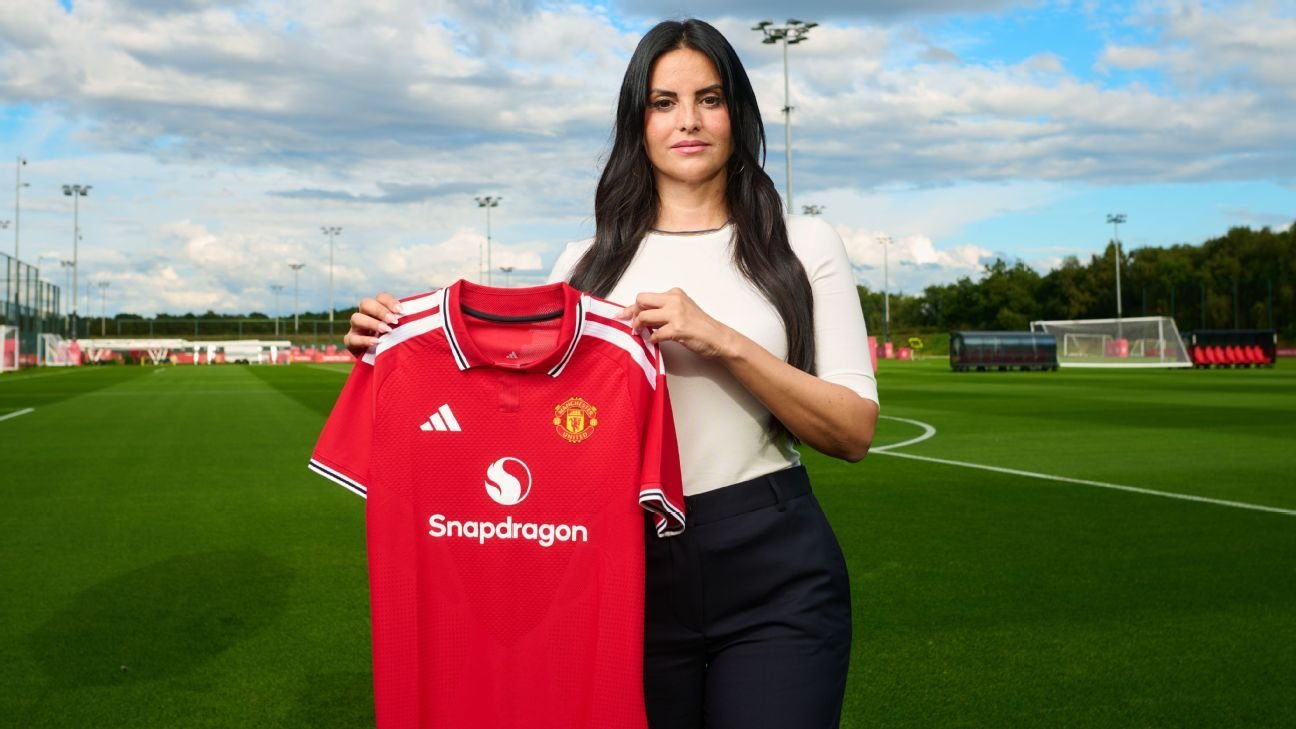
His exit clears the way for former Hearts coach Eva Olid, who is stepping in on a two-year contract, with an option for a third. This managerial change represents more than just a new leader; it signals a shift in the club’s overall approach.
ESPN sources indicate that United is shifting towards a long-term strategy that emphasizes promoting academy talent and developing younger players instead of competing with elite European teams in the transfer market. This strategy also clarifies the club’s lackluster recruitment this summer.
This marks a considerable change for a club that reached the UEFA Women’s Champions League (UWCL) quarterfinals last season and has long maintained aspirations of vying for the sport’s top accolades.
Will the new manager and philosophy lead to a successful future, or is United merely tasking a younger squad and an inexperienced coach with the challenge of competing against teams with significantly greater resources?
Skinner’s Departure Was Expected
Skinner’s exit wasn’t unexpected. Sources revealed that he offered his resignation before it was mutually agreed that he would leave. However, his departure, just weeks before the new WSL season kicks off, feels sudden.
During his time at United, Skinner experienced notable successes but also faced ongoing pressures. He sought to position the club among England’s elite, all while managing a budget much smaller than those of their direct competitors.
On the field, it can be argued that the team overachieved. United reached four domestic cup finals – losing three, including last season’s League Cup final against Chelsea. The crowning achievement of Skinner’s tenure would have been securing the FA Cup in 2024 against Tottenham Hotspur, or their remarkable run to the UWCL quarterfinals during their inaugural European journey.
Skinner’s WSL campaigns mirrored the duality of the project’s advancement and its inconsistencies. United finished fourth, second, fifth, third, and fourth in successive seasons. Yet behind those placements lay frustrations: Following the UWCL quarterfinal loss to Bayern Munich, Skinner issued a remark that starkly expressed the club’s ambitions.
“We will learn what investment is really necessary to be competitive at this level consistently,” he commented. “We are still discovering as a club. I feel immense pressure, and I embrace it. I am incredibly proud of my players given what we have.”
“Wearing Manchester United’s badge brings with it expectations to be the best. We share that ambition. But we need to grow; we have only been around for eight years. Understand that I’m here to take the flak for it.”
“If we aim to compete at this higher level, we recognize the steps we need to take as a club. The choice is now ours to determine what we truly want to achieve.”
Both privately and publicly, Skinner contended that United lagged behind clubs with vastly superior investment in their women’s teams. Though the club is among the wealthiest globally under the Glazer family and minority owner Sir Jim Ratcliffe, their women’s program has never enjoyed the financial backing seen by clubs like Chelsea or Arsenal. More alarmingly, they have struggled to compete financially with independent clubs like the London City Lionesses, buoyed by billionaire Michele Kang’s support.
The question of funding is not new; Skinner’s predecessor Casey Stoney also left over frustrations regarding the club’s commitment to the women’s program.
However, Skinner faced criticism as well. Supporters questioned his tactics and some of his media statements — occasionally misinterpreted — further alienated fans. His remarks following the League Cup final loss to Chelsea increased scrutiny.
Many fans believed Skinner’s departure should have occurred long before. The 2023-24 league campaign saw United finish fifth despite winning the FA Cup, leading to a surprise contract extension for him. The season concluded with a demoralizing 6-0 home defeat to Chelsea, a result considered a low point of his tenure.
Eventually, Skinner became the public embodiment of issues that extended far beyond his control. His departure marks the end of a chapter, but it does little to address the underlying structural challenges that persist.
Investment Issues
Attributing Manchester United’s struggles entirely to Skinner or his tactics would be overly reductive. While he had shortcomings, the challenges hindering the club’s growth are deeply rooted and existed throughout his time there.
United have consistently claimed a desire to establish themselves in the WSL’s top three, achieving this twice on the field. Yet off the pitch, they have rarely come close. How much further could they have advanced had they matched the investment and planning of clubs like Arsenal, with their 2025 Champions League win, or Chelsea, which has dominated through substantial financial investment?
The women’s team often seems secondary within the broader football operation.
Ratcliffe acknowledged in 2024 that his focus on the men’s team has limited his attention to the women’s side. He has yet to attend any women’s first-team games, including their FA Cup finals. In a troubling development, this past summer, the women’s team was moved to temporary facilities at Carrington after the men’s team occupied their purpose-built training space due to a £50 million renovation. This decision symbolizes the perception that the women’s team remains an afterthought for the club.
Despite this, under Skinner, the club was not entirely inactive. They recruited 37 players during his tenure and reportedly increased the women’s operational budget from just under £5 million in 2021-22 to £10.7 million by 2024-25.
However, these figures are still modest compared to their main rivals. United’s wage bill for the 2024-25 season was £5.88 million, just over half of Arsenal’s £11.3 million in the same season they claimed the Champions League. Manchester City had operating expenses exceeding £14 million before winning the WSL, and Chelsea has consistently led the league in spending, which is reflective of their dominance.
Concerns have also arisen around the club’s recruitment strategy, as key players have departed for free after contract negotiations stalled. Players like Alessia Russo, Mary Earps, Ona Batlle, and former captain Katie Zelem all left on free transfers, bolstering rival teams in the process.
ESPN disclosed earlier this summer that United pocketed £850,000 from Chelsea for the transfer of striker Melvine Malard, yet evidence is lacking that any of that money has been reinvested into the squad.
Additional revenues have flowed in from sporting achievements; United reportedly earned around £250,000 for finishing as runners-up in the 2026 World Sevens tournament, with their Women’s Champions League run estimated to have brought in around £1.38 million in prize money.
Given this backdrop, the club’s quiet transfer window has left many confused. United have added only Spanish defender Andrea Medina and goalkeeper Janina Leitzig, while allowing three senior players to depart permanently and one on loan. They have also missed opportunities in the free-agent market, despite evident gaps in the squad.
Focusing on Youth Instead of Big Signings
United’s long-term vision is evolving toward a model they believe to be more sustainable. Sources indicate that key figures in the club think the current spending across the WSL is unsustainable; therefore, United plans to invest more in developing their academy talent and creating a younger squad.
Whether this genuinely reflects a long-term vision or serves as a justification for decreased spending is a question that will shape the future trajectory of the club.
On paper, this strategy makes sense, but few clubs have successfully implemented it quickly enough to remain competitive at the top level.
Even Arsenal, hailed for its robust academy, has only seen two recent graduates, striker Michelle Agyemang and defender Katie Reid, establish themselves in the first team. Both suffered ACL injuries in their initial year, demonstrating the risks of relying on youth development.
Chelsea is frequently cited as a model but faces its own difficulties. Forward Aggie Beever-Jones has become an international player, but even Chelsea struggles with providing consistent pathways for burgeoning talent. Players like Lexi Potter, Lola Brown, Chloe Sarwie, and Vera Jones contribute depth by training with the first team, but none have yet emerged as pivotal players competing for major trophies.
United is faced with an even steeper climb. They handed professional contracts to Layla Drury, Scarlett Hill, and Jess Anderson, though these 17- and 18-year-olds received minimal playtime last season. In fact, United ranked last in the WSL for minutes given to players under 21, highlighting the difficulty for academy products to break into the first team.
Drury will also miss the start of the season, as she has been selected for England’s Under-20 World Cup squad happening in September.
This reality complicates their current strategy amid the immediate pressures of competing atop the WSL.
Last season, the squad’s lack of depth was exposed during the latter stages of the UWCL, with injuries and rotation testing the team’s limits. Now, with an even thinner squad, questions loom about whether the current players can sustain the demands of a full league season.
Developing a successful academy pipeline is a long-term endeavor. Barcelona serves as a prime example, with their yield built over years in one of the top youth systems globally. Midfielder Clara Serrajordi started in the latest Champions League final at just 18 years old, after gradual integration into the first team. Achieving that level of continuity in the WSL is challenging, especially given the less developed infrastructure for women’s academies.
United’s track record with their academy also emphasizes the scale of this challenge. Seven academy graduates departed the club throughout the 2023-24 season, followed by another 11 across 2025-26. While player departures occur naturally, high turnover makes establishing a regular pathway increasingly difficult.
CEO Omar Berrada has voiced that United’s goal is to clinch the WSL title by 2028. The feasibility of such an ambition under the revised strategy remains questionable.
Notably, the club previously disbanded its women’s team in 2005 to emphasize the academy, and two decades later, it appears they might be revisiting those same principles.
The Rationale Behind Hiring Eva Olid as Manager
Manchester United wasted no time in naming Skinner’s successor, opting for Spanish coach Eva Olid.
The 40-year-old joins after five fruitful years at Hearts, turning the club from relegation threats into Scottish Women’s Premier League (SWPL) champions. Those who worked alongside her in Scotland commend her tactical insights, player management skills, and ability to nurture young talent.
ESPN sources reveal that United prioritized youth development when seeking a new head coach—an area where they felt Skinner needed improvement.
Yet, Olid encounters a distinct challenge compared to her previous role. The SWPL provides a fertile training ground for young athletes, but the WSL is more competitive, featuring a greater depth of teams and intense scrutiny, which often limits opportunities for inexperienced players.
Her track record in youth development may prove invaluable; however, the question recurs: can a coach with such expertise expedite a process that typically takes years to cultivate?
Olid’s entry into English football allows for little error. United will commence their league campaign against a well-prepared London City squad that has enhanced its roster, followed by critical matches against Chelsea and Arsenal. Should they falter in these initial encounters, United’s aspirations may be dashed before even reaching October.
Time remains before the transfer window closes for United to bolster their ranks. Securing additional depth, particularly in defense and attack, could alleviate the strain on a squad that has already been stretched thin since last season.
Olid’s appointment signifies a new chapter for United. While there is excitement around welcoming a highly regarded female coach, mere optimism will not bridge the gap to the WSL’s top clubs.
Whether this new approach becomes sustainable—or merely further isolates United—hinges not only on the new manager but also on the support the club is willing to provide.