



-

Jeff Kassouf
Multiple Authors
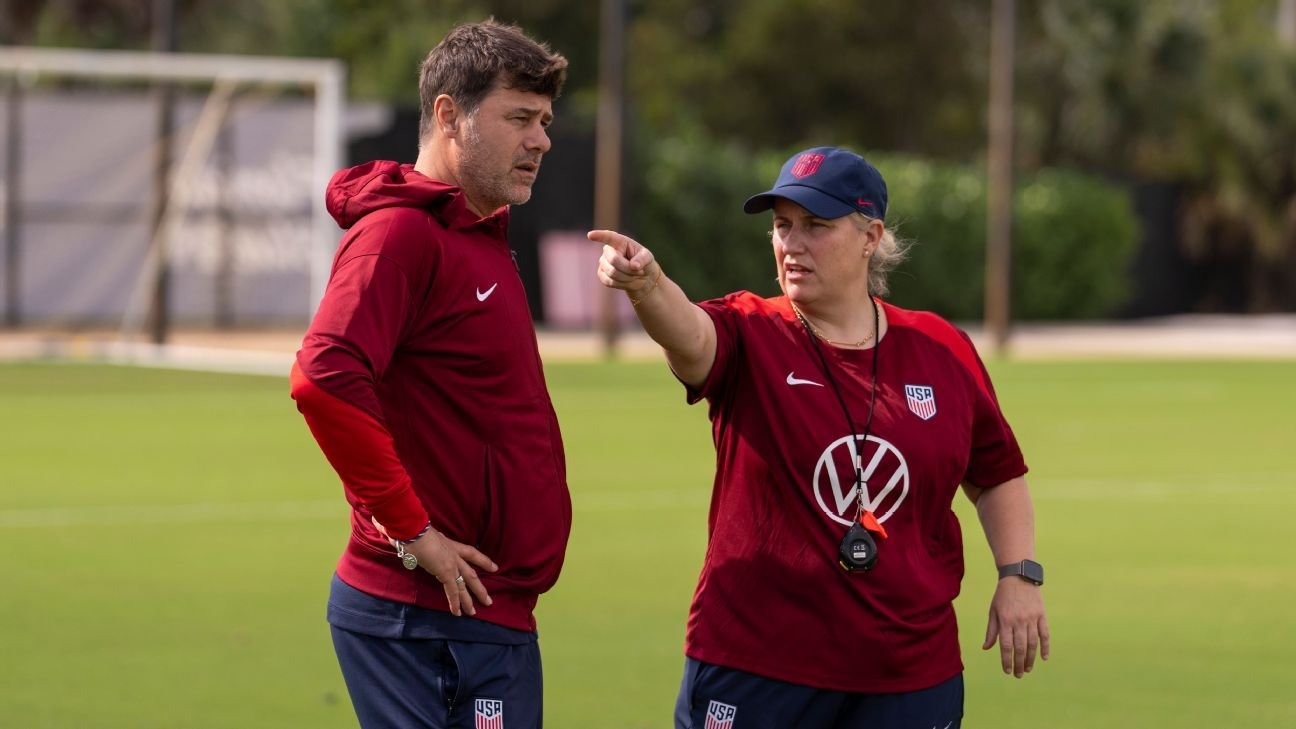
Emma Hayes, coach of the United States women’s national team, expressed her excitement over Mauricio Pochettino’s new four-year contract extension as head coach of the U.S. men’s national team. She believes both coaches are now equipped to concentrate on the long-term goals of their respective programs.
“This summer, he fully embraced what comes with soccer in this country,” Hayes told ESPN. “He did an incredible job instilling belief in the team. I think this is just the start for them.”
Earlier this week, U.S. Soccer announced that Pochettino had signed a contract extension to lead the U.S. men’s team through the 2030 World Cup. He had previously guided the team to the round of 16 during the tournament co-hosted by the United States, Canada, and Mexico.
The U.S. team had a disappointing 4-1 defeat to Belgium in the round of 16, despite a strong start in the tournament.
Pochettino’s overall record with the U.S. men’s team stands at 17 wins, 12 losses, and 2 draws since he began his tenure in September 2024, marking the midpoint of the World Cup cycle. His renewed contract provides a full cycle to strategize for the upcoming 2030 World Cup, allowing him to focus on the program’s long-term goals. He recently mentioned his aim is to “leave a lasting impact on soccer in this country, extending beyond just on-field results,” while fostering a new generation of talent.
Hayes noted that similar discussions about player development are occurring in both men’s and women’s soccer in the U.S.
“He is undoubtedly excited to engage in discussions, just as I am with you now, regarding the youth across the country,” Hayes remarked. “We need to enhance the preparation of the next generation. I believe he faces comparable challenges, perhaps even greater ones.”
Earlier this week, Hayes emphasized to ESPN the significance of American players gaining experience at the U20 Women’s World Cup. Since taking over the U.S. women’s team in late 2023, she has been vocal about the necessity for the program to innovate its playing styles and development strategies to maintain its global success.
Hayes led the U.S. women’s team to gold at the 2024 Olympics, managing many of her early games remotely while concluding her role with Chelsea in the Women’s Super League.
“I want to ensure we don’t slip into mediocrity in women’s soccer due to a lack of value for development,” Hayes said. “It’s not enough to rely solely on our historical success.”
“For [Pochettino], bridging the gaps in player development is crucial. It will dictate how we nurture our players. I’m confident that if we spent two days together, we would share similar insights and strategies for addressing the fragmented system we have in place. We need to tap into communities currently underrepresented in soccer.
Hayes mentioned she supported Pochettino as the 2026 Men’s World Cup approached but allowed him space post-tournament. Both coaches are currently taking time to recharge, yet she plans to reach out for further discussions soon.
Pochettino and Hayes are familiar with each other’s challenges, having coached Chelsea’s men’s and women’s teams during 2023 and 2024. They both acknowledged the importance of optimizing talent attraction and training methods from a young age.
“It’s about maximizing our ability to develop players, where game intelligence together with skills and tactical understanding come first,” Hayes explained. “While physical attributes do matter, they shouldn’t be prioritized over those fundamental skills. We need to better define the trajectory of a top-level soccer player’s journey and work backward from that.”
“I’m certain our conversations will continue on this front. Pochettino is deeply committed to advancing youth development.”
Hayes noted that she “absolutely” gleaned insights from the 2026 Men’s World Cup that she’ll utilize for the 2027 Women’s World Cup. As an analyst during the men’s tournament, she witnessed several matches firsthand.
“I continually pondered whether FIFA is adequately preparing the women’s side for advancements in officiating quality and the pacing of VAR,” Hayes remarked. “Moving forward, I aim to advocate for a transparent and efficient VAR process that will expedite decision-making and keep the game flowing. I’ve recognized how critical it is for officials to remain vigilant against tactics that disrupt the game.”
Since the U.S. women’s team rarely has access to VAR, they will employ it in their two October friendlies against Spain, at Hayes’ request, to ensure they’re well-prepared for the upcoming World Cup in Brazil next summer.