



Nigeria have qualified for every one of the nine Women’s World Cups, beginning with the inaugural edition in China in 1991.
Falling short would be hard to accept in a nation used to dominance, with the Super Falcons having clinched Wafcon a record 10 times.
Yet getting past Desiree Ellis’ well-drilled Banyana side was never likely to be straightforward.
The first half in Casablanca offered little, but the second was lively and packed with chances.
Asisat Oshoala battled through several tackles and prodded goalwards from inside the six-yard box, but her effort lacked the power to really trouble Swart.
Soon after, the six-time African Footballer of the Year was substituted, prompting inevitable questions over whether the 31-year-old has featured in her final Wafcon.
The opener came on a 56th-minute counter, with striker Ronnel Donnelly sliding a superb through ball from inside her own half to send Hildah Magaia clear.
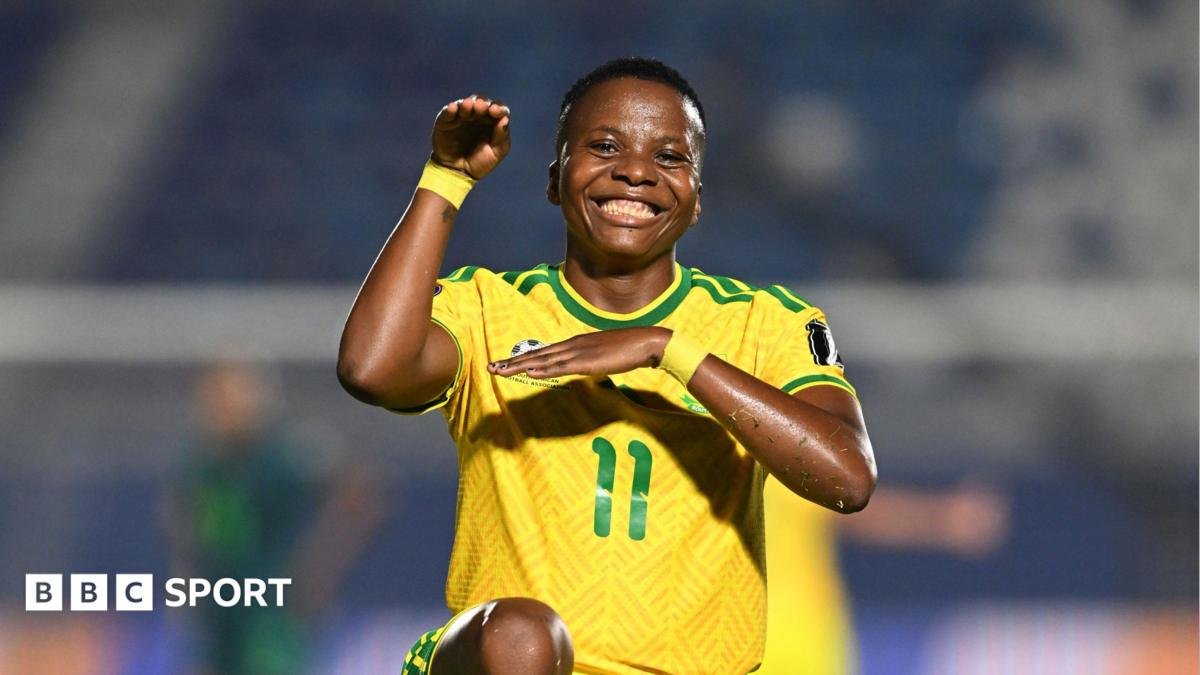
Magaia’s delivery from the left found the onrushing Kgatlana, whose shot had just enough on it to cross the line despite Chiamaka Nnadozie getting a strong hand to it.
Nnadozie thwarted Kgatlana again five minutes later, while Swart produced a spectacular one-handed save to turn away Uchenna Kanu’s header, springing to her left.
In the 77th minute, Jane’s effort deflected off Ucheibe’s outstretched foot, and less than a minute after the restart, Magaia should have scored when clean through.
Nigeria looked short on ideas until VAR spotted an avoidable handball by Jane, offering a late lifeline.
The captain did not need to extend her arm, with Swart seemingly well positioned to claim the ball on the goal line.
With the extra player, Nigeria surged forward and nearly leveled in the 97th minute when Alozie drilled the ball across goal, only for Swart’s left boot to divert it away from the bottom corner.
Swart and South Africa celebrated a jubilant victory, though a World Cup berth remains unsealed.
They must now navigate a six-team round-robin in November and December alongside Ghana, Uzbekistan, Chinese Taipei, Papua New Guinea and Ecuador.
The top two from that mini-league advance to a final intercontinental qualifier in February, where three places in Brazil are on the line.