



-

Chris Jones
Multiple Authors
From the book LEGS HEARTS MINDS: Loss and Its Remedies by Chris Jones. Copyright © 2026 by Chris Jones. Published by Random House, an imprint and division of Penguin Random House LLC. All rights reserved.
I’m not certain that Hull has a charming side, especially not on a dreary March evening in 2023. My son Sammy and I gazed through the rain-specked train windows at the dull North of England landscape, all shades of gray. I had chosen a hotel conveniently close to Hull‘s stadium, but the walk felt like a challenge, aggravated by the relentless rain and the crunch of glass beneath our feet. Our earlier matches had been played in the upscale, sunny ambiance of London, where we’d caught games at Tottenham and Fulham, mingling with the Premier League’s elite. Now, Sammy was experiencing a starkly different reality—one tied to his great-grandfather’s past—where football serves a purpose beyond entertainment. I kept my grandfather’s Burnley scarf concealed under my rain jacket while I explained to Sammy the nuances of football decorum in such settings.
For North American sports fans unfamiliar with the intensity of English football, the nature of rivalry can be surprising. A Championship clash between Hull and Burnley might not match the intensity of a Glasgow derby, but the separation between fans is palpable. Football grounds designate specific areas for away fans, often isolated by a buffer of empty seats and security personnel. In Hull, the typical buffer zone was replaced by fishing nets, and we found ourselves on the frontline, flanked by two thousand Burnley supporters behind us. Across the nets, the resolute Hull fans stood defiantly, brandishing crooked fingers and delivering their own rather rude gestures. I worried about how Sammy might react. The atmosphere isn’t easy—Hull breeds tough people, and their football often deepens their discontent. There’s a certain type of English football fan—what I call Homo miserablis—not violent in a traditional sense, but brimming with an existential disdain. They often lack the capacity for joy and seem almost engineered to harbor grudges. Typically, they are older white men, balding and dressed in attire that would grace a high-end nursing home. Their fiery skin can transition from pale to a vibrant crimson at will, much like an agitated octopus. Perched on their noses are glasses that emphasize their pronounced features, often set in a permanent grimace.
Just days earlier, I had sat next to one such fan at the Tottenham game. Arriving mere seconds before kickoff, he awkwardly slid into his seat, partially invading mine. His three companions barely exchanged words with him upon his arrival, prompting one to ask, “How’s it going?” to which he barked back, “F—ing s—e!” before the whistle blew.
Even a spectacular goal from Harry Kane couldn’t quell his fury. “Waste of money!” he bellowed continually. I couldn’t help but appreciate his liberal use of British epithets, especially “muppet” and “pillock,” gleeful in their redundancy. His relentless outbursts left me pondering his purpose at the game; why be there if not for enjoyment? As the final whistle blew, he stood in evident disgust and declared to his friends that “the referee ruined the game!”—despite Spurs winning 3-1.
Having become more self-aware over time, I saw how easily I could have become a hooligan in my youth or even a Homo miserablis in later years. Growing up in a small Canadian town during the 1980s, violence was a common way to settle even minor disagreements; minor scuffles were a daily occurrence. I fought not just out of cultural obligation, but from a certain enjoyment in the act—so much so that I picked up boxing in my twenties. Had my upbringing taken place in North England, I could easily envision myself as one of those reckless boys on the train, cider cans in hand. I might have grown into one of those scowling men across the nets.
When it came to whether Sammy inherited my predisposition toward aggression, I sincerely hoped he had not taken that part of me. I had moved past those tendencies and wished the same for him. Thankfully, he hadn’t shown any signs of similar rage and, as far as I knew, had never been in a fight. He was evolving into a remarkable young man, markedly kinder than I had been at his age, and better at listening. Yet, caution lingered—I worried for him. At fifteen, he stood at the edge of adulthood. I, too, had been an unassuming, studious child at that age. My own violence had surfaced unexpectedly. In that gloomy Hull stadium, no one in our confined corner thought to sit down. After Nathan Tella completed a remarkable hat trick—an unfamiliar, revitalizing Burnley performance—our collective excitement spilled forth. We were exuberantly embracing strangers, celebrating like family. Sammy was embracing it all joyfully, even playfully urging me to sing in an English accent—a feat I resisted, arguing a fake accent was worse than our own. Undeterred, he belted out “Nathan Tella, baby!” in an exaggerated manner reminiscent of Dick Van Dyke.
After Tella scored his third goal, a man in front of us turned around, clearly curious. “What are two Americans doing at a Burnley game on such a rainy night?”
“Canadians,” I corrected, prompting an immediate apology. I gestured to my scarf and shared a brief history of our family, culminating in this moment—witnessing my grandfather’s team rise again alongside my football-enthusiast son.
“What are your plans for tomorrow?” he inquired. I detailed our upcoming matches—first against Bolton at Sheffield Wednesday and then back with Burnley that Saturday to face Manchester City at the Etihad.
“You can’t leave without visiting Turf Moor,” he exclaimed.
I nodded, though our schedule hadn’t aligned. “Maybe we’ll catch them for their first Premier League game,” I replied optimistically, especially given this decisive victory over Hull, which made promotion seem nearly guaranteed.
“I work for Burnley,” he revealed.
His name was Chris, and he managed hospitality; a Mother’s Day brunch at Turf Moor was scheduled for Sunday, and he extended an invitation for us to come early and tour the venue.
“Really?”
“Of course,” Chris said, and we shook hands before returning our focus to the pitch.
We continued to marvel at the game, realizing Chris spoke to us because we stood out yet felt like we belonged. Traveling thousands of miles, across generations, watching Burnley play on a rainy night in Hull—this spirit was shared, connecting us as fellow Burnley fans.
I leaned closer to Sammy and quipped, “Good thing I didn’t try to fake an accent.”
Our supporters kept singing, teasing the Hull fans: “Enjoy the Championship next season!” Their attempts to save face through louder jeering were met with fresh police and security arriving, ushering a few overly boisterous fans away. When Hull finally scored late to bring the score to 3-1, their supporters surged forward, mimicking a coordinated attack from opposing forces. The police’s presence ensured it ended without incident, a mere serve of football theatrics, yet Sammy caught a glimpse of what true devotion can entail.
With the match concluding, it was announced that our corner would receive a five-minute head start before the remaining fans were permitted to exit. Essentially, we were told to run. Sammy, emboldened, retorted across the nets, hands gesturing, singing “We are Premier League,” in his questionable accent. I tucked my Burnley scarf under my raincoat and braced myself for the sprint back to our hotel, hoping to avoid any complications.
The next morning, as we enjoyed breakfast, I asked Sammy whether he wanted to take Chris up on his offer to explore Turf Moor. It felt risky; Burnley lay a good hour’s drive from Manchester, and we needed to trust Chris’s sincerity. Without contact information or any sort of guarantee, we took a leap of faith. Yet Sammy seemed enthusiastic about the prospect, and I figured if it didn’t pan out, we could swing by Rawtenstall, where my grandfather was from, to locate his childhood home and the soccer field of my youth.
Sammy and I took an Uber to Burnley, and the ride was even more picturesque than I remembered. The hills between Manchester and Burnley glistened fresh and green in early spring, the trees bursting with new leaves. The quaint mill towns along the route—Summerseat, Ramsbottom, Lumb—seemed charming as we arrived in Burnley. It wasn’t the dark, uninviting place I recalled from my youth. We stopped by Turf Moor, its patchwork of bricks and corrugated steel greeting us at Harry Potts Way. Nearly forty years had passed since my first visit with my grandfather in 1985, and as feared, the ground appeared entirely shut up.
We spotted some glass doors further down and, on a whim, I pulled one open. To my surprise, it swung wide, revealing an elderly gentleman seated behind a desk.
“Apologies,” I stammered, “I can’t quite explain this, but …”
“Oh, aye,” the old man said, his face lighting up. “You must be the Canadians! Chris told me you’d be stopping by. I’ll go fetch him.”
The gentleman may not have been built for speed, but he mustered enough pace to quickly return with Chris, sharp in his suit and tie, a welcoming smile plastered across his face. I was floored that he had remembered our earlier conversation.
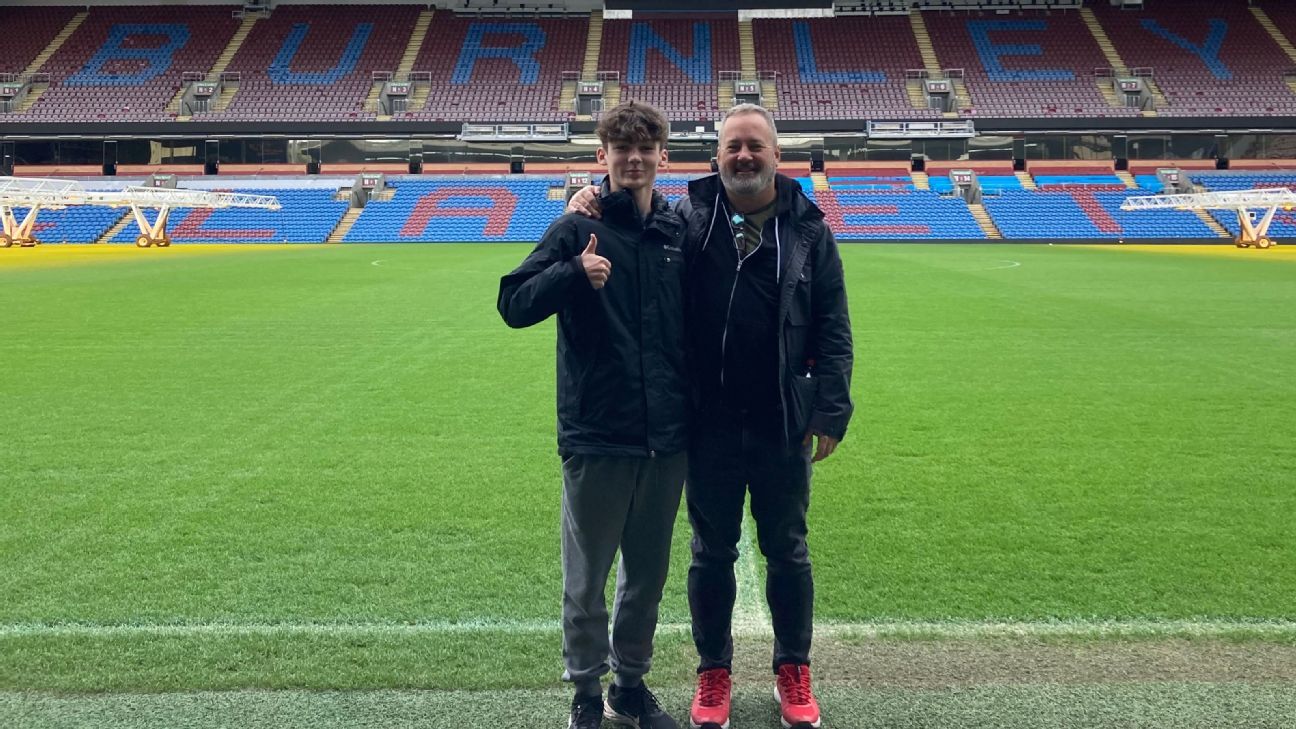
For the next two hours, Chris guided us through every crevice of Turf Moor, revealing the inner workings of the historic venue as if unveiling the secret compartments of a grand ship. We explored executive offices, the trophy room—with still some space available on the shelves—and the lounges. Then he took us down a hallway and led us to the Bob Lord Stand, emerging from the buzz of anticipation into the cool air, where we beheld the rows of claret and blue seats—one for nearly every resident of Burnley—complementing the immaculate pitch below, perfectly lined and vibrant. This ground had been the site of sports since 1843—a cricket field originally—and it shone with memories of countless games long past. Chris took us to the touchline, where I watched Sammy gaze at the grass, realizing it was unlike any field he’d ever played on.
Chris proceeded to show us around the entire stadium, entering the dressing room and inspecting Kompany’s neat quarters. When Chris asked Sammy if he wanted to walk through the players’ tunnel, I observed a rare spark in Sammy’s demeanor. We ventured where football’s heroes tread. As we approached the pitch, Chris pointed out a hole in the wall created by a frustrated player: “We’ll be sending them a bill for that,” he joked, and Sammy traced his fingers over it, understanding a little more about what football represents in such a passionate environment. Finally, we stepped into the light.
Sammy lingered there, entranced, hands tucked in his coat pockets, silently absorbing every detail of Turf Moor, treating it almost like a sacred pilgrimage. While I too reveled in the experience, I found myself instead reminiscing about everything that had led me here, reflecting on the journey of my life and my family that brought us to this moment. I pondered what my grandfather would think had he seen his great-grandson, with his curly hair, lost in wonder at Turf Moor.