



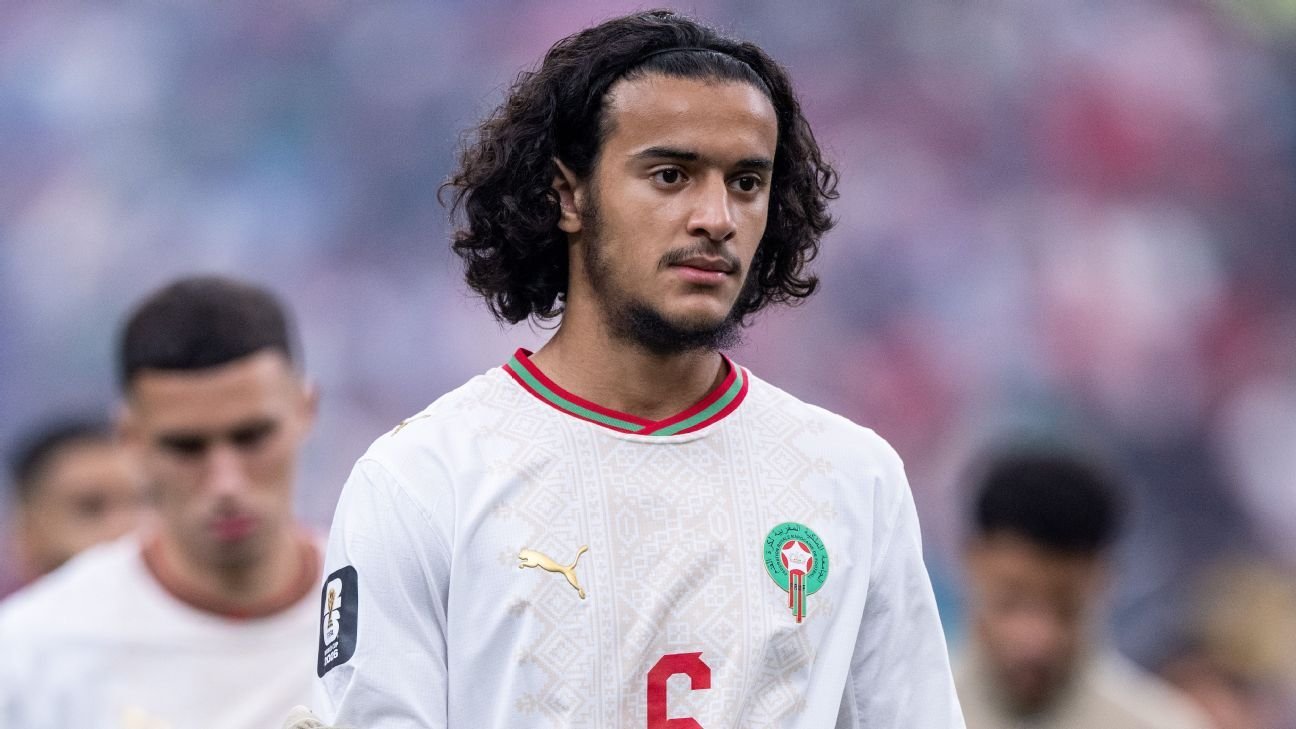
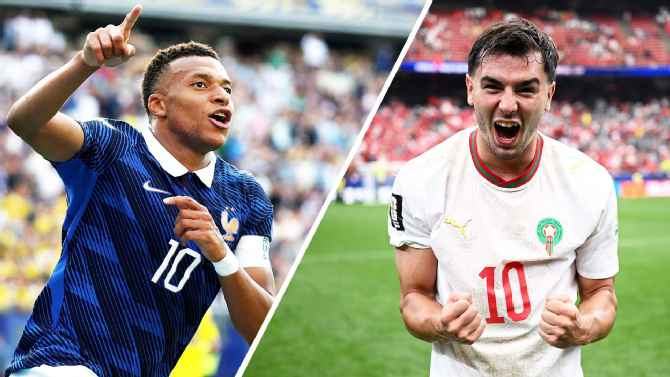
In an alternate reality, Ayyoub Bouaddi would sport the blue jersey of France as they faced off in Boston during Thursday’s World Cup quarterfinals, rather than the red of Morocco. He would have been guided by French coach Didier Deschamps instead of Mohamed Ouahbi, while sharing midfield duties with Adrien Rabiot rather than Neil El Aynaoui, another player whose roots are in France but who could also have represented the other side. His captain could have been Kylian Mbappé, instead of Achraf Hakimi.
For many French fans, “losing” an 18-year-old talent like Bouaddi to Morocco feels like a significant loss.
Hailing from Senlis, just an hour north of Paris, Bouaddi has represented France in every youth category and even captained the U21 team at 17. His heart was set on playing for the 2018 World Cup champions and he turned down a chance to play for Morocco months ago during the Africa Cup of Nations, despite attempts by former head coach Walid Regragui to sway his decision towards the country of his heritage.
Fast-forward six months, and Bouaddi grew impatient to seize his opportunity at the international level, especially with the 2026 World Cup on the horizon.
Deschamps had opportunities to invite him during the last international break in March and before that, but it never materialized.
Having observed Bouaddi’s performances closely, he is undoubtedly aware of the midfielder’s immense talent—one that has shown generational potential throughout this World Cup. Deschamps recalls Bouaddi’s professional debut at 16 for Lille and the impressive display he put on in the Champions League against Real Madrid on his 17th birthday in October 2024. Yet, he chose to bring N’Golo Kanté and Warren Zaïre-Emery as rotation options, instead of Bouaddi alongside first-choice players like Manu Koné, Rabiot, and Aurélien Tchouaméni.
“Our midfield is already brimming with talent, and Didier wants to ensure no one feels blocked,” commented Guy Stephan, Deschamps’ assistant, when asked about Bouaddi’s absence from the squad. “With Tchouaméni, Rabiot, Kanté, Zaïre-Emery, and Koné, if I ask you who should be removed to include Bouaddi, I doubt we’d all agree.”
While the French midfield shows great depth and skill, it’s worth considering that Kanté, at 35, has yet to play a single minute in this tournament. Despite his invaluable experience and contributions to the 2018 World Cup win, Bouaddi’s talent may have warranted his inclusion instead.
“[Bouaddi] has the right to choose his national team,” Deschamps stated back in March. “I haven’t spoken to him; that’s not my approach. When I call a player, it’s because I believe it’s the appropriate time, or I see them fitting into the France A team. Naturally, we keep track of his performances, but there’s considerable competition for his position.”
Recently, Zinedine Zidane, who will become the head coach of France after the World Cup, reached out to Bouaddi, likely prompted by fears from the French FA about losing the young prospect. According to sources, Zidane expressed admiration for Bouaddi but provided no guarantees.
In contrast, Morocco’s new head coach Ouahbi actively pursued Bouaddi’s commitment to their national team, promising him a pivotal role, even a starting position in the 2026 World Cup. That was all it took for Bouaddi to finalize his decision.
So, like five of his teammates born in France—notably Issa Diop and El Aynaoui—who once played for France’s youth sides, Bouaddi is set to challenge his country of birth during what promises to be a captivating quarterfinal matchup on Thursday.
2:06
Do France need to improve to beat Morocco?
The French squad eagerly anticipates this clash, which serves as a rematch from the 2022 World Cup semifinals in Qatar, where Les Bleus secured a 2-0 victory. This encounter represents their toughest test thus far in the tournament. They have overcome all challengers to date, demonstrating flair against Sweden in the round of 32 and resilience against Paraguay in the round of 16.
Despite the setback of Tchouaméni, who will miss this match but should return for the semifinals, the French camp has faced minimal challenges throughout the tournament. Deschamps has been encouraged by the performances of his players.
Among his three primary attackers—Mbappé, Ousmane Dembélé, and Michael Olise—have tallied a combined 20 goal contributions in the current World Cup: seven goals and two assists from the captain, four goals and two assists from the Ballon d’Or holder, and five assists from the Bayern Munich star. This total mirrors what Ronaldo, Rivaldo, and Ronaldinho achieved (15 goals and five assists) for Brazil in 2002 when they claimed the World Cup. Moreover, Les Bleus may still have up to three more matches to go.
The overall atmosphere within the France squad is exceptional, characterized by camaraderie, solidarity, and determination. The recent challenges faced by Deschamps due to the loss of his mother earlier in the World Cup have further solidified the team’s bond while he briefly returned home.
As Deschamps approaches the final days of his tenure—14 years after his appointment and eight years after guiding France to glory—Thursday may mark either the conclusion or continuation of his journey with the team. Only three steps now separate France from another World Cup triumph.
From Day 1, France has been viewed as the favorite and continues to hold that status. Whether against Bouaddi and Morocco or subsequent challengers, they must remain formidable to secure their path to victory.