



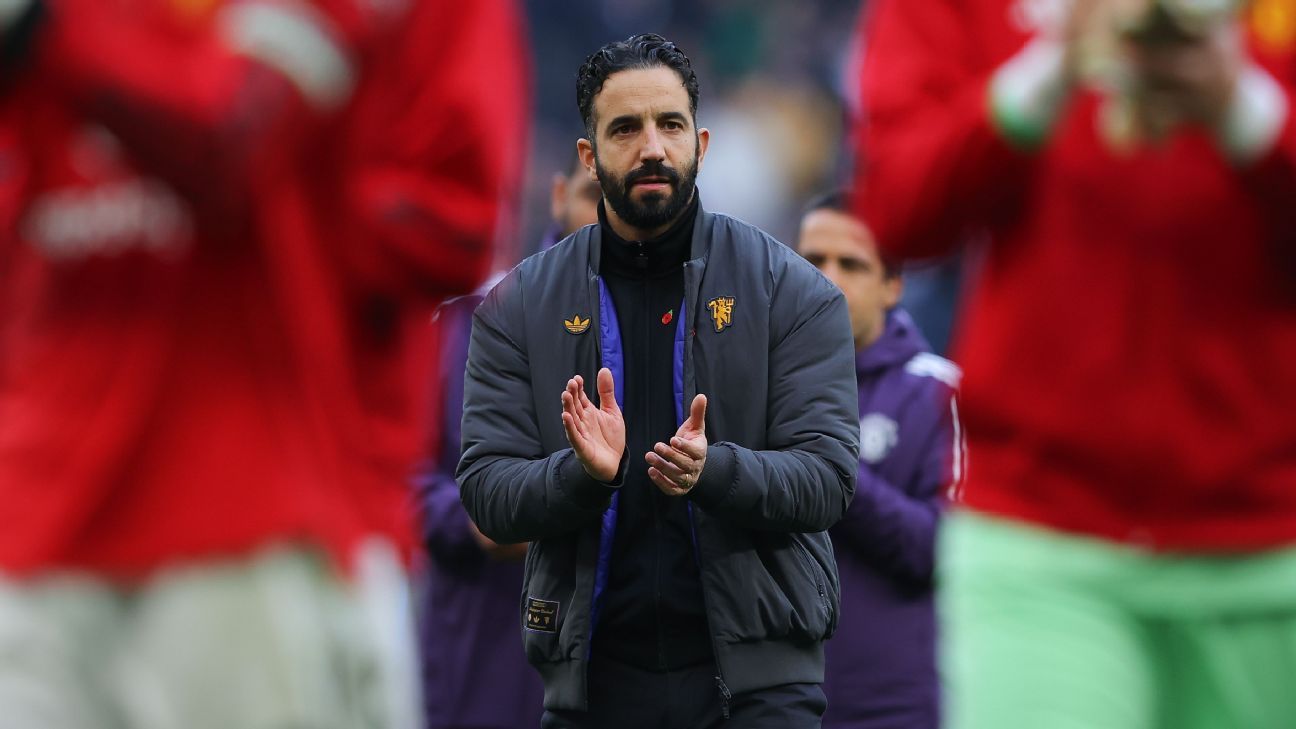
When asked about the challenges he faces at Manchester United, Ruben Amorim often remarks that “we have a lot of problems in our club.” His news conferences, typically capped at about 30 minutes, often hint that the issues are simply too numerous to fully address.
The Portuguese manager seldom dives into the specifics of these difficulties, but he occasionally hints at particular problems that overshadow everything at Old Trafford.
Amorim is spearheading a long-term project at a club where short-term success is paramount—it’s a precarious balancing act.
“We know we need time,” Amorim stated last week. “But there is no time in this club.”
– Manchester United hasn’t proven they’re worthy of a Champions League spot
– Arsenal’s dramatic late defeat at Aston Villa opens up the title race
– What do the Big Six PL teams need to address before the January transfer window?
Following the 1-1 draw with West Ham United on Thursday, Amorim finds himself under pressure again. United’s upcoming match against Wolverhampton Wanderers on Monday evokes a sense of apprehension among fans.
Wolves have yet to win a league game this season, managing only two draws. There’s a palpable fear that Rob Edwards, Wolves’ new manager, could be due for a breakthrough against a United side known for its inconsistency, having recently lost to Everton—who played for over 70 minutes with ten men—just two weeks prior.
Last December, United suffered a 2-0 defeat at Molineux despite Wolves occupying the Premier League‘s relegation zone. Fans are understandably anxious that history might repeat itself.
A loss to the bottom-ranked team in the Premier League would bring even greater scrutiny on Amorim, with some supporters already calling for his dismissal.
Amorim understands he cannot request patience despite the arguments in favor of needing it. Given his record of 13 wins from 41 league games, “time” might feel like a contentious topic.
Nonetheless, it is clear that Amorim’s team is still a work in progress. The attacking unit was overhauled with a £200 million investment this summer, bringing in players like Matheus Cunha, Bryan Mbeumo, and Benjamin Sesko, but the rest of the squad remains largely unchanged since his arrival.
Amorim relies on a young core, featuring talents like 22-year-old Sesko, 23-year-old Senne Lammens, 23-year-old Amad Diallo, 21-year-old Patrick Dorgu, and 20-year-old Leny Yoro. After a subpar performance against Crystal Palace, Yoro was taken off for 19-year-old Ayden Heaven.
The team is banking on these young players to develop. However, Amorim has recently described Sesko and Dorgu as “struggling.”
The club could have opted to sign Argentina’s FIFA World Cup-winning goalkeeper Emiliano Martínez, or English striker Ollie Watkins, instead of Lammens or Sesko. Both Martínez and Watkins would have enhanced United’s present performance, but that would have contradicted the club’s strategy of prioritizing younger talent. The decision to invest in young potential came at the cost of immediate effectiveness, leaving Amorim to rely on less experienced players like Sesko, Dorgu, and Lammens, who are expected to deliver results now.
“It’s clear that we need time,” Amorim commented on November 29. “With every other club in the Premier League improving rapidly, we must find a way to win immediately, or changes will need to be made. We simply must improve.”
“It’s not acceptable for Manchester United to not win games. The pressure is immense, and that frustration is ever-present for me.”
After the draw with West Ham, Amorim displayed visible frustration during a tense post-match conference. Meanwhile, veteran right-back Diogo Dalot spoke candidly about the precarious situation: having spent eight years at the club, he understands the need for patience—even if United cannot afford to ask for it.
"We've shown this season that we can compete at a high level, capable of beating any team," Dalot said. "But sometimes, it’s not about technical ability; it comes down to inner drive and determination to win day in and day out."
"I'm not going to use the excuse of 'needing time.' Winning is imperative immediately because that’s what this club demands, but we are working through a process."
To move forward, United must address the shortcomings in their squad. Amorim's tactical approach necessitates high-energy midfielders and proficient wing-backs, both of which are currently lacking.
This past summer, the club made a strategic choice to direct the majority of its transfer budget toward enhancing the attack rather than spreading it across various positions. This approach has resulted in a somewhat unbalanced squad. However, CEO Omar Berrada and director of football Jason Wilcox prioritize gradual improvements over a "shock and awe" transfer strategy. The objective, as reported by sources, is to recruit a midfielder like Nottingham Forest's Elliot Anderson for next season, possibly even two.
However, this plan provides little solace for Amorim as he readies his squad for Monday's match against Wolves. Under mounting pressure, the United manager faces a must-win situation with a team still learning to win.