



-

Jeff Kassouf
NWSL commissioner Jessica Berman highlighted the groundbreaking agreement between United States forward Trinity Rodman and the Washington Spirit as evidence that the league’s new High Impact Player initiative is successfully retaining and attracting top talent.
“We are thrilled to have Trinity in the NWSL,” Berman stated to ESPN on Friday. “It was always our priority to secure her, and we worked hard to ensure we could sign her in accordance with league rules.”
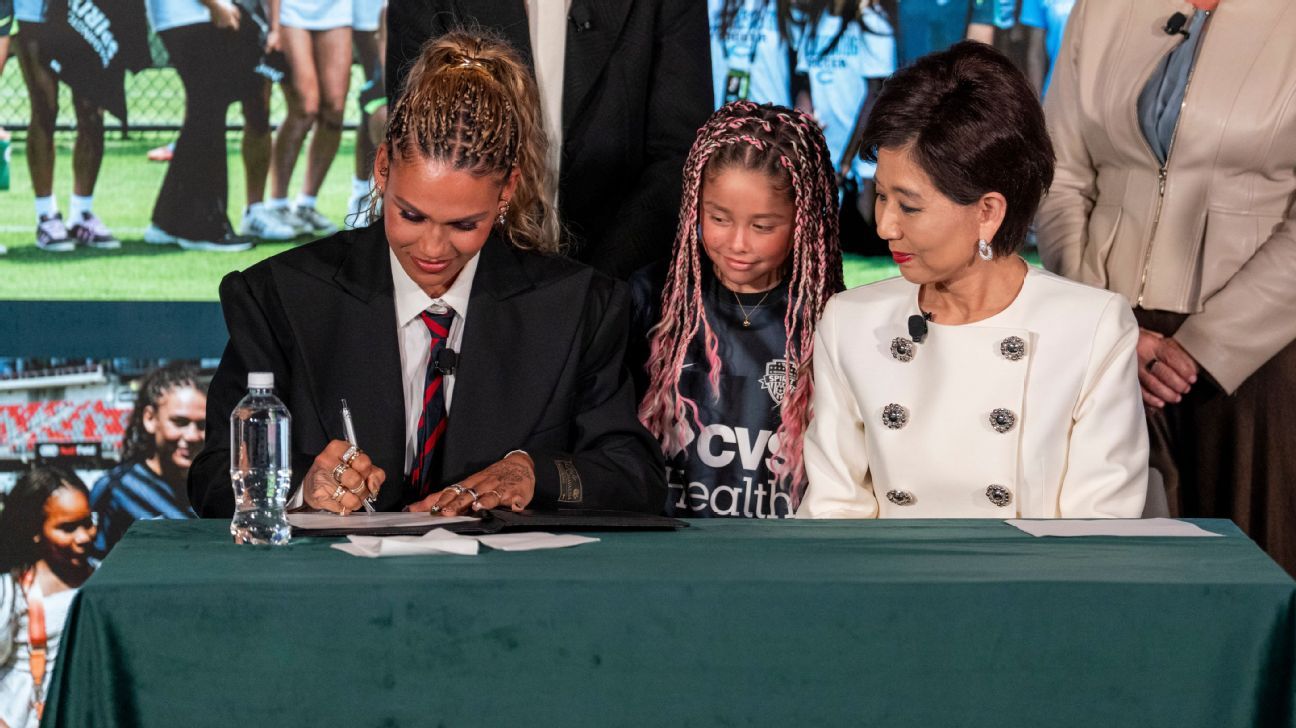
Rodman became the first player in NWSL history to officially benefit from the High Impact Player rule with the announcement of her three-year contract on Thursday. Reports confirm that this deal will earn Rodman over $2 million per year, making her the highest-paid player in NWSL history.
Her agent, Mike Senkowski, noted that this contract also positions her as the highest-paid women’s player globally.
However, the NWSL Players Association has expressed opposition to the High Impact Player (HIP) rule and has filed a formal grievance, asserting that the league’s execution of the rule infringes on the collective bargaining agreement and federal labor law.
The HIP rule, informally referred to as the “Rodman Rule,” permits teams to exceed the salary cap by up to $1 million for elite players.
In contrast, the union recommended increasing the salary cap by $1 million without restrictions on player eligibility.
Berman indicated that the HIP rule was crafted to strategically grow the league. The NWSL has seen USWNT stars Naomi Girma, Alyssa Thompson, and Sam Coffey leave for England recently, and the aim of the HIP rule is to remain competitive for top talent.
“Our responsibility as a league is to establish policies that drive behavior,” Berman remarked to ESPN. “We must also ensure our capital and resources are strategically allocated to foster long-term business growth.”
She added, “We are aligned with the players in our mission to develop this league sustainably and with a focus on viable growth.” Such strategic policies are standard practice in professional leagues, Berman noted.
The Players Association contends that the HIP rule needs to be negotiated collectively. According to Article 8.16 of the CBA, the league “may, at its discretion, consult with the NWSLPA and subsequently reduce or eliminate the salary cap charge for certain roster classifications.”
Berman noted she couldn’t elaborate further due to the ongoing grievance but affirmed that the NWSL has the right to implement the rule following good-faith consultation with the union.
“In a broad sense, good-faith consultation means proceeding despite objections on several fronts,” Berman explained. “It’s crucial that we express genuine interest in the Players Association’s insights and feedback.”
Berman mentioned that discussions about the HIP rule began “in various forms” with the NWSL’s board of governors as early as 2023, and that the league monitored global trends before deciding to roll out the rule this fall.
“We were aware of Trinity’s contract expiration, but our focus was broader, noting various market trends,” Berman said. “We always hoped Trinity would benefit from the new rule, and we are pleased that it worked out that way.”
The fund for High Impact Players will increase proportionally with the salary cap: $1.257 million in 2027, $1.342 million in 2028, $1.4 million in 2029, and $1.457 million in 2030, as confirmed by ESPN.
Berman highlighted that this totals $115 million in new investment over time, considering increased salary caps and revenue sharing alongside HIP funds.
Another point of contention for the union is the criteria for player eligibility under the HIP rule, which may include marketability metrics from external media sources.
“The league is overstepping by trying to dictate player compensation through these funds,” NWSLPA executive director Meghann Burke told ESPN earlier this month. “Teams are best equipped to assess how to structure their rosters and negotiate contracts.”
“We believe that measuring a player’s value involves nuanced criteria both on the field and in business terms, thus it’s up to the teams to make those judgments in a free agency context,” she added.
Berman countered that the criteria were designed to be specific and targeted for optimal allocation of this additional capital, asserting that the league does not have a subjective list of player qualifications.
“We aim for objective, external sources to help identify top players,” Berman said.
The NWSLPA has also filed a second grievance regarding the league’s rejection of a prior agreement between Rodman and the Spirit, which occurred before the HIP rule was ratified. The union called this an infringement of Rodman’s free agency rights and a violation of multiple sections of the CBA.
This grievance remains unresolved even after Rodman signed a new deal with the Spirit.
“Absolutely, it breached league rules,” Berman responded regarding the annulled previous deal. “Our responsibility is to uphold our regulations uniformly and with integrity across all clubs, which is why the contract couldn’t be approved.”
Both grievances might proceed to arbitration.
Berman expressed confidence that these issues have not damaged the relationship between the league and the union or its players. “From my perspective, there’s been no strain,” she stated. “I believe in conducting our business professionally, transparently, and respectfully, and that remains unchanged.”