



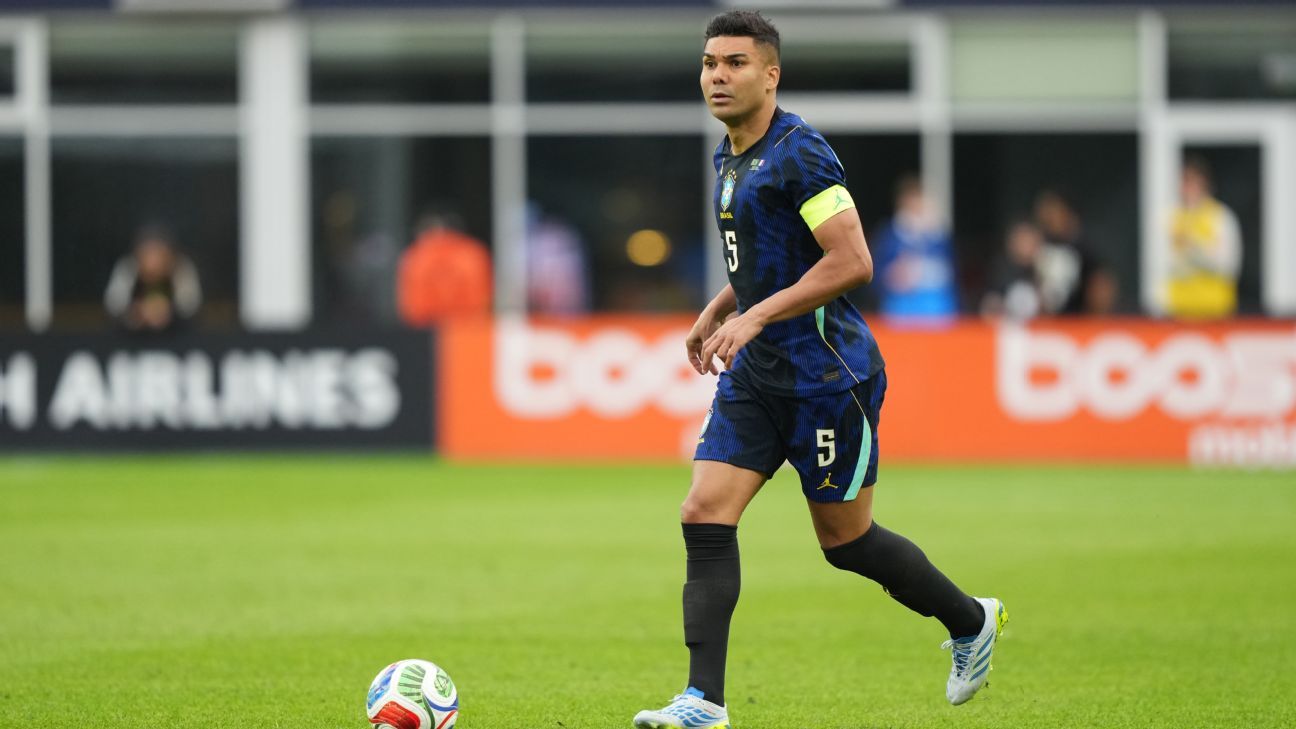
Approximately two years ago, certain Premier League analysts were suggesting that Casemiro should consider retiring. They believed the Brazil midfielder had lost his edge and urged him to exit the upper echelons of football before it got ahead of him.
Carlo Ancelotti, however, had a different perspective.
The Italian manager was disappointed to part ways with Casemiro, who made a surprising switch from Real Madrid to Manchester United. When Ancelotti assumed command of the Brazilian national team last year, his priority was reinstating Casemiro to the squad after an 18-month absence.
In his book “The Dream: Breaking Champions League Records,” Ancelotti describes Casemiro as “the steady metronome at the heart of midfield.” As a former international central midfielder, Ancelotti seems to regard Casemiro as an extension of himself on the pitch, providing structure, shielding the defense, and facilitating initial forward passes.
The impact of Casemiro’s return is evident. Recently, Brazilian outlet Globo Esporte conducted a poll asking fans to select their preferred lineup for an upcoming friendly against France. Casemiro received the highest number of votes, even surpassing Vinícius Júnior, and subsequently showcased his value in the match against the French in Foxborough.
Right from the onset of the game, during France’s initial serious attack, Casemiro executed a crucial tackle at the edge of his penalty area. Brazil’s best early opportunities stemmed from his two exceptional long passes to Raphinha. He even posed a goal threat, narrowly missing the target with a long-range effort and a header from a corner.
From winning the ball and initiating plays to finishing, Casemiro was engaged in all aspects of a midfielder’s role. Nonetheless, he may have felt a sense of frustration at halftime.
France took the lead with a well-placed strike from Kylian Mbappé, following a sequence that began when Casemiro lost possession near the halfway line. However, the primary blame could be directed toward the defense, as debutant center-back Léo Pereira mistakenly played the team into a precarious situation with a misplaced pass, leaving the midfielders vulnerable and subsequently being easily outmaneuvered.
This goal, along with France’s eventual 2-1 victory, underscores the hazards of reading too much into the results of friendly matches. If these teams were to clash in the upcoming FIFA World Cup, the Brazilian defense would undoubtedly perform at a higher level. Ancelotti’s squad was missing several key defenders due to injuries, providing him with an opportunity to assess some less-utilized players.
Additionally, a captivating structural dilemma arises. Acknowledging Brazil’s remarkable talent in wide attacking positions, Ancelotti clearly envisions a front four: against France, this was comprised of Raphinha, Vinícius, Matheus Cunha, and Gabriel Martinelli. When fully fit, Estêvão, who thrived under Ancelotti, would presumably replace the Arsenal winger. Yet, despite the attacking brilliance of this quartet, there remains a mathematical concern.
With a goalkeeper, back four, and front four, only two midfielders can be accommodated. One of these, currently sidelined through injury, is Bruno Guimarães, leaving Casemiro as the other choice. This raises the risk of the midfield duo being overwhelmed, as occurred with Andrey Santos and Casemiro for France’s opening goal.
Post-match, Ancelotti expressed satisfaction with the team’s organization. He noted that Éderson faced minimal challenges, and the attacking players exhibited commendable defensive effort, with Cunha standing out in this regard. The coach has consistently emphasized that he is not interested in players going to the World Cup merely for the Ballon d’Or, stressing that the success of his system relies on the collective sacrifice of the forwards.
However, there’s an additional consideration that can’t be evaluated on a chilly spring afternoon in Boston. A significant portion of the upcoming World Cup matches will be contested in extreme heat—take, for instance, Brazil’s third group game, which is scheduled for a local evening kickoff in Miami. This adds a significant challenge: can 34-year-old Casemiro effectively function in a two-man midfield under soaring temperatures?
Brazil might explore alternative arrangements against Croatia in Orlando on Tuesday. Changes might also occur during the World Cup itself, as these tournaments often unfold rapidly, leading to teams either thriving or disintegrating.
Successful teams often adapt their formations throughout the tournament. A likely adjustment would be incorporating a third midfielder; Botafogo‘s Danilo, who shone in a dynamic appearance against France, and Lucas Paquetá, omitted this time, would both be strong contenders for the position.
There’s a great deal for Ancelotti to consider following the encounter with France. He may have anticipated more progress from his players, especially after France went down to ten men early in the second half. Concerns may also arise regarding Vinícius’s performance, as he struggled throughout the match. Moreover, he likely noted the crowd’s chants for Neymar once France scored their second goal. Yet, perhaps the greatest uncertainty lies in the tactical layout of his team.
When Brazil triumphed in USA ’94, they adjusted to the climatic conditions by reinforcing the midfield—an approach Ancelotti witnessed firsthand as an assistant coach for the runners-up Italy. The team he is currently constructing appears quite different. In the sweltering conditions of June and July, can he genuinely rely on Casemiro to cover extensive ground and shoulder such burdensome responsibilities? Or could his reliable presence as a metronome be better utilized within a three-man midfield structure?