



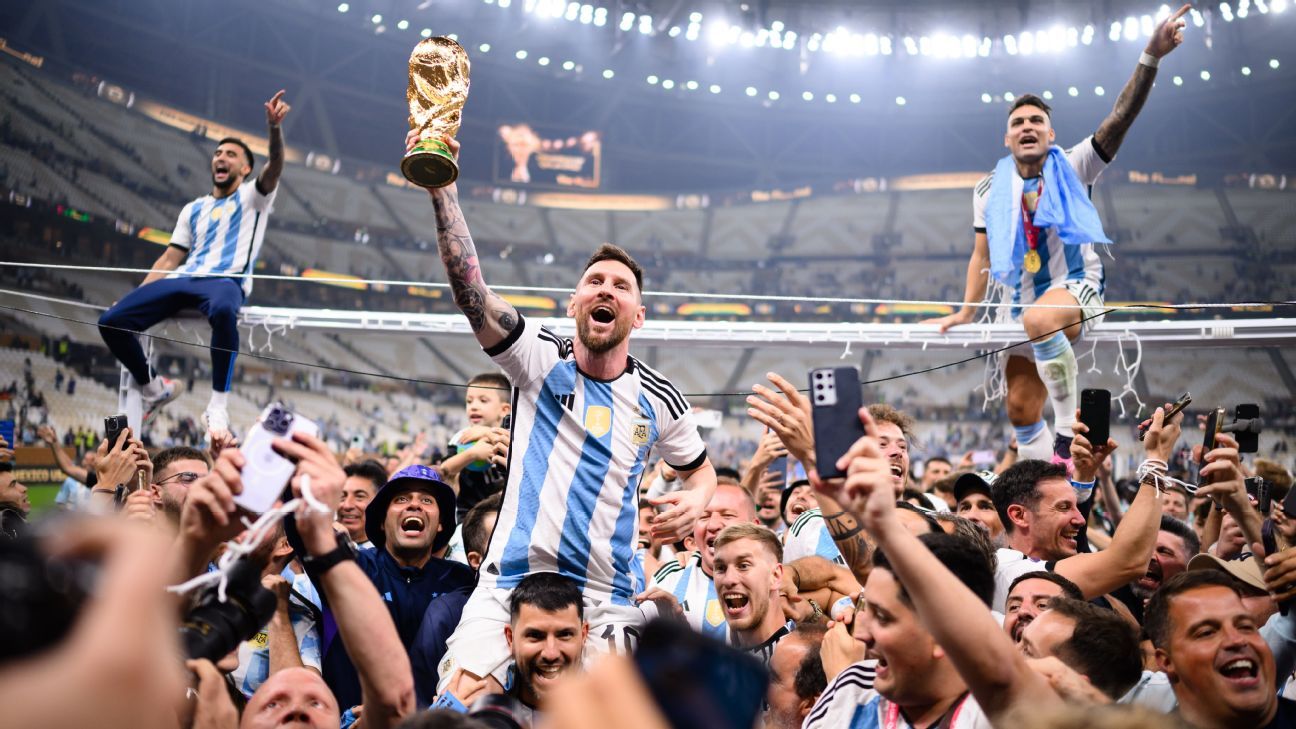
The challenges ahead for Argentina are substantial.
Italy was able to defend its World Cup title in 1938, following their victory four years prior, while Brazil successfully did the same in 1962, but both victories occurred on their home continent.
No team has successfully defended the trophy in a tournament hosted far from their native land. Thus, Argentina faces not only formidable opponents but the weight of history as they seek to reclaim the championship. Despite these challenges, they enter the tournament in the USA as one of the frontrunners, buoyed by their remarkable success since that thrilling win against France at the 2022 World Cup in Qatar.
Similar to the legendary Spain squad from about 16 years back, Argentina has established a remarkable streak with three consecutive triumphs: the Copa Americas in 2021 and 2024, flanked by the 2022 World Cup victory. Before this glorious era, their last title had been the Copa America way back in 1993.
Winning has become ingrained in the mindset of this squad. During South America’s lengthy World Cup qualification process, they displayed both consistency and flair.
While qualifying may seem simple with many teams advancing, the reality is that there are few easy matches along the way. Nevertheless, Argentina finished atop the standings, nine points clear of their closest competitors.
So, are they poised to defy the odds and secure consecutive World Cup titles?
How an aging Messi still keeps Argentina in a winning position
One advantage for Argentina is that they have developed strategies to lessen their reliance on Lionel Messi, who will be 39 during this World Cup.
While he was the top scorer during qualification, La Albiceleste delivered remarkable performances even in matches where he was absent, such as decisive victories against Bolivia (3-0), Chile (3-0), Uruguay (1-0), and the spectacular 4-1 win against Brazil, which may be marked as their most impressive showing since Lionel Scaloni took charge.
When they triumphed over Colombia in the 2024 Copa America final, Argentina arguably improved after Messi departed the pitch due to injury, and occasionally sitting him on the bench has proven to be manageable.
While Messi’s role is undeniably significant, he no longer is solely responsible for driving the offense.
Julián Álvarez, who started as a backup during the last World Cup cycle, has emerged as a key asset due to his energetic play, talent, and adaptability. Alvarez can function as a center forward alongside Messi or drop deeper to assume a role traditionally held by Messi. His partnership with attacking midfielder Thiago Almada also looks promising.

0:35
Scaloni: Messi will get minutes in Argentina World Cup friendly
Additionally, Messi’s mere presence in the locker room serves as a vital source of motivation for Argentina. Current players often cite him as an inspiration as he prepares for his sixth World Cup.
“Anyone who knows Leo understands that his presence drives the desire to win,” said Rodrigo De Paul to ESPN. “He competes fiercely — he always aims to win and be a pivotal player for both club and country.”
Former Argentina player Oscar Ruggeri believes that legendary figures like Messi can elevate the performance of the entire team. Ruggeri, a member of the 1986 World Cup-winning team that reached the final in 1990, sees in Messi a similar influence to what they had in another Argentine great, Maradona.
“Today’s team has a captain [Messi] strikingly similar to the one we had back in ’90 [Maradona]. I trust he will guide them correctly,” he remarked.
Challenges from History and Injuries that Might Hinder Argentina This World Cup
On the surface, this Argentina team appears to exhibit confidence in their ability to win again.
“I truly believe that when the decisive moment arrives, this team becomes remarkably competitive. That is our strongest asset,” said defender Nicolás Tagliafico during an interview with ESPN’s “Fuera de Juego” last month.
However, the reality is that statistics do not favor Argentina. Since the tournament’s inception in 1930, only five national teams have reached consecutive World Cup finals: Netherlands, Argentina, France, Italy, and Brazil. Yet, merely 9.09% of these tournaments have seen a team successfully defend their title.
Mario Kempes, a former national team player and 1978 World Cup champion, highlighted the difficulty of overcoming these odds, sharing his own experience in 1982. After winning the 1978 tournament, Argentina failed to progress past the group stage in the following World Cup.
“I experienced this firsthand after 1978 during the 1982 World Cup. We realized it is certainly not an easy task,” Kempes told ESPN last week. “Opponents are more familiar with us now; they know how we play. Teams must adapt, as Argentina is a national team that everyone aspires to beat.”
Kempes explained that part of the challenge in securing back-to-back tournament victories rests in maintaining peak fitness across four years, especially with players aging and enduring grueling schedules.
“The physical condition of this roster is not quite what it was, given that three years and a half have passed,” he noted. “Players have accumulated much more playing time and many have faced injuries; numerous individuals are arriving not in peak condition due to fatigue.
“Additionally, some players have not returned to their previous peak level on the field due to various reasons. Scaloni has acknowledged this, and I concur with him.”
As Argentina prepares for the World Cup, multiple players are dealing with injury concerns, leading to uncertainty regarding their availability for the opening match on June 16 against Algeria.
Messi joined the Argentina camp following muscle fatigue, which caused him to exit his latest match with Inter Miami in the 73rd minute. Meanwhile, attacking midfielder Nico Paz is training individually due to a left knee injury. Messi participated in Argentina’s last friendly before the World Cup, while Paz came on as a late substitute.
However, the primary injury concerns may lie within the defense.
During Argentina’s title run in Qatar, their back line consistently showed vulnerability under pressure. This issue surfaced against Australia, it reappeared against Netherlands, and nearly cost them the title during the final against France.
Since Qatar, Scaloni has assessed several young defenders, yet none have proven themselves effective. Thus, La Albiceleste will likely enter the World Cup with the same defensive lineup from 2022 but with added injury worries.
Goalkeeper Emiliano Martínez sustained a broken finger during a warm-up prior to Aston Villa‘s European League triumph, and center back Cristian Romero was sidelined due to a knee injury leading up to Tottenham’s crucial relegation battle. They are expected to recover in time, but Martínez missed the farewell match for Argentina while Romero only played one half.
These two players were crucial additions prior to the 2021 Copa America, greatly enhancing the defense. If the defensive setup appears shaky even with Martínez and Romero, Scaloni’s sleepless nights may be warranted as he contemplates how to navigate the World Cup without them.
In addition, defenders Gonzalo Montiel and Nahuel Molina are also dealing with minor injuries. Montiel participated in Argentina’s farewell match, while Molina did not. With this larger World Cup format including an additional knockout round, there exists a greater risk of defensive lapses.
Can Mindset Propel Argentina During This World Cup?
Ruggeri remains optimistic about the current Albiceleste squad’s ability to rise above injuries and historical challenges. He asserts that their determination to win will help them navigate these hurdles.
“It’s not about defying the statistics; Argentina has previously experienced reaching the final after having won,” he said. “This team possesses unique traits. Our squad in 1990 faced numerous injuries upon arriving in Italy, reflecting the challenges this team is currently experiencing.
“While we weren’t in the best condition initially, we improved steadily throughout the World Cup. Once you’ve tasted victory, you’re left with that lingering feeling from the experiences shared and everything the fans made you feel. This squad understands what they are doing,” he stated confidently.
Tagliafico is also in agreement. He recalls watching Messi kneel in tears at Lusail Stadium as Argentina was crowned world champions, emphasizing that the joy of that moment, with much of the 2022 squad returning, serves as motivation to overcome any hurdles they face this year.
He cites the Copa America as a case in point—after winning the title in 2021, they went on to secure it again in 2024.
“This team competes at its best when it needs to,” Tagliafico noted. “Ultimately, what matters is achieving success; getting lost in data and statistics is misguided.
“Particularly when you belong to a national team that’s had countless opportunities to excel in finals and has repeatedly lifted trophies. Such a history instills confidence; if we succeeded once, we can do it again. As a result, we’re approaching this tournament with the intent to work hard, fueled by the competitive spirit we always possess.”
It will be fascinating to observe Argentina’s emotional state as they kick off the tournament. Historically, the pressure of defending their title has proven challenging for them. Their campaigns in 1982 and 1990 were laden with a sense of tragedy, as the fear of losing their champion status introduced an unnerving tension.
The experience from 1990, in particular, comes to mind. The anxiety transformed into motivation, enabling a modest squad to fight through to the final, drawing strength from adversity, even if they were less admired by neutral observers, their fighting spirit won hearts back home.
Can They Do It?
For Scaloni, managing a favored Argentina team amid myriad challenges is no small feat, especially when prevailing evidence suggests otherwise.
Even though Scaloni has adeptly handled Messi’s transition into the later stages of his career, he finds himself attempting to fill the void left by the international retirement of winger Ángel Di María, arguably one of the most brilliant yet underappreciated players of the 21st century.
Di María, now 38, has always epitomized talent, selflessness, versatility, and football intelligence—an indispensable figure during crucial moments. This was evident from the 2008 Olympics and was reaffirmed through his match-winning performances in all three finals they won.
Despite injuries and absences, it’s undeniable that this Argentina team can deliver breathtaking football. When they sync into their possession-based play, characterized by intricate passing and clever positional shifts, the result can be truly magnificent. Nonetheless, uncertainties surrounding their defensive setup cast a shadow over their ambitions of retaining the title.
What unfolds over the coming weeks will ultimately determine how the class of 2026 is remembered as they embark on another World Cup journey with a rich legacy at stake.