



Paris Saint-Germain has emerged as one of Europe’s leading women’s clubs in recent years, famously breaking the 18-year domestic reign of OL Lyonnes by claiming the French Première Ligue title without a loss in the 2020-21 season. However, since that achievement, they have consistently finished at least 10 points adrift of their rivals on three occasions.
The Parisian club has remained a fixture in the UEFA Women’s Champions League (UWCL) over the last decade, having reached the semifinals in four out of the last six seasons and finished as runners-up in 2015 and 2017. However, last season, PSG faced elimination by Juventus in the second qualifying round, losing 5-2 on aggregate. This season, they have suffered two consecutive defeats against Wolfsburg (4-0) and Real Madrid (2-1) and will face Manchester United later this week.
After hinting for years at the potential for growth, the recent atmosphere suggests a regression. So, what is unfolding in Paris?
– Quiz: Which UWCL team should you follow?
– Thakur: Who is the MVP on all 18 UWCL teams?
– Hamilton: Has Earps ruined her legacy with her book?
A Talent Exodus
A major contributor to PSG’s decline in form has been a significant loss of talent, with key players departing in consecutive transfer windows.
The club has struggled to retain its stars, and this summer saw all-time leading scorer Marie-Antoinette Katoto (to OL Lyonnes), USWNT star Korbin Shrader (to OL Lyonnes), and midfield star Grace Geyoro (to London City Lionesses) leave the club. Previous departures include notable players like Christiane Endler, Kadidiatou Diani (both to OL Lyonnes), Sara Däbritz (to Real Madrid), and players like Sandy Baltimore and Ashley Lawrence (both to Chelsea).
PSG has seen much of its talent transferred to direct competitors OL Lyonnes, and their efforts to secure permanent deals from successful loan spells have faltered, as exemplified by Malawi striker Tabitha Chawinga. After leading PSG in goals and assists during her loan from Wuhan Jianghan University in the 2023-24 season, Chawinga moved to OL Lyonnes the following season, leaving PSG in search of a scoring solution.
A closer examination of the PSG roster reveals a noticeable decline in overall quality in recent years. While notable talent remains, including Sakina Karchaoui, Griedge Mbock Bathy, and Rasheedat Ajibade, the departure of many top players to other clubs across Europe has hampered their competitive edge.
A Shift in Tactical Approach
While squad changes are typical in women’s football, the departure of key players has significantly altered PSG’s playing style this season.
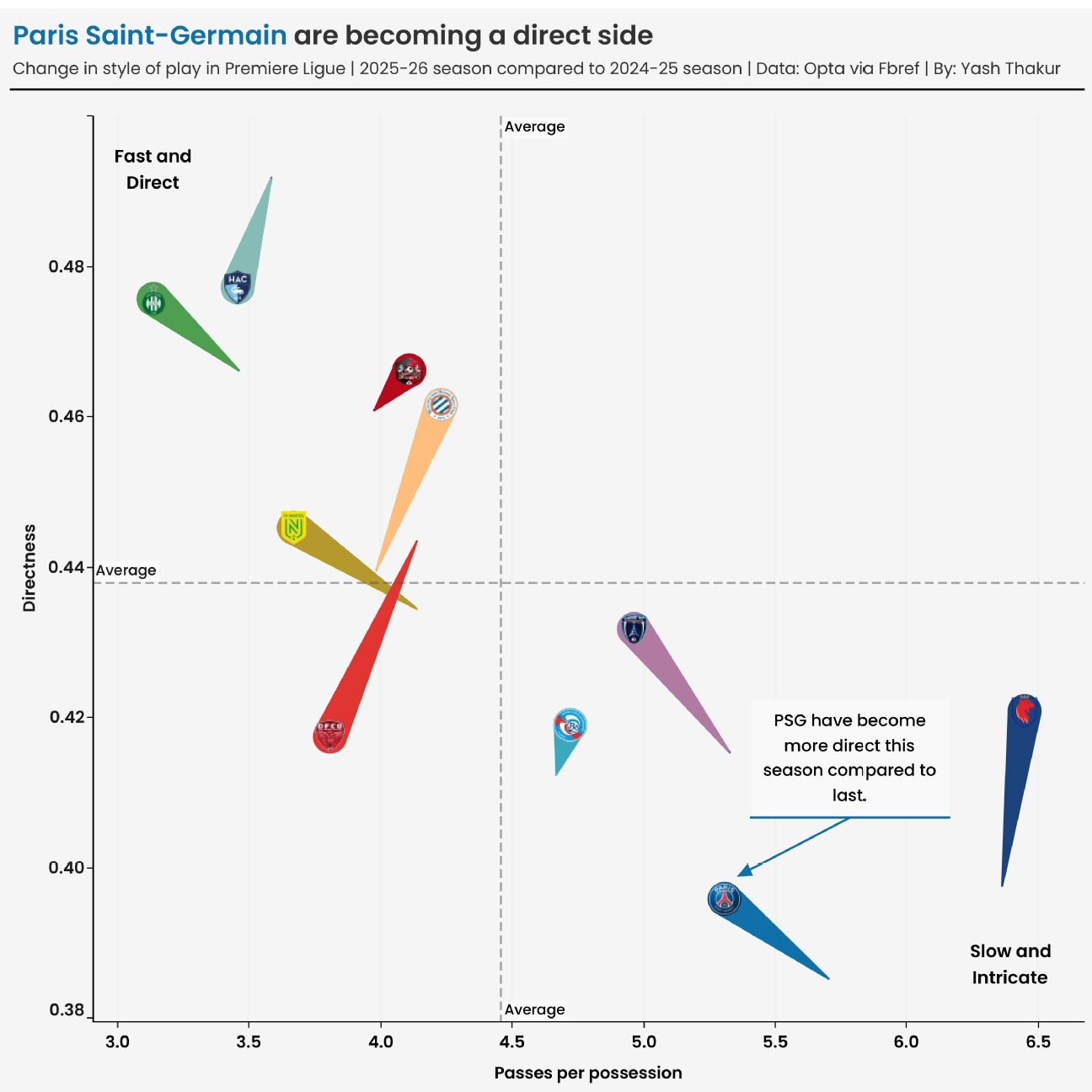
Leading clubs generally aim to control matches through possession, but with the acquisition of Ajibade, Jennifer Echegini, and Merveille Kanjinga in the past two seasons, PSG has shifted toward a more direct style of play under manager Paulo Parente.
The graphic above compares last season’s play style to this season, illustrating changes over the past year. A greater number of passes per possession indicates a preference for controlling play, while increased directness shows rapid vertical movement.
PSG’s passes-per-possession rate in the UWCL has significantly dropped, while rivals OL Lyonnes maintain a possession-focused strategy and have added verticality to their game under former Barcelona manager Jonathan Giráldez.
The drop in PSG’s possession quality is reflected in the statistics. Their possession percentage has decreased from 62% last season to 56% this year, and their pass completion rate fell from 82% to 78%, dropping below 80% in a single campaign for the first time in four years.
PSG has struggled to create possession sequences and maintain ball control during buildup play, forcing them to resort to a more direct approach. This shift is evident in their long-ball usage, which has increased from 12.6% in the 2024-25 season to 17% currently. Their average of 104 long balls per game this season marks a substantial rise from just 77 the previous year.
Defensive Vulnerabilities
The departure of talent has also negatively impacted PSG’s defense this season. While Parente’s squad has mostly held up well in domestic play (with six of their eight conceded goals coming from a 6-1 defeat to OL Lyonnes in September), they have struggled against potent offenses, conceding four goals to Wolfsburg and two to Real Madrid in the UWCL.
Until 2021, PSG’s defense was anchored by current Barcelona player Irene Paredes. The pairing with Paulina Dudek was crucial in limiting goals to just four in 22 matches on their way to the title.
While Dudek remains in the squad, injuries have affected her performance, resulting in a defense that is increasingly prone to errors in high-stakes games.
Former OL Lyonnes defender Mbock has also faced her own injury concerns. Meanwhile, the recent inclusion of Olga Carmona from Real Madrid was promising, but the left-back has struggled defensively this season. Additionally, forward Ajibade has been forced to fill in at right-back in several matches.
Current No. 1 goalkeeper Mary Earps has also faced difficulties, especially against tougher opponents. Across seven games this season, Earps has surrendered 14 goals and has appeared out of her depth at times. Her save percentage (53%) is the lowest in any of the last six seasons, and her ability to manage crosses has been subpar. With a cross-collection percentage of just 3.3%, she ranks among the league’s worst in that category, and opponents have capitalized on her hesitance to come off her line during critical matches.
The Euro 2022-winning goalkeeper will face her former club, Manchester United, this week, presenting a chance to break free from the cycle of struggles in the UWCL this season. However, with ongoing scrutiny following the release of her controversial book, the last thing PSG needs is additional off-field distractions during this challenging period.