



-

Jeff Kassouf
Multiple Authors
The nation that has long embodied the essence of soccer witnessed one of its most chaotic matches on Tuesday, one that will be remembered for Brazil’s antics and could serve as a pivotal moment for the United States women’s national team (USWNT).
In a tense encounter, Brazil received a total of eight red cards in a 1-0 defeat to the USWNT at Arena Castelão in Fortaleza, with two cards issued even after the final whistle, leading to police intervention as they surrounded the referees.
Prior to this match, the USWNT hadn’t triumphed against Brazil on home soil since 1997, a streak that included a 2-1 loss just three days earlier. However, the Americans broke that streak on Tuesday, showcasing the grit and resilience necessary for success in next year’s FIFA Women’s World Cup at the same venue.
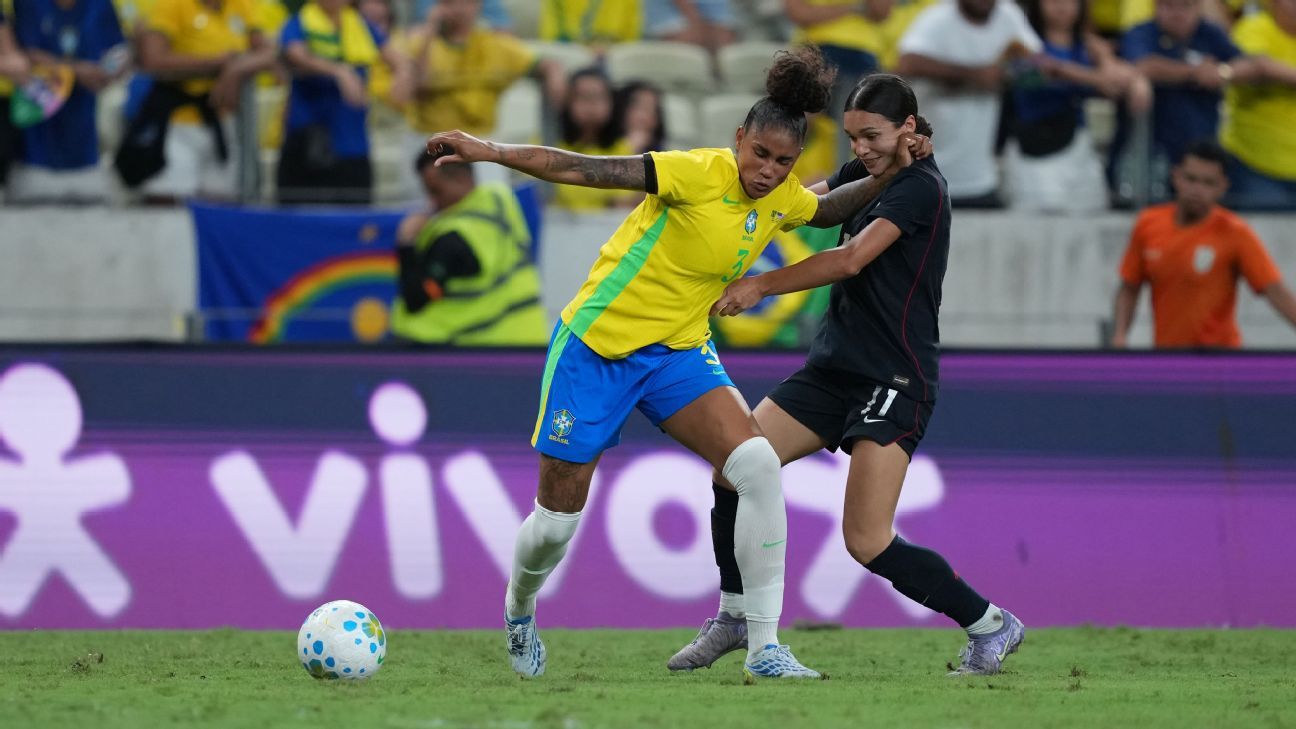
Tuesday’s match resembled a brawl more than a typical soccer game, a deliberate tactic from Brazil head coach Arthur Elias to play aggressively in front of a raucous crowd of 55,744. The USWNT responded with the fierce determination that head coach Emma Hayes had been looking for.
– The USWNT wanted a fight in Brazil, and World Cup prep will be better for it
– USWNT Big Board: How the 2027 World Cup team is taking shape
– Trinity Rodman on Triple Espresso: ‘Having my sisters back is amazing’
In the face of mounting pressure, Brazil imploded. Four coaches, including Elias, were sent off during the match, along with two players receiving red cards in regulation. Defender Tarciane retaliated against US forward Sophia Wilson in a fit of frustration. Following the final whistle, two more players were dismissed in a fracas.
The chaos on the field was unprecedented for the USWNT, whose matches are generally held at home with few road games, usually in Europe.
Hayes acknowledged the unique challenges posed by the Brazilian environment. Tuesday’s focus was on winning, even if it was an unsightly method. In their previous match on Saturday, the USWNT had struggled during the first half as Brazil applied pressure and tested the boundaries of what constituted a foul. The Americans made adjustments at halftime but were unable to find an equalizer.
To prepare for Brazil’s physicality, Hayes deployed a more robust lineup from the start. Midfielders Avery Patterson and Michelle Cooper began Tuesday’s match after having made a significant impact in the previous game as substitutes. Both played the full 90 minutes, with Cooper showcasing remarkable versatility as she transitioned from a winger in the first half to a fullback in the second.
The match’s only goal came in the 63rd minute, credited as an own goal after Wilson’s shot deflected sharply off Brazilian defender Isabela. This fluke was fitting for one of the most bizarre encounters between these two rivals—a match that harkened back memories of the infamous 2011 World Cup quarterfinal in Brazil.
Brazil goalkeeper Lorena thwarted attempts from Wilson and Trinity Rodman, denying both from close range. Olivia Moultrie struck the post, while Rose Lavelle missed a one-on-one opportunity. Additionally, Emma Sears saw herself denied from close range on two occasions by Lorena.
The USWNT’s lack of clinical finishing remains a concern moving forward. Their inability to capitalize on clear chances allowed Brazil to stay in contention, a team that was losing control of the match.
This two-match stint in Brazil was always designed to prepare the USWNT for hostile environments against skilled opponents who excel in the darker aspects of soccer. On Tuesday, the Americans met that challenge, exhibiting intensity without losing composure.
USWNT defender Emily Sonnett and Brazilian player Dudinha jostled off the ball right from the start, displaying the type of physical play Hayes had anticipated. Lavelle received a yellow card for a professional foul, halting a promising Brazilian attack—something that was needed but hadn’t occurred in their previous meeting. Center-back Kennedy Wesley, in a crucial starting role, successfully tackled every challenge she faced, along with Patterson who exhibited similar dominance.
As Brazil retaliated, the USWNT players largely maintained their composure. They participated in the game’s roughness when necessary, notably in late-game circumstances, like when Claire Hutton accepted a yellow card to prevent Lorena from launching a counterattack. There was a moment in the second half when Cooper appeared to inadvertently make contact with the knee of Taina Maranhão, a situation that some Brazilian players contested post-match.
In contrast to the USWNT’s discipline, Brazil fell apart. Elias was shown a yellow card in the first half for (allegedly) not changing his shirt, which matched too closely to the USWNT’s colors. He donned a white bib and playfully displayed it to the crowd, mocking the referee’s decisions.
Elias picked up a second yellow for kicking the ball away in the 77th minute. He then humorously tossed his bib onto an assistant referee. Two more Brazilian assistant coaches were dismissed around the same time, followed by a third shortly thereafter.
Brazil forward Bia Zaneratto, who had come on for an injured Dudinha, was sent off for a second yellow after pushing Sonnett in stoppage time. Sonnett, known for her assertiveness as a center-back, navigated the situation skillfully, refraining from retaliation.
The violent intent became clear when Tarciane deliberately left the ball in the penalty area to strike Wilson as Sears rushed toward goal. The significance of Tarciane’s actions mattered less than the evident intent behind them; Brazil’s grip on the match had completely unraveled.
While the literal victory was significant for the USWNT, it symbolizes their ongoing journey toward a fifth World Cup title next year—assuming they qualify, as Hayes frequently reminds. There may be few moral victories in elite sports, but this match was undoubtedly one for the Americans.
They emerged slightly more virtuous from a contest that descended into emotional turmoil, demonstrating their ability to adapt their winning strategy. Previous generations of USWNT players, fortified by the presence of icons like Abby Wambach or Michelle Akers, often endured tough matches.
This new generation, however, had yet to navigate such challenging conditions. Where Saturday’s setback against Brazil focused on embracing adversity, Tuesday’s triumph was about overcoming it. A blend of youthful talent, represented by players like Sears and Lily Yohannes, was matched with seasoned leadership from veterans like Sonnett and Lindsey Heaps. And they did so without key injured players, such as Sam Coffey, Naomi Girma, and forward Mallory Swanson, who did not play due to the match’s conditions.
The USWNT has the skill to win games while dominating possession, as evidenced in recent victories against a strong Japan team. They can also secure victories through a more direct approach. This adaptability was pivotal in winning the gold medal at the 2024 Olympics against Brazil.
Yet, to secure victory in the 2027 World Cup, they may need to repeat Tuesday’s grit-filled performance, especially against a Brazilian team that has historically impeded their progress at major tournaments.
This younger, less experienced USWNT has now proven they can handle the pressure of intense games. When faced with adversity in the future, they will be ready to confront it head-on.