



-

Jeff Kassouf
Multiple Authors
In recent years, several NWSL players have shown their frustration with referees, but Michelle Cooper‘s recent defiance towards league authority might not seem controversial at first: it involves her cleats.
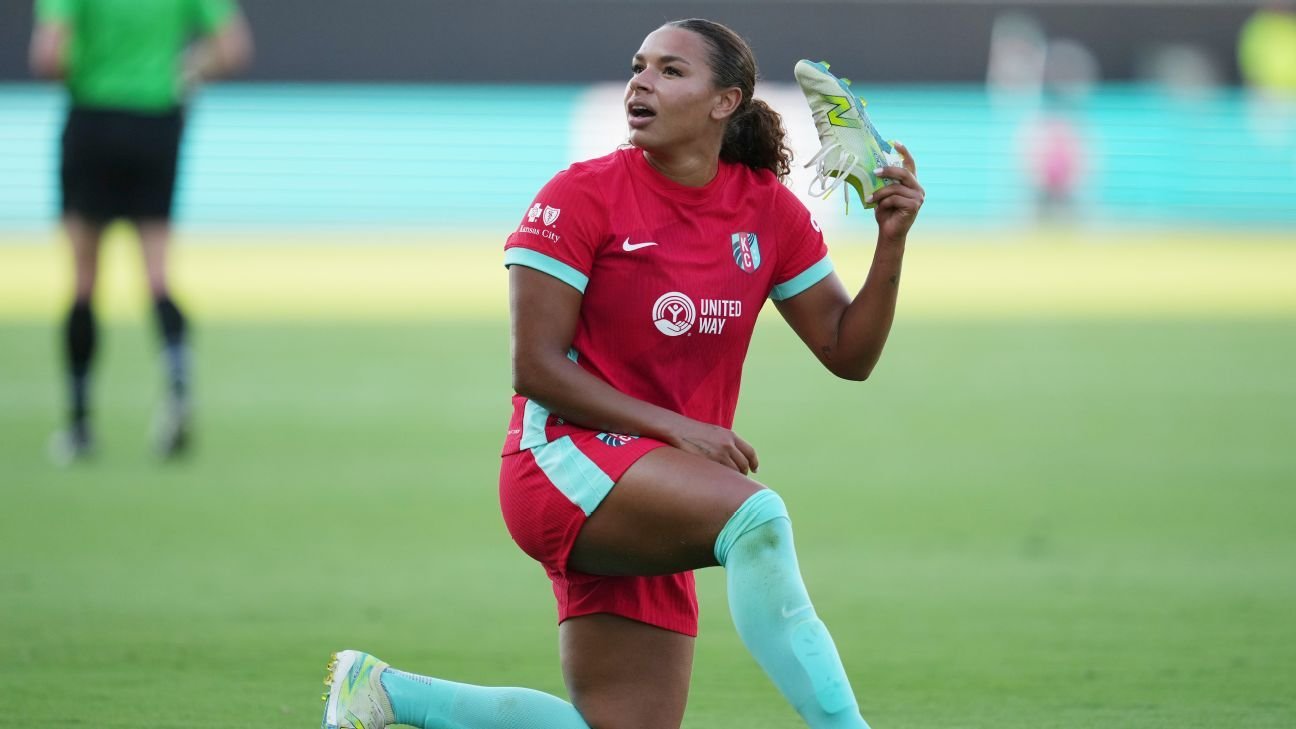
Cooper celebrated her game-winning goal in the Kansas City Current‘s nail-biting 3-2 victory over the North Carolina Courage by kneeling, removing her right boot, and holding it up for the audience to see. This wasn’t the first time this summer she drew attention to her New Balance footwear, highlighting a financial dispute off the field.
Cooper’s stance is central to the NWSL’s new footwear policy, which restricts which brands players can wear while playing. The league claims that this policy is designed to maximize commercial success, but for players like Cooper, it creates a hurdle for the personal sponsorship deals they have traditionally been free to negotiate.
Cooper has become a prominent figure in the public discourse around this policy. After scoring in July, she showcased her cleats again and, in early August, mocked the NWSL by sharing an email on Instagram from the league that warned her of potential disciplinary action for her choice of footwear, followed by a link for fans to purchase her preferred brand.
The NWSL now mandates that brands must pay not just the league, but also the players, to have their logos displayed on the field. Currently, New Balance, Cooper’s cleat sponsor, does not have such an agreement with the league.
If brands refuse to pay, their products cannot be displayed. Players who wear unauthorized brands must cover their logos, and those who fail to comply, like Cooper, face fines.
While footwear policies exist in other major American sports leagues, this concept is unfamiliar in global soccer. The greatest challenge arises from exceptions to the rule, particularly in cases like Cooper and New Balance, which already share a prior agreement.
Croix Bethune with the pass. Michelle Cooper with the finish 👌 pic.twitter.com/tK5iBe6HrZ
— National Women’s Soccer League (@NWSL) July 4, 2026
New Balance does not qualify as an “authorized” footwear supplier for the NWSL, which also affects smaller brands that focus on injury prevention but cannot afford the league’s six-figure fee for marketing rights.
This situation encapsulates the broader issues within the NWSL: the footwear policy aims to generate additional revenue in a fast-evolving league, yet, as seen with the “Rodman rule,” it has been met with resistance and skepticism from players.
How does the NWSL’s new sponsorship policy work?
Under the new footwear policy introduced this year, any brand outside of the league’s sponsor Nike must make a qualifying payment to the league, rumored to be at least $100,000. Additionally, they must pay each sponsored player a minimum of $5,000 to wear their brand in official NWSL competitions.
An NWSL spokesperson did not confirm the required payment but stated that entry fees are based on a sliding scale determined by how many athletes the brand sponsors. The $5,000 per player minimum remains consistent across brands and applies to goalkeeper gloves as well.
As of late August, only Adidas and Puma have formalized their agreements, joining Nike as authorized footwear providers. The NWSL has reportedly held positive discussions with New Balance, although the latter has yet to respond to requests for comments.
The league first presented a draft of this policy to brands in March with plans for it to start soon after, but multiple sources indicated that the launch date kept changing, leading to confusion among players and brands alike.
The NWSL argues that it has established itself as a commercial powerhouse that offers brands considerable visibility, hence the need for compensation. By entering into this “authorized footwear supplier” agreement, brands can use the imagery and branding of teams and the league to promote their players.
For instance, if Cooper wins the MVP award, New Balance could leverage her imagery in their marketing campaigns, provided they signed up for the agreement.
Should a player opt to wear unapproved footwear during a game, they will need to conceal the manufacturer’s logo, confirmed by an NWSL representative. Violators will receive warnings leading to escalating fines for repeat offenses, confirmed to start at $500 and doubling for subsequent violations.
So far, no fines have been imposed, as there is an open grievance filed by the NWSL Players Association concerning the enforcement of this policy, especially regarding existing sponsorships like Cooper’s deal with New Balance.
As an additional complication, even if a player dons an approved brand, they must still secure individual payments as per the exposure agreement for the footwear to comply, unless the cleats are Nike.
This means that if a player wears Adidas but isn’t receiving the minimum $5,000 payment from the brand, they would also face penalties for not covering the logos. Nike, as the league’s primary sponsor since its inception in 2013, will provide additional boots for unsponsored players, enhancing value for clubs.
Players and brands caught in the middle
Professional players shifting to the NWSL from other leagues can retain their existing boot contracts until their term ends, according to league officials.
However, this provision does not extend to current NWSL players with deals from “unauthorized” brands. Moreover, NIL arrangements signed by college players are also excluded. Cooper’s partnership with New Balance began after she earned the prestigious MAC Hermann Trophy as the best college soccer player at Duke and was selected second overall in the 2023 NWSL Draft by Kansas City.
Innovation-focused brands aiming to create footwear that reduces injuries could be forced out due to this new policy.
Jack Rasmussen, founder of Caddix, highlighted that the league’s $100,000 requirement severely affects his business. Kansas City Current defender Kayla Sharples was the first NWSL player to wear Caddix boots, which feature patented studs to minimize knee injury risks.
To comply with the league’s policy, Rasmussen opted to pay Sharples the $5,000 player fee, which led to her receiving a fine for wearing Caddix.
The women’s gear brand IDA has partnerships with four NWSL players and is negotiating with several others, as shared by chief operating officer Rachel LaSala. IDA co-founder Laura Youngson noted players have sought them out but typically ask first if they are permitted to wear IDA in games.
IDA conducted a survey among players, yielding mixed reactions where some wished to contest the policy, while others preferred to avoid drawing attention.
Both Caddix and IDA have seen success recently due to their research-driven approaches in sports gear design.
Caddix has gained traction among NFL players who are voluntarily switching to the brand because of its innovative pivoting studs. IDA has entered mainstream retail and secured investments, including from NWSL owner Michelle Kang, by focusing on cleats specifically designed for women. Historically, female players have struggled to find suitable footwear and often settled for men’s options.
“Everyone else is playing by the rules, but I don’t believe those rules are worth following,” Rasmussen shared. “It’s creating discord between players and the league. My support is with the players.”
Notably, some NFL players wearing Caddix, including Bengals quarterback Joe Flacco, have offered to cover Sharples’ fines incurred.
With a global sports footwear market exceeding $100 billion, numerous brands can afford the NWSL’s new fees. The league anticipates significant revenue from footwear brands.
An NWSL spokesperson issued the following statement:
“The NWSL’s footwear exposure framework acknowledges the substantial value our players and competition generate. It provides a clear pathway for brands seeking visibility through the league, establishing minimum compensation standards for sponsored players, delivering additional product support for players without individual sponsorships, and creating expanded marketing opportunities for brands and athletes.”
“As the league progresses, this structure ensures that brands benefiting from exposure through our players are making meaningful investments in both athletes and the league. Players may wear any brand’s footwear, but logos from brands not participating in the framework must be concealed during matches.”
An unusual concept in soccer
Requiring brands to pay for “authorized footwear” is a concept more common in American sports leagues. The NFL and NBA have enforced rules regarding footwear colors and brands, only relaxing restrictions over the last decade.
Conversely, in global soccer, players usually have the autonomy to choose their footwear. Some have endorsement deals, while others opt to buy their own cleats.
An NWSL representative noted that although the existing standard player agreement has historically required approved footwear, the league now feels equipped to enforce this policy.
The current standard player agreements stipulate:
“Players shall not display or endorse logos on any on-field equipment not produced by the Team’s Official Equipment Supplier, excluding goalkeeper gloves and footwear, which may show logos of official League suppliers.”
The NWSL modeled its shoe policy after that of the WNBA, which also mandates the same $5,000 payment from brands to players.
In recent years, NWSL team values and sponsorship revenues have surged, leading to increased player salaries and attendance. However, the WNBA, being twice as established as the NWSL, draws larger peak TV audiences and inherently features more footage focused on footwear than soccer, which is played on larger fields.
Key concerns from brand representatives and player agents have centered around communication related to the policy. Many feel its introduction lacked clarity and preparation time for brands, especially those with predetermined marketing budgets. (An NWSL spokesperson insisted talks with the NWSLPA started in 2024.)
The policy’s starting date shifted from March to the summer, resulting in ongoing ambiguity in how to manage situations like Cooper’s—an elite NWSL player with a long-standing endorsement agreement.
While many stakeholders seem to accept the rule’s general framework, they desire more clarity before implementing such policies rather than facing confusion afterward.
In the interim, players like Cooper may continue to don “unauthorized” cleats, inadvertently drawing more attention to brands that haven’t signed the NWSL’s new sponsorship agreements.