



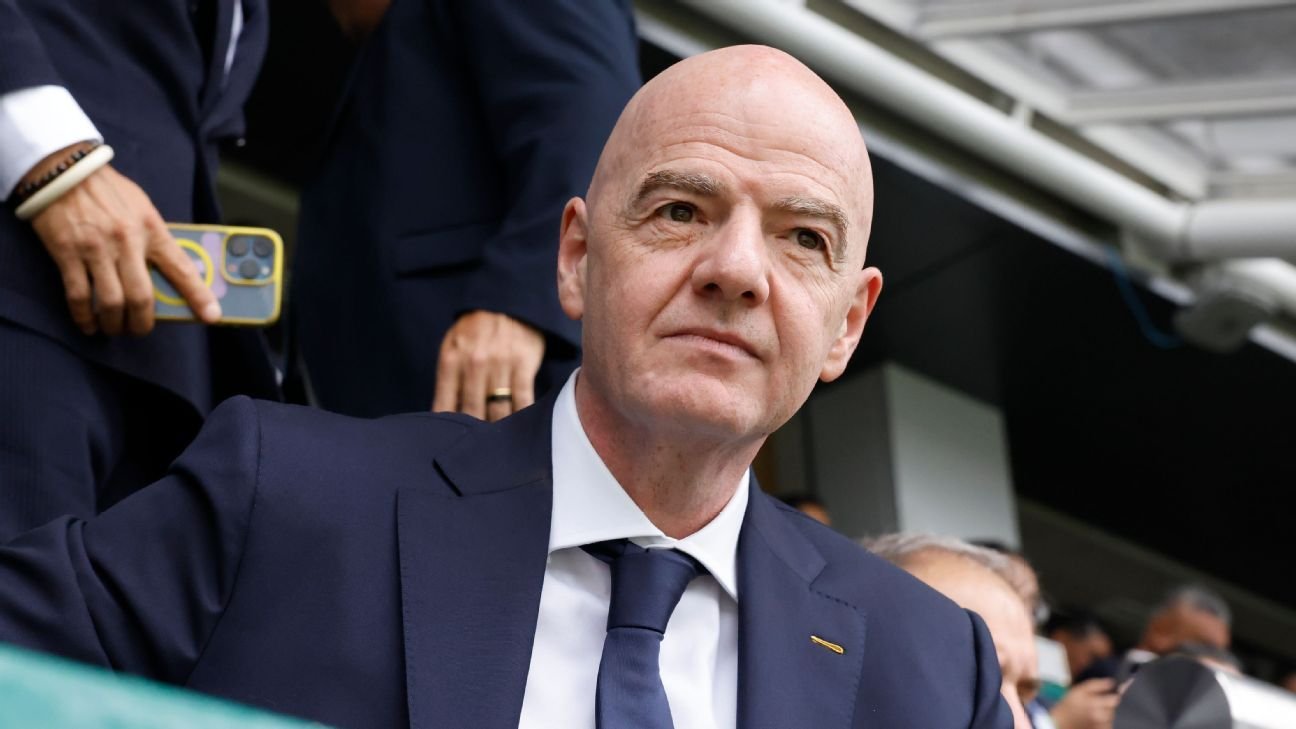
Gianni Infantino is facing significant challenges in his role as FIFA president, and he may have already encountered an unexpected setback.
Following a week of poor judgments regarding his authority and influence in global soccer, Infantino’s efforts to sell a stake in future World Cups were abandoned on Friday, which now puts his reelection efforts for 2027 in jeopardy. Charting his progress in soccer terms, Infantino initially led 3-0 at the end of regulation, but a series of hasty choices have erased his advantage, leaving him vulnerable to a potential loss.
How likely is it that Infantino, 56, will be ousted or compelled to resign? Will his decision to retract his controversial plans be recognized as a move to save his position, or will it be perceived as a sign of weakness that ultimately leads to his departure?
There exists a process that could pave the way for his removal a decade after he succeeded the disgraced Sepp Blatter, but challenging Infantino is far from straightforward. It would take 43 member nations to initiate a vote of no confidence against him, but his adversaries also require a viable alternative candidate, which has yet to materialize. A deadline of November 18 looms for any challenger to declare their candidacy before the FIFA Congress vote in Rabat, Morocco, on March 18 next year.
Infantino previously believed he had ample support to ensure his reelection, but this week has drastically changed the landscape. His ego and hubris have placed him in a precarious position, making the possibility of his downfall seem increasingly tangible.
His plan to expedite a $20 billion equity sale in a newly formed FIFA entity, FIFA Forward Enterprise (FFE), to an investment firm linked to Joshua Kushner, brother of Jared Kushner (U.S. President Donald Trump’s son-in-law), has faced widespread backlash. This is in spite of a pitch that promised an immediate $20 million payout to each of FIFA’s 211 member associations, along with an additional $66 million by 2037 if approved by a majority of nations.
The UEFA, Concacaf, and AFC confederations have all rejected the proposal, representing a combined 143 member associations against it. With Infantino needing 106 votes for the proposal to succeed, and only 68 votes left in Africa, South America, and Oceania, the initiative is effectively dead.
However, it has escalated beyond mere numbers.
UEFA has confirmed that all 55 nations in Europe, including reigning champions Spain, will boycott every FIFA tournament unless the proposal is withdrawn, eliminating any chance of the plan advancing. A World Cup without key teams like Spain, Germany, England, and France would not attract the interest of those billionaires seeking to invest in the tournament.
Furthermore, two senior FIFA executives have publicly opposed Infantino’s unilateral push for his plan, with former U.S. Soccer president Carlos Cordeiro resigning in protest and COO Kevin Lamour expressing that staff felt misled regarding the private investor scheme. The rapid loss of Infantino’s authority is becoming increasingly apparent.
Nonetheless, Infantino has powerful allies. He has established close ties with Trump, the Qatari royal family, and Saudi Crown Prince Mohammed bin Salman. As long as these relationships endure, it would be unwise to completely dismiss him. However, influential leaders often sever ties with those who can no longer fulfill their purposes; if Infantino’s plan truly collapses, he may find those high-profile connections faltering, emboldening his opponents within the soccer community.
Critics of Infantino see a leader desperately clinging to dwindling power, primarily due to his many missteps. While he has dramatically increased FIFA’s revenues since 2016, he has simultaneously brought embarrassment and ridicule upon the organization.
Infantino has faced condemnation for awarding Saudi Arabia the hosting rights for the 2034 men’s World Cup without an appropriate bidding process. He has been mocked for ensuring Inter Miami participated in the inaugural FIFA Club World Cup last summer, leveraging Lionel Messi’s involvement to drive viewership. His autocratic style reached new lows before and during the 2026 World Cup.
This began with his unilateral decision to create the FIFA Peace Prize, awarded to Trump in December. In July, Trump openly admitted to calling Infantino to intervene in a decision that affected U.S. player Folarin Balogun’s participation in the knockout stage against Belgium.
Infantino’s increasingly sycophantic tendencies among global leaders and celebrities during the World Cup have further aggravated fans and fellow soccer officials alike.
Now, Infantino is combating multiple challenges: the scrapped sell-off plan, his efforts to expand the World Cup to 64 teams, friction with UEFA, and ultimately his struggle to retain the FIFA presidency.
As Infantino increasingly loses allies and inspires more opposition, his attempt to capitalize on the World Cup’s success may prove to be the blunder that leads to his exit from power and the world of soccer.