



-

Ryan O’Hanlon
Having reached the unofficial halfway point of the Premier League season, we’ve taken a moment to reflect on the past.
Last week, I presented my award winners for the first part of the season, including the best goals, standout players, promising young talent, and top coaches. It wasn’t just a predictive exercise; I focused on what has already transpired.
But what lies ahead in the final 17 matches of the Premier League season? Who will capture the title? Who faces relegation? Who will secure European competition for next season? I will answer these questions, along with some others that might not be on anyone’s radar. For instance, who will finish 11th? Will Brighton or Fulham finish higher?
Here’s my forecast for the Premier League table when the season concludes on May 24:
– End-of-season award predictions
– Grading January transfers: Major moves assessed
– Premier League parity: Are we seeing strong teams or weak ones?
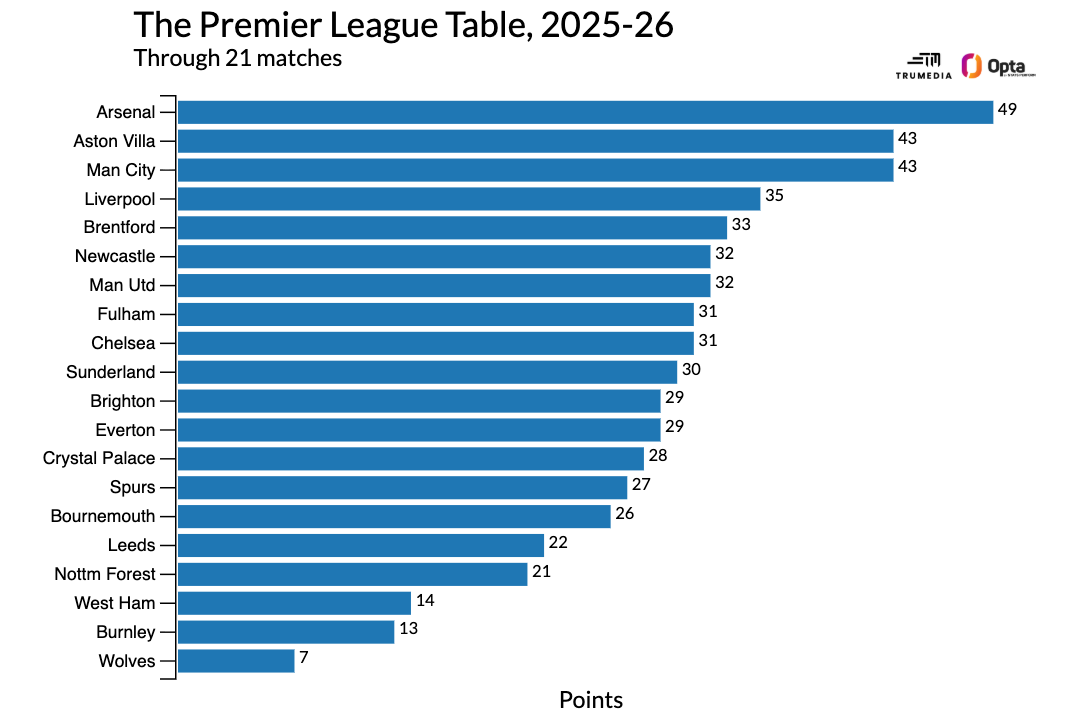
The current standings highlight how teams are ranked by their points accrued so far:
Next, here’s how the standings look based on our leading predictive metric, non-penalty expected goal differential, suggesting how teams may perform moving forward:
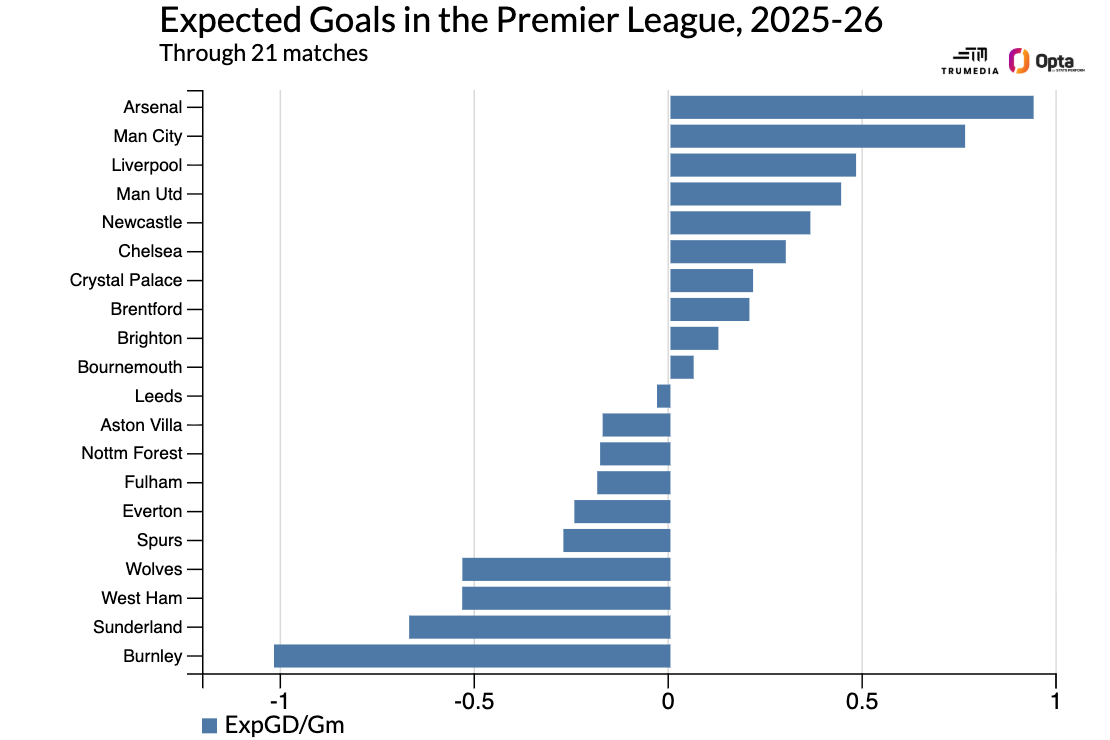
Mikel Arteta’s squad currently leads the league and is seen as the most likely to earn the most points in the concluding 17 matches, boasting around an 80% probability of clinching their first title since 2003.
As shown above, the league’s second-best side also holds the second-most points, indicating that finishing in second is a strong possibility for them.
To challenge Arsenal, City will need either a scoring spree from Erling Haaland or a revival of Rodri as he regains fitness and match rhythm.
Aston Villa appears poised for a downturn after their initial strong start. Their non-penalty expected goals (xG) differential indicates they may not be as robust as their points suggest, akin to Leeds and closely mirroring Nottingham Forest. I expect Villa to finish third but believe another team may edge them out.
Enter Liverpool.
This season has been peculiar for them. After a major outlay on new attacking talent, their matches now often feature less excitement, relying on possession rather than explosive offense. Their recent goalless draws against Arsenal and Leeds highlight this trend.
Defensively, Liverpool has performed well:
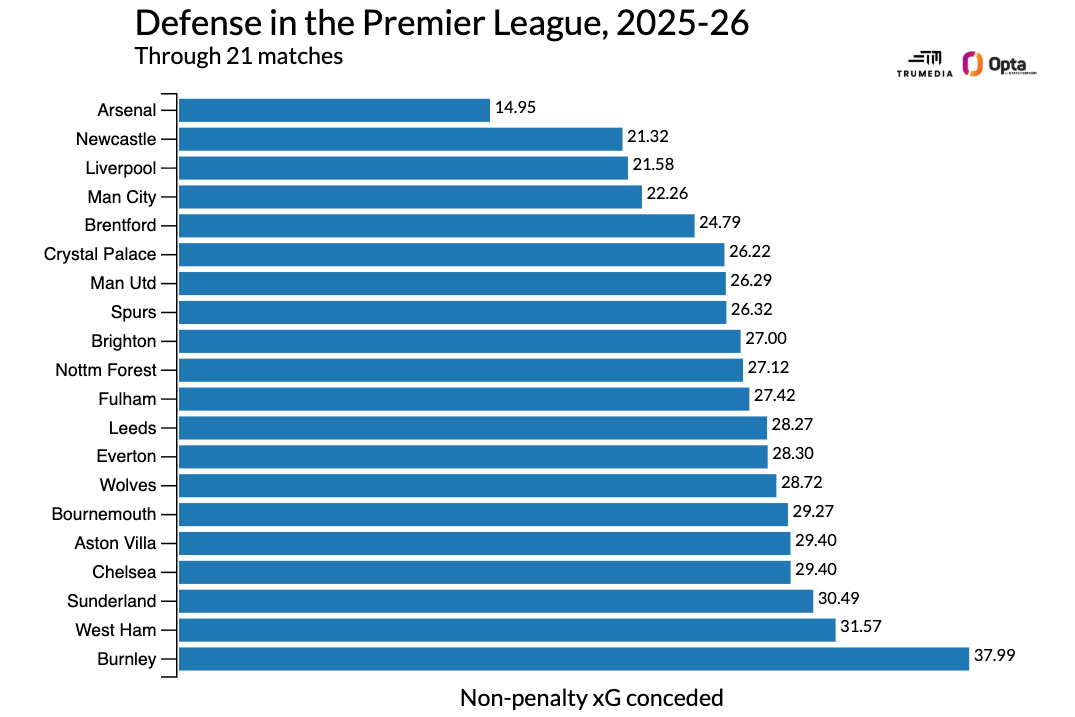
However, they rank fifth in non-penalty xG generated. With players like Alexander Isak out injured and Mohamed Salah occupied with the Africa Cup of Nations, their offense is hampered. Yet with the return of players and the emergence of others like Florian Wirtz, there is hope for an attacking resurgence.
If Liverpool can find their rhythm, they should ascend the league standings.
Simon Tinsley’s projections on Analytic Footy give Arsenal, Man City, Aston Villa, and Liverpool each an 89% chance or higher of finishing in the top five, making it likely the Premier League will secure an additional Champions League spot for next year.
That said, the battle between 5th and 10th places is tight, with only three points separating them. Tinsley’s data suggests seven teams have varying chances of finishing in the top five, ranging from 29% to 5%.
The competition promises to get exciting. I predict the tussle for fifth place will mostly involve Newcastle, Chelsea, Manchester United, and Brentford as they contend for the remaining European spot.
Despite new managerial changes, both Chelsea and Manchester United have performed decently this season. Chelsea possesses the third-best goal differential, while United displays a top-four xG differential. However, the recent managerial transitions introduce uncertainty that could negatively impact their performance. Employing a 41-year-old in his first Premier League job could suggest a long-term strategy rather than immediate improvement.
United built their squad around Ruben Amorim’s preferences, and just as they were hitting their stride, they parted ways with him due to internal conflicts. It’s uncertain if a new permanent manager will come in before summer.
If Amorim had remained, I might have anticipated one of these two clubs finishing in the top five, but their current situations warrant skepticism.
Brentford enjoys the advantage of being fifth currently without European commitments. They have successfully integrated attacking players following the exits of Yoane Wissa and Bryan Mbeumo. Yet, I’m concerned about the sustainability of a strategy that results in having only 43% possession in the final third—the fourth-lowest in the league.
So, I’m leaning towards Newcastle, a team that has been on an upward trajectory since Eddie Howe took charge and Saudi Arabia’s Public Investment Fund acquired the club. They have tough away fixtures left, but they can claim a stronger position with key players returning to fitness. Unlike Chelsea and United, we know their competitive style under their current leadership, and unlike Brentford, they’ve demonstrated top-five potential before.
Though Newcastle is a mere four points away from fifth place and possesses promising young talent, their performances this season have averaged out to league mediocrity.
I regret not including Marco Silva in last week’s “Managers of the Season” discussion from my previous column. Despite an aging squad and losing talent, he keeps the team clear of relegation threats.
The bottom of the table has seen challenges, particularly for Crystal Palace, who are struggling to manage both their European ambitions and Premier League commitments due to a thin squad. Additionally, I question the sustainability of their playing style.
This chart compares team aggression in pressing, measured by PPDA (passes per defensive action), to their pace of play:
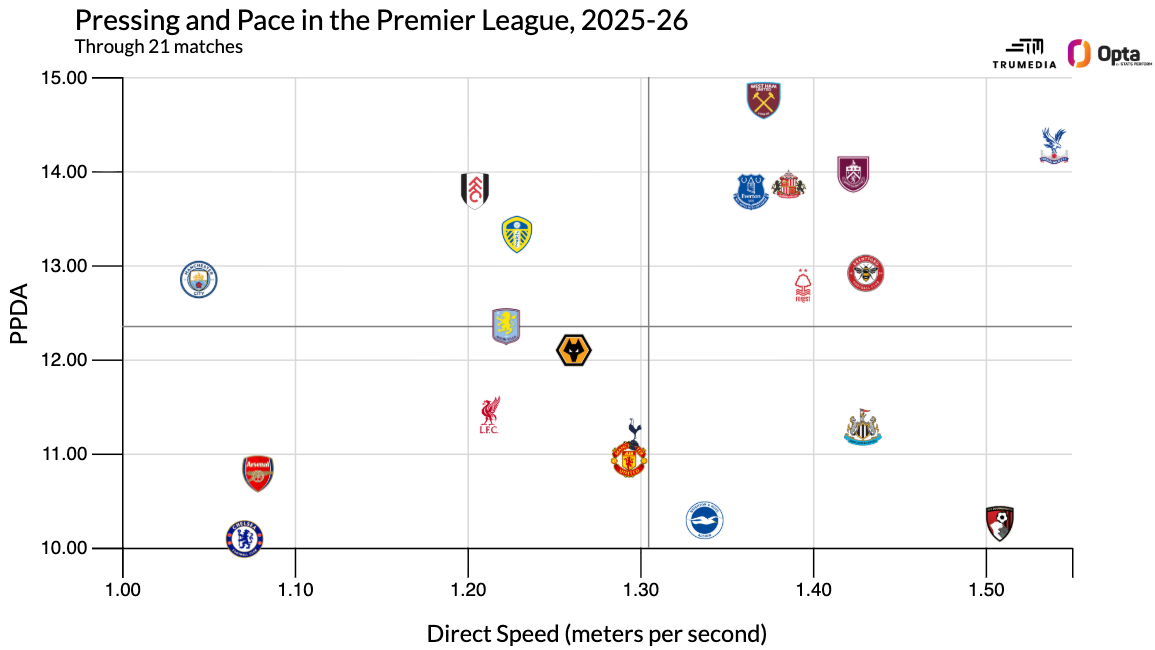
Teams in the bottom left are slow movers who press. The top left has slow movements and no press; bottom right signifies pressing with pace, while the top right showcases quick movement without pressing.
Oliver Glasner’s Palace plays the fastest but doesn’t pressure opponents effectively, making it hard for them to achieve Champions or Europa League qualifying standards consistently.
By studying that chart, it’s evident that Andoni Iraola could fit a larger club better than Glasner. While Bournemouth’s chaotic style may not be suited for giants like Liverpool or Manchester United, Iraola successfully fosters high pressure on opposing teams when necessary.
Bournemouth may be positioned unfavorably on the table, but losing key defenders and a crucial midfielder while still maintaining a positive xG differential further confirms Iraola’s capabilities as a manager.
What unfolds when you lose Harry Kane and Son Heung-Min, struggle to find replacements, and hire a manager with a reputation for high offensive output? You get a talented team that struggles to generate scoring opportunities, producing the fourth-fewest non-penalty expected goals in the league.
While Thomas Frank’s emphasis on set-pieces keeps Tottenham afloat, their alarming fourth-worst xG differential signals deeper issues, deviating from what they were under Ange Postecoglou or any previous coach since 2010.
Despite being only four points from the top four, Tottenham has exciting attacking players but has yet to form a cohesive and effective attack.
Sunderland could experience the most significant drop off. They could win their upcoming match against Crystal Palace and find themselves tied for fifth next week, but they’ve only netted 21 goals—bettered only by Wolves. Despite conceding 22—only better than Arsenal and Man City—their outcomes seem surprising given 314 shots allowed (third-most) and 674 defensive touches in their box (the highest).
There seems to be little expectation for improvement in their offense while the defense could worsen significantly.
Leeds, meanwhile, has outperformed teams like Aston Villa, Fulham, Tottenham, and Sunderland in expected goal differential.
While soccer isn’t entirely about outdoing opponents in quality chances created, it constitutes a significant part of success—around 75%. Leeds have done well in this aspect, so I anticipate they’ll earn more points than Sunderland in the upcoming matches.
Here are Forest’s xG differentials under each manager this season:
• Nuno Espirito Santo: minus-0.51
• Ange Postecoglou: minus-0.82
• Sean Dyche: plus-0.02
We must laud the Dyche Effect.
Although I don’t place Forest or Leeds among the league’s bottom three, I view West Ham as one of the weaker teams this season, making it hard to foresee a tight relegation battle with West Ham trailing Forest by seven points and Leeds by eight.
Wolves have performed decently in away matches against teams like Liverpool and Arsenal recently, but they are doomed with only seven points from 21 matches—yet they’re a better team than their season’s output suggests.
Burnley, however, stands out as one of the poorest teams in Premier League history. They generate the fewest attempts in the league and allow the highest number of shots.
There’s nothing distinctive about their approach, no strategies that might help them yield better results. They simply face a barrage of chances each game, hoping for a favorable outcome.
By season’s end, I believe Wolves will surpass them in a race where both will ultimately struggle.