



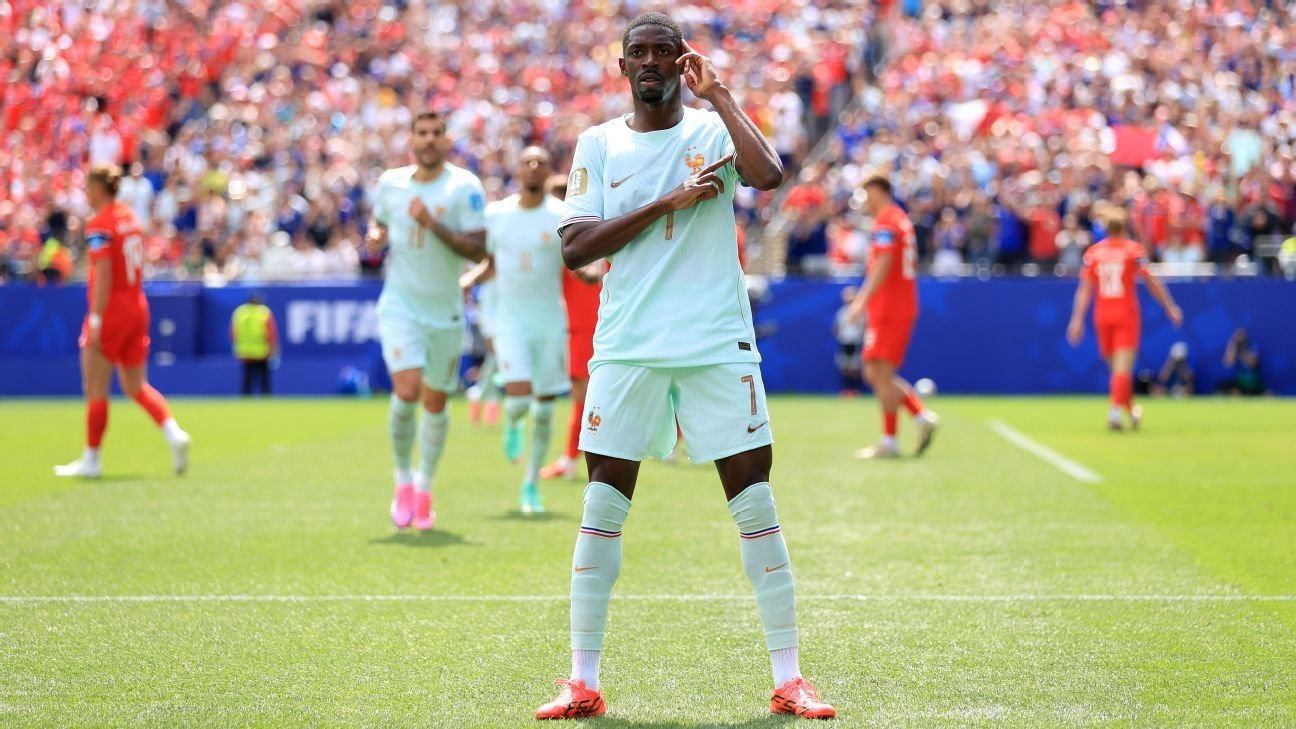
BOSTON — Scoring a hat trick in a World Cup is a rare achievement; in fact, many players never manage to do it in their entire careers.
Notable legends like Diego Maradona and the original Ronaldo (R9) never achieved this feat. Neither did Neymar, Thierry Henry, or Johan Cruyff. In the history of French football, only Just Fontaine in 1958 and Kylian Mbappé in 2022 had previously managed to score three goals in a World Cup match.
Even achieving a brace for France had eluded Ousmane Dembélé in his 61 appearances until last Friday. His hat trick in France’s 4-1 victory over Norway, accomplished in just 25 minutes (the second-fastest in World Cup history), changed everything.
This performance dramatically altered Dembélé’s trajectory for the 2026 World Cup, reshaping his narrative with the national team and enhancing his momentum as France preps to face Sweden on Tuesday in New Jersey during the round of 32.
Before the match against Norway, discussions surrounding France primarily centered on the chemistry between Mbappé and Michael Olise. Dembélé, the third member of this formidable French attack, found himself in negative conversations at home.
What issues plagued the PSG forward? Why couldn’t France replicate the form he showed at Paris Saint-Germain? Which position would suit him best? How could he be maximized? Many of these discussions overlooked that he is the defending Ballon d’Or holder, arguably the best player in the world, a two-time Champions League winner, and has undergone a significant transformation over the last three years under Luis Enrique in Paris.
Despite being a central figure in the squad, Dembélé had often appeared sluggish in the France jersey, showing flashes of brilliance but not consistently. Before the Iraq game (a 3-0 win) a few days earlier, where he scored one and assisted another, Dembélé had never made a decisive impact in a major tournament (Euros or World Cup) nearly a decade after his debut for les Bleus. It remained a mystery why the forward, so effective at club level, struggled to replicate that form internationally.
– World Cup match schedule: All fixtures, results, features
– Bracket Overreactions: Is the USA’s path too easy?
– Marcotti: Best XI of the World Cup group stage
Internally, Dembélé remained unfazed. He continued to be a leader within the group, embodying the heart and soul of the team. However, on the field, he appeared to struggle, often overshadowed by Mbappé and Olise. While he assured his entourage that a breakthrough was imminent, he began to feel some frustration from the criticism he faced from the French media. Normally indifferent to public opinion, this time he felt the sting.
Following his first goal against Norway, he celebrated in a manner aimed at silencing his critics, making a gesture with his right hand reminiscent of shutting someone up.
This isn’t the first instance of a French player using a goal celebration to respond to criticism; Christophe Dugarry did so at the 1998 World Cup, and Samir Nasri at the 2012 Euros. While the circumstances were far more severe for them than for Dembélé, the PSG winger still felt the impact of the discourse surrounding him.
After the match against Norway, as he got the match ball signed by his teammates, who welcomed him back to the dressing room with shouts of “MVP, MVP, MVP,” he was tasked with addressing the media as the player of the match. His response? To repeat the same answer to six different questions.
“We have to stay focused!” Dembélé was not in the mindset to provide engaging sound bites for the media.
In a bid to further assert himself, he claimed he “preferred his performance against Senegal,” a match where he didn’t score. He had always believed, and Deschamps concurred, that his contribution to Les Bleus was more comprehensive than just goals or assists; it encompassed his overall involvement. For former France defender Samuel Umtiti, who was a champion alongside Dembélé in 2018, there was no question about it.
“He will never perform for France the same way he does for PSG. The teams have different styles and he occupies distinct roles in both,” he explained to ESPN.
Some fans called for Deschamps to center the team around “Dembouz,” but it was clear that the coach’s strategy wouldn’t shift dramatically. His main aim was to instill confidence in his No. 7 so he could play freely and showcase his full potential.
Deschamps and Dembélé engaged in several private discussions about this. After initially trying to utilize Dembélé in a more central No. 10 role against Senegal, where he struggled, the coach switched him back to the right wing, where he excelled against Iraq and performed brilliantly against Norway. Following Dembélé’s display against Iraq, Deschamps expressed his support.
“Maybe you’ll find someone else to criticize now,” he quipped to reporters. “There haven’t been any issues with him; he’s simply adapting to a system he’s not accustomed to playing in the rest of the year. Once he’s physically in good shape, it’s just a matter of making necessary adjustments.”
It appears the adjustments have paid off, as Dembélé has finally made his mark for France. If the Scandinavian teams can challenge him, Swedish defenders ought to prepare for a daunting encounter on Tuesday.