



-

Emily Keogh
Germany faced their familiar challenge once again: a lack of finishing in the decisive moments of the match.
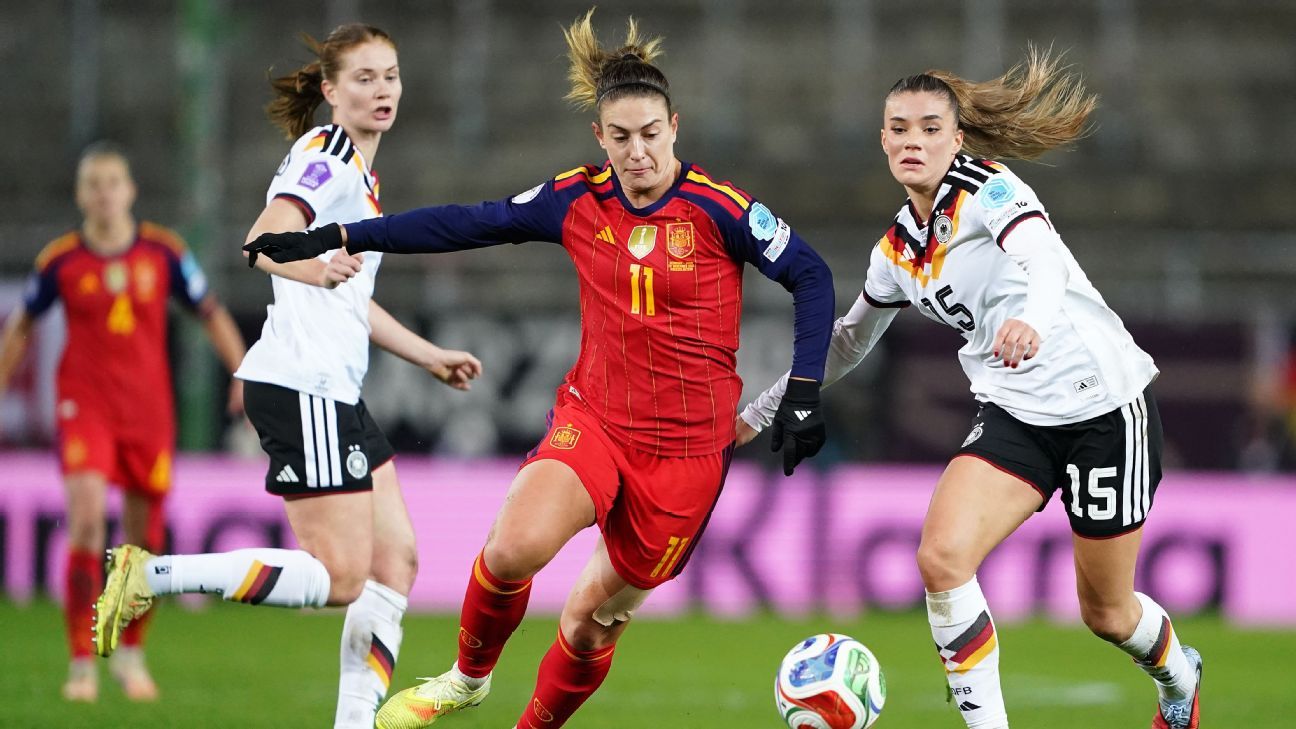
Despite statistically outperforming Spain in the first leg of the UEFA Women’s Nations League final, their failure to convert several promising opportunities resulted in a frustrating 0-0 draw, leaving the tie wide open for the second leg.
Typically, a goalless draw against the reigning world champions might be seen as a positive outcome. However, Germany will be acutely aware that they squandered a crucial opportunity to take a lead into the return match.
– Why Spurs’ record transfer Gaupset is considered one of the top U21 talents
– UWCL talking points: Evaluating Chelsea’s title prospects and PSG’s decline
– Carpenter’s pivotal role for Chelsea against Barcelona in UWCL
This persistent issue of goal-scoring inefficiency has been a thorn in Germany’s side before, especially noted during last summer’s Euros, particularly in their quarterfinal against France and the semifinal against Spain. However, the sting of missed opportunities felt more acute in this match.
Germany executed near-flawless tactics throughout the game, generating numerous scoring opportunities and putting Spain on the defensive, while goalkeeper Ann-Katrin Berger was hardly troubled. Yet the one element they desperately needed—a goal—eluded them.
The first half was particularly frustrating. Young fullback Franziska Kett made a penetrative run but opted to go solo, allowing Spain’s defense to comfortably thwart the attempt. Another chance from Jule Brand was saved off the line by Irene Paredes. A shaky moment from goalkeeper Cata Coll on a corner kick from Rebecca Knaak was fortunately recovered just in time.
With Lea Schüller missing for personal reasons, the goal-scoring responsibilities shifted to Nicole Anyomi of Eintracht Frankfurt, who has yet to find her stride under coach Christian Wück. Both Anyomi and Klara Bühl found themselves in key positions repeatedly, yet neither could finish the chances needed to break through. Bühl, in particular, didn’t manage to get a shot in until the 70th minute, and when she finally did, the woodwork denied her, echoing a similar fate for Spain’s Esther González moments earlier.
Selina Cerci struggled throughout the match, her long-range attempt lacking precision, reflecting the overall frustration of the team. As the match drew to a close, Germany intensified their efforts, with opportunities from Bühl and Kett illustrating their dominance in possession and pace.
Two agonizingly close opportunities by Sjoeke Nüsken and substitute Shekiera Martinez almost broke the deadlock. Still, Germany’s precision issues in the attacking third meant they ultimately had to settle for a frustrating draw, despite a commanding overall performance.
Once a dominant force in European soccer, with 11 titles including two World Cups and seven (eight if you count West Germany’s victory in 1989) Euros, Germany has not lifted a trophy in ten years since their success at the 2016 Olympics.
A decade is a long time between titles, and Germany’s chances of reclaiming glory are hampered by their ongoing struggles to capitalize on scoring opportunities in critical moments.
Such issues seem to be magnified in high-stakes games. In their Nations League journey, Germany scored 29 goals in total, with 26 coming from the six group-stage matches, including two 10-1 routs against Scotland and Austria, and a solid 6-2 against the Netherlands. Over 15 matches, they’ve found the net 35 times.
This draw follows an announcement by the German Football Federation (DFB) about a historic €100 million investment over eight years, beginning in 2026, aimed at professionalizing the Women’s Bundesliga, which is expected to bolster the competitiveness of the national team.
Part of the FF27 Strategy Goals (set for 2027) includes the objective of winning international titles with the national squad. As they focus on achieving results in this Nations League final and the upcoming 2027 World Cup, the DFB’s priorities must center on these pivotal matches.
Germany can draw morale from their ability to neutralize Spain, but their goal-scoring woes expose them to risks against a side that is expected to be more aggressive and accurate in Madrid.
Creating 15 scoring opportunities is impressive against the world champions, with nearly half on target—but it is unlikely that Germany will replicate this level of offensive production in the second leg. Wück and his players may find themselves regretting this tactical inefficiency after the return match next week.
Nonetheless, hope remains. By refining their execution in the attacking third, Germany stands a strong chance to secure their first major title since 2016.
If they aspire to end their decade-long trophy drought, they must be far more ruthless in front of goal when the matchup resumes in Madrid.