



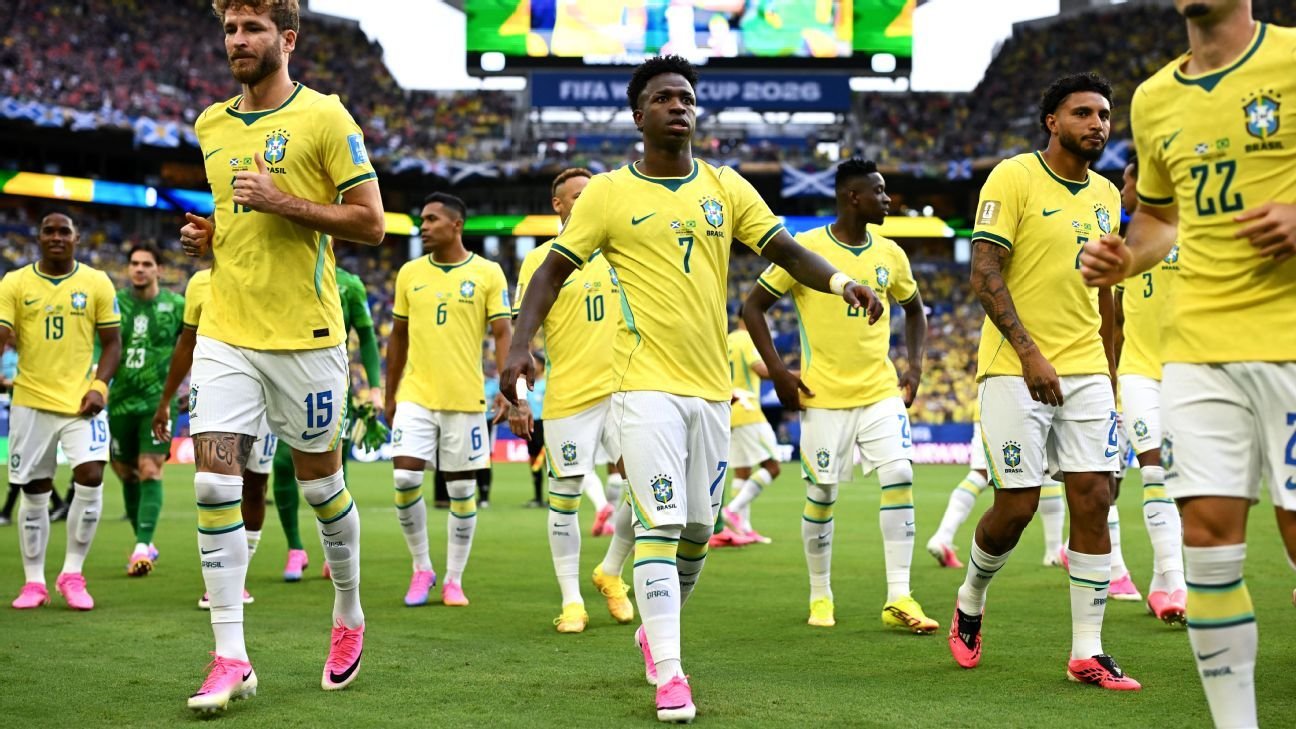
Brazil is gearing up for a FIFA World Cup round-of-16 match against Norway this Sunday. This is familiar ground for them.
The Seleção has not been eliminated in the group stage of a World Cup since 1966, reaching at least the quarterfinals every four years since 1990. Such a record is fitting for a team that has claimed the World Cup five times, more than any other nation.
Brazilian teams, particularly the world champions of 1958, 1962, 1970, 1994, and 2002, were celebrated for their captivating style and the brilliance of key players, admired not only in Brazil but around the globe.
– Brazil narrowly escapes World Cup upset with late win against Japan
– The science behind Roberto Carlos’ ‘impossible’ free kick
– World Cup kit rankings: Which teams have the best uniforms for 2026?
However, it has been over two decades since Brazil last lifted the World Cup trophy, and the breathtaking football and extraordinary talents they once produced are not as prominent today. Do they still inspire the same passion among fans, evoking the nostalgia felt by those who remember their past glories?
We reached out to ESPN writers from various generations around the world for their insights on Brazil’s historic teams and current squad to see if they’ve lost their World Cup charm.
How is Brazil perceived in your country?
Sam Borden: There’s no doubt that when American sports fans think of Brazil, soccer comes to mind. Older audiences remember Pelé and his time in the U.S.; my generation recalls Romário’s triumph in 1994; and younger fans follow Neymar, especially with greater social media exposure to Brazilian stars and their influence in leagues like the Premier League.
Most casual fans would quickly say that Brazil remains a powerhouse in soccer, regardless of the facts.
Lizzy Becherano: In Mexico, Brazil, as both a national team and a country, is still dearly loved. Mexicans often support Brazil once their own national team is out of the competition.
Tom Hamilton: In the U.K., Brazil is fondly remembered. They are intertwined with our earliest footballing experiences. Depending on your age, you might think of legends like Pelé, Zico, or Ronaldo. They’ve produced an extraordinary array of football icons.
Julien Laurens: In France, Brazil is seen as the greatest football nation ever. They have a rich history of Brazilian players in our league, creating a fondness for their style. Memorable encounters between Les Bleus and Brazil in the World Cup over the years have left a mark on French football history.
Lluís Bou: In Spain, Brazil is regarded as the quintessential football nation, the embodiment of the World Cup spirit. Themes of samba, sun-soaked beaches, joy, and football are synonymous with their identity. Growing up in Barcelona, I was captivated by players like Ronaldinho and Neymar, who made a significant impact in our football scene.
Joey Lynch: In Australia, football is less prominent compared to sports like Aussie rules and rugby. Nevertheless, the legend of Brazil persists; they often come to mind when discussing the world’s best soccer nations and are synonymous with skillful play and entertainment.
What are your earliest World Cup memories of Brazil?
Borden: I vividly remember Brazil’s 1994 squad, featuring Romário, Bebeto, and Dunga. I can still picture Leonardo’s elbowing incident against Tab Ramos in the round of 16, as well as the thrilling penalty shootout against Italy in the final. My recollections of Claudio Taffarel as a goalkeeper are particularly strong.
Becherano: A standout moment for me was Brazil’s match against Mexico in 2014, where goalkeeper Guillermo Ochoa delivered an incredible performance that prevented Brazil from winning.
Hamilton: It’s interesting to note that while I have many memories of Brazil’s past glory, it’s challenging to recall which moments I experienced live. I do remember the iconic Bebeto “rock the baby” celebration during the 1994 World Cup and the captivating journey they had in France ’98, highlighted by the brilliance of Ronaldo.
Laurens: I recall the unforgettable 1986 match against France that went to penalties, though I primarily experienced it through videos. My first real memory of Brazil in World Cups is from 1994, staying up late to watch their matches.
Bou: Being just four years old during the 2002 World Cup, I have no memories of that tournament. My earliest vivid recollection is from the 2006 national team, which felt like an All-Star lineup of superstars: Ronaldinho, Ronaldo, Kaká, Adriano—all the best talent donning that iconic yellow shirt.
Lynch: Growing up in the 1990s, my memories of Brazil are largely tied to Ronaldo Nazário—O Fenômeno—and his performances in the World Cups: the young prodigy shining in 1998 before his return in 2002 to claim victory. It was Ronaldo who inspired me to play as a striker when my coach asked me where I wanted to play.
Which Brazil team or players do you think of when discussing the World Cup?
Borden: Undoubtedly, the ’94 squad stands out because of what they achieved in the United States. It felt inevitable watching them dominate as they played, and Romário’s skill was undeniable. The dynamic between him and Bebeto, who had their differences, was fascinating; I distinctly remember Bebeto’s celebration after scoring, which was groundbreaking at the time.
Becherano: I can’t help but think of Pelé’s iconic win during the 1970 World Cup, but the 2002 team remains legendary as well.
Hamilton: For my generation, names like Romário, Ronaldo, Ronaldinho, Cafu, and Roberto Carlos are what come to mind. Ronaldo is still one of my all-time favorites; I was starstruck talking to Cafu, and seeing any of these legends brings back a wave of nostalgia.
Laurens: For those of us of a certain age, Ronaldo and the squads from 1998 to 2002 are unforgettable. While I admired Romário and Bebeto from 1994 or Rai and Ronaldinho from my favorite Paris Saint-Germain, R9 is my enduring favorite.
Bou: The 2006 squad is the most iconic in my eyes. But if we focus on individual players, Pelé leads the way as a symbol of Brazilian football. Neymar’s journey during the 2014 World Cup, where he tried to elevate his nation on home soil, was also remarkable—especially the heartbreak of his injury, which changed everything.
Lynch: Strangely, I often recall Pelé’s performance at the 1958 World Cup, likely due to a VHS tape I had that highlighted that tournament, especially his first goal against Sweden in the final. Although he never won another World Cup, Sócrates also deserves an honorary mention for his immense legacy.
What sets them apart?
Borden: Tradition plays a vital role in soccer identity, and Brazil’s footballing identity is among the most established in the sport. They have a specific style and set of expectations, which rarely change. While the essence of their beautiful game has evolved, the anticipation surrounding Brazil is unmatched by any other nation.
The essence of beauty in their game may not be as prevalent as in the past—it’s impossible to recreate that magic—but the expectation remains much stronger with Brazil than with any other team globally.
Becherano: Their style of play is characterized by Joga Bonito [the beautiful game].
Hamilton: There’s a mystique surrounding Brazil and an extraordinary lineup of players. They’re known for playing exciting football, and fans still find it thrilling to watch them contend for their sixth title.
Laurens: Brazil has contributed significantly to football. I cherish their unique style, their identity, and the essence of Joga Bonito. They embody the spirit of playing joyfully, focusing more on technical skills than physicality, and aim to entertain the audience.
Bou: Their joy and ousadia e alegria [daring and joy] resonate deeply within Brazil’s identity. Historically, this has been the foundation for assembling outstanding Brazilian teams. Even in years with less talent overall, it’s the brave and uniquely gifted players who need to carry the team. Meanwhile, Argentina thrives on garra [grit], Spain is known for tiki-taka [passing and possession]; Brazil seeks the magic to win.
Lynch: Brazilian football captured global adoration not only because they won but also due to their joyful style. Joga Bonito allowed Brazil to express its culture on the pitch, showcasing the exuberance of a nation that takes great pride in the beautiful game—this vibrant representation remains significant worldwide.
1:08
Nicol expresses doubts about Brazil’s chances against Norway.
Do you believe Brazil has lost some of its former magic from past World Cups?
Borden: I think they have, though this is only partially due to Brazil itself. Most of it stems from the remarkable depth and competition in the sport today. While the achievements of historical Brazil teams were commendable, they only played against the challengers of their era. Nowadays, the overall quality of competing teams is significantly higher.
Even looking at how tough CONMEBOL qualifying has become offers insight into Brazil’s current challenges in South America. The bar has been raised across the board, making it harder for any single team to maintain extraordinary status.
Becherano: I don’t think so. While this current team may not feature a Pelé, Ronaldo, or Ronaldinho, it still possesses exciting players. Brazil will always remain a formidable opponent because of its footballing passion and the distinctive playing style that continues to shine through.
Hamilton: Perhaps there’s a sense of diminished magic since their last World Cup win in 2002? I still find it thrilling to watch them, as I did during the Scotland vs. Brazil match. Seeing legends in the stands adds pressure for the players on the field. Some may now view Brazil as more vulnerable than before, but they remain a formidable force.
Laurens: I do believe so, to a degree. This generation lacks the same level of attacking talent as past squads. Aside from Vinícius Júnior, who could fit into the ’90s teams, they seem less imposing than before, but they won’t be underestimated.
Bou: Yes, I think so. A legacy isn’t solely defined by results; it’s also about maintaining your football identity and culture. Brazil has strayed from the principles that made them revered. The absence of standout talents and the hiring of more pragmatic coaches seeking to win at any cost have made today’s Brazil feel somewhat less … Brazilian.
Lynch: For those passionate about the sport, there seems to be a shift toward structure and control over the joyful individualism of the past. However, for more casual fans, the allure earned by generations of remarkable players may yet endure.

Does Ancelotti need to make changes for Brazil’s upcoming match against Norway?
Analysis of potential changes for Brazil vs. Norway.
Is there another team that shares the same World Cup legacy as Brazil?
Borden: Not really. While Lionel Messi and Argentina, as well as France, evoke World Cup associations, no other nation has the same deep connection to the tournament as Brazil has historically enjoyed. This variety is probably a positive reflection of how the sport has evolved, becoming less tied to a single player or team.
Becherano: Currently, Argentina seems closest to Brazil in this respect.
Hamilton: Players shape narratives. While Messi now represents the concept of the World Cup, so did Diego Maradona. Still, when people think of the World Cup, it’s often images of Pelé, Maradona, or Messi that come to mind. Brazil remains synonymous with this tournament.
Laurens: No other nation can match Brazil’s historic significance in the World Cup. Brazil is the World Cup, and the World Cup is Brazil, not just due to their five victories.
Bou: Argentina could reach that level if they secure another title, but it’s not just about winning; it’s about the legacy that Messi’s generation is establishing. Italy once approached that status, but their recent struggles have distanced them from that elite group.
Lynch: At present, no other team possesses the mystique Brazil brings to the tournament. Across the globe, people stop what they’re doing to watch Brazil play in the World Cup. Other major footballing nations do not exhibit the same mix of success, charm, and goodwill as Brazil does today.