



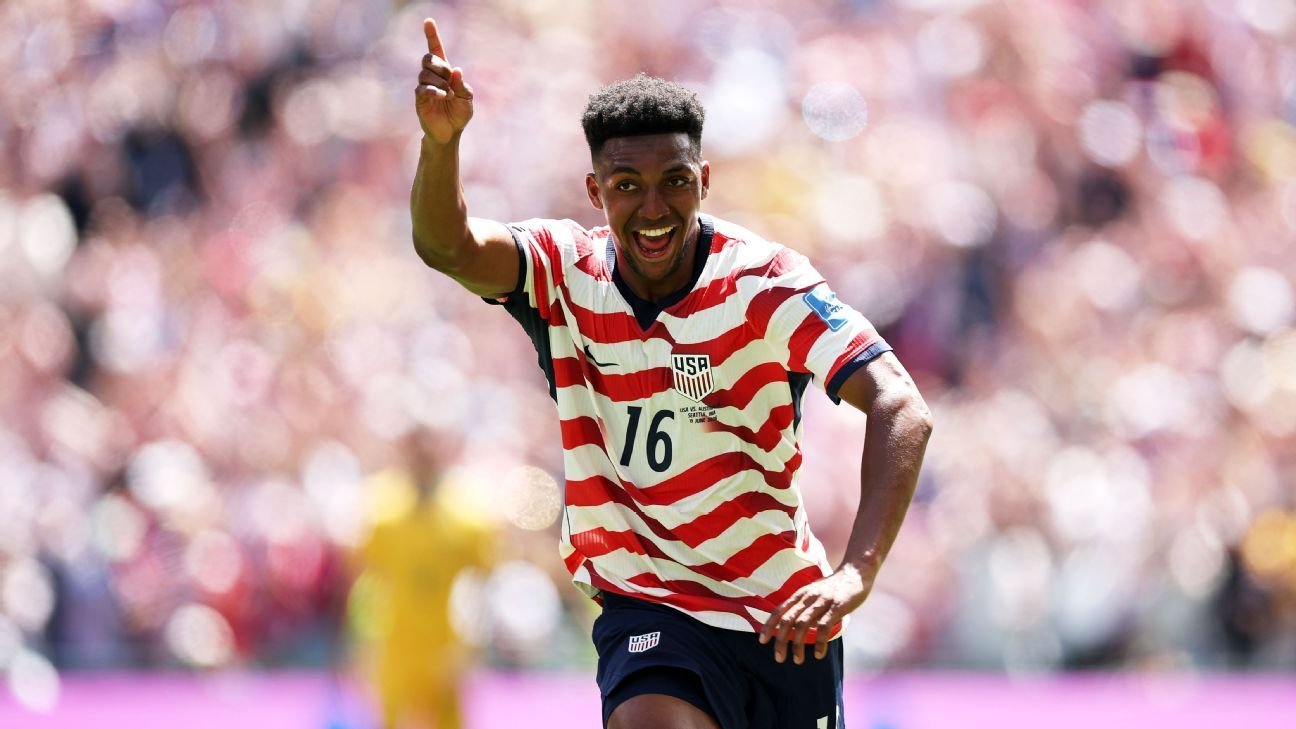
ATLANTA and SEATTLE — Before fans got acquainted with the Freeman Hops, they were introduced to the Freeman Hips.
During a friendly match against Uruguay last November, U.S. men’s national team defender Alex Freeman deftly maneuvered around defender Ronald Araújo, executing a smooth hip fake to evade him. After a skillful turn to evade midfielder Manuel Ugarte, Freeman struck the ball into the net for his second goal of the evening in what concluded as a 5-1 victory.
In the stands was his father, former All-Pro wide receiver Antonio Freeman, who was overflowing with pride. As the days passed, Antonio’s former Green Bay Packers teammates such as Derrick Mayes, LeRoy Butler, and K.D. Williams couldn’t help but notice the resemblance in movement and style.
“Oh wow, I see those Freeman hips. He’s definitely inherited your moves,” one former teammate remarked. “He looked just like you on that run,” another chimed in.
In the lobby of the Atlanta Westin, Antonio demonstrated the movements he used to execute a slant route.
“When I approached a slant, it was all about that rhythm, shifting my weight like this,” he shares, mimicking the motion. “When he had that defender on his heels during that [goal], he moved with the same grace before scoring.” He continued, “I went back to watch some old footage of myself running the slant and thought, ‘He definitely has those hips!'”
On Friday, during a World Cup group-stage clash against Australia, the world got its first glimpse of the Freeman Hops. When Sergiño Dest’s shot was deflected high, Freeman reacted swiftly, heading the ball into the net past Socceroos keeper Patrick Beach. Although the goal was initially ruled offside, a lengthy VAR review confirmed Freeman had been onside, allowing the goal to stand, much to the excitement of the crowd and his teammates.
“When they announced it was a goal, I turned around to see my teammates rushing toward me. It felt overwhelming, and I had to join in the celebration,” he recounted in the post-match mixed zone. “It was a very emotional moment for me.”
This event was especially poignant, echoing a moment from almost 30 years prior when his father scored two touchdowns in a Green Bay Packers victory over the Seattle Seahawks.
“This just shows the greatness of our family lineage,” Freeman said. “It illustrates that my father achieved greatness, but I can carve out my own path as well. It’s an incredible blessing to have a successful dad who has mentored me to seize moments like this.”
Antonio’s response was simple yet impactful: “Amazing to watch,” he texted.
Freeman’s rise to become a key player for the USMNT in the World Cup isn’t solely because of his genetics. His hard work, intelligence, and innate athleticism have also played a crucial role.
Looking back at his journey, Freeman’s development over the past year has been remarkable. Just a year ago, he was starting his first season with Orlando City SC and had received his first call-up to the national team. Now, he has signed with Villarreal in LaLiga. His performances as a right-back in manager Mauricio Pochettino’s sometimes hybrid, sometimes rigid system have been so impressive that the national team coach has been able to shift Sergiño Dest into a more advanced position as a winger.
“The past year has been a whirlwind of changes for me,” Freeman told ESPN in an exclusive interview. “A year ago, if someone told me I would be playing in the World Cup, I would have laughed. The opportunities are increasing rapidly, and I need to make the most of them. It’s surreal but I realize I have to take it one step at a time.”
In this World Cup, Freeman has exhibited remarkable awareness, knowing when to push forward while also providing essential speed and support in defense, stabilizing a backline that has, at times, looked shaky. Pochettino, with extensive coaching experience from clubs like Tottenham Hotspur, Chelsea, and Paris Saint-Germain, has noted Freeman’s development.
“His evolution is significant. He’s incredibly humble,” Pochettino said following the match against Australia. “He has a fantastic profile; he’s eager to learn and always listens. Coaching him is genuinely enjoyable. He’s a wonderful individual and an outstanding player. He has the potential to become one of the best in his position globally.”
The Village Relay
It’s easy to attribute Alex Freeman’s accomplishments to his well-known father, but his success results from a blend of support from parents, coaches, and guiding figures throughout his life.
Following Alex’s birth, his parents split, but he has always had the support of his father Antonio Freeman, his mother Rochelle Hinkle, and his stepfather Jake Hinkle. The two branches of his family lived close to one another in Tamarac, South Florida. Alex appreciates their cooperative efforts, extending his arms as if to embrace them all as a united family.
“As a stepdad, it can be challenging to step into that role for a son who’s not biologically yours,” he said of Jake. “He made an effort to treat me with the utmost respect and support. Having a stepdad and a dad who both care deeply is a rare and precious gift.”
Though Antonio had the credentials of an ex-professional athlete, Jake, a passionate Manchester United fan, along with Rochelle, introduced Alex to soccer at the young age of four.
By the time Alex joined the competitive Weston FC at age 12, his journey was marked by steady advancement rather than meteoric rise. Rochelle recalls how Alex frequently began in reserve teams, only to quickly earn his way up to the first team after showcasing his talent.
“Every season, after a game or two, they would say, ‘We need Alex on the field,'” Rochelle recounted. “And he would shine once they brought him up.”
It was not until Alex was around 10 or 11 that he fully grasped the significance of having a famous father and the opportunities that came with it.
“His advice for me focused on hard work, discipline, and what it takes off the field to succeed. He may not have known soccer well, but he understood the commitment needed to advance in any sport,” Alex explained.
In contrast, Jake and Rochelle played crucial roles in his soccer education. While Antonio would have enjoyed coaching Alex in football or basketball (he had excelled in both), he understood the complexities of pursuing a professional soccer career, especially as a Black athlete, in a sport that historically lacked diverse representation.
“To be honest, I didn’t see many pathways for him in soccer,” Antonio admitted. “In Florida, I heard stories about how kids are used in academies—spending their childhood in soccer but facing uncertainty as they approach adulthood.”
Trusting that Jake and Rochelle could guide Alex on the right path, Antonio supported his decision to pursue soccer full-time in ninth grade.
“He turned me into a believer—not just in him but in the system,” Antonio acknowledged.
Rejected by Miami, Embraced by Orlando
A pivotal moment in Alex Freeman’s journey came in 2019 when he tried out for Inter Miami CF‘s academy.
Rochelle recalls the competitive environment, with 400 to 500 kids auditioning. Alex made it to the final round, despite playing right back—an unfamiliar role for him, as he had primarily played as a winger. Eventually, he received the rejection email. This was particularly painful since some of his peers, like Benjamin Cremaschi and Noah Allen, were accepted.
Despite failing to make the cut, Rochelle sensed Alex’s performance hadn’t been his best that day. The setback struck hard.
“It felt like a gut punch for him—and for us,” she recalled, “because we all knew he might not have been the top player there, but he was certainly capable of competing.”

1:19
Klinsmann: Doesn’t get much better for USMNT after 2-0 win
Antonio struggled with how to console Alex, feeling lost after the rejection.
“It was tough because I didn’t know how to guide him. I just told him to keep grinding. It’s like cutting a tree. It’s a process that takes time—but eventually, you’ll succeed,” he shared.
Not long after, the COVID-19 pandemic hit, leading to the closure of youth academies and forcing many to stay home. However, a new opportunity emerged when Javier Carrillo, Freeman’s former coach at Weston, moved to Orlando City’s academy and extended an invitation for Alex to join.
The decision was complicated. The Hinkles couldn’t relocate to Orlando, and neither could Antonio. Alex would need to stay with a host family.
Antonio supported the idea, believing that being in a competitive environment would be more beneficial than college soccer. Rochelle was apprehensive, concerned about missing critical parenting moments. Alex found himself torn but ultimately opted to seize the opportunity.
“Making that choice was challenging, and it took a couple of months for us to figure things out, especially since I’m just a kid,” Alex reflected. “My family needed to discuss it, considering the kind of development moments I would miss. Ultimately, we came together to decide it was best for me to pursue my lifelong dream.”
Once in Orlando, everything changed as Alex matured rapidly, taking on chores, cooking, and managing his own studies—essentially growing up two years early.
Despite the challenges, both Alex and his family quickly found their rhythm. Antonio and the Hinkles made frequent trips to see him play, traveling up to Orlando several times a month. During the pandemic, they even had to watch from the back of their truck.
“I could see him play from a distance, but I couldn’t touch him or offer any affection due to lockdown restrictions. Our communication was limited to calls and texts,” Antonio recalled, emphasizing how challenging the initial separation was.
‘He Got Better, and He Got Better’
Freeman scored a homegrown contract with Orlando at 17, marking a moment for celebration but also a time for reflection on the responsibilities ahead.
“It felt like a pivotal time, similar to when my dad first signed with a professional team,” Alex remarked. “He emphasized that signing was just the beginning, and I needed to focus on building my legacy.”
He spent the next three seasons with Orlando City B, devoted to making an impression. Initially, he wasn’t always selected by head coach Oscar Pareja, but eventually, his skills shined through.
“I started to see Alex as a player who could correct his mistakes consistently,” said Pareja. “I instructed him that he needed to improve his defense and body positioning. I noticed immediate reactions from him. It wasn’t about just having a fleeting good day; he put in the effort and kept improving.”
Freeman quickly secured a starting position in the 2025 season and was soon called up to the USMNT. His debut appearances during last summer’s Gold Cup showcased his commitment to playing a solid, reliable game. When asked if Pochettino had influenced his playing style, Freeman attributed it to his own approach.
“I had some nerves,” he admitted. “I wanted to focus on solidifying my defense and maintaining my position.”
The transfer to Villarreal posed some dangers for Freeman, particularly regarding game time affecting his World Cup aspirations. Nevertheless, a strong finish to the season, with three starts in four games, mitigated those concerns.
By the time the World Cup roster was revealed, Freeman had established himself firmly on the team, proving he wasn’t on the bubble, despite being the youngest member of the squad.
Upon the announcement of the roster, both father and son were together in Spain, eagerly refreshing their devices and sharing congratulatory messages from Pochettino. In that moment, they celebrated their shared soccer journey together, much like that night against Uruguay—the elder Freeman was full of joy.
“I was so thrilled—I felt like a weight had been lifted, as these selections can be very unpredictable,” Antonio recalled. “I erupted in excitement, running around his living room.”
For Alex, the teachings of his past, the current experience, and the future all fuel his focus. He remains grounded, knowing there are more games to come in the World Cup.
“Now that I’m here, it’s about how I can give my all for my country and make everyone proud,” he stated on Friday.
Thanks to his hops and hips, he’s already made a significant impact.