



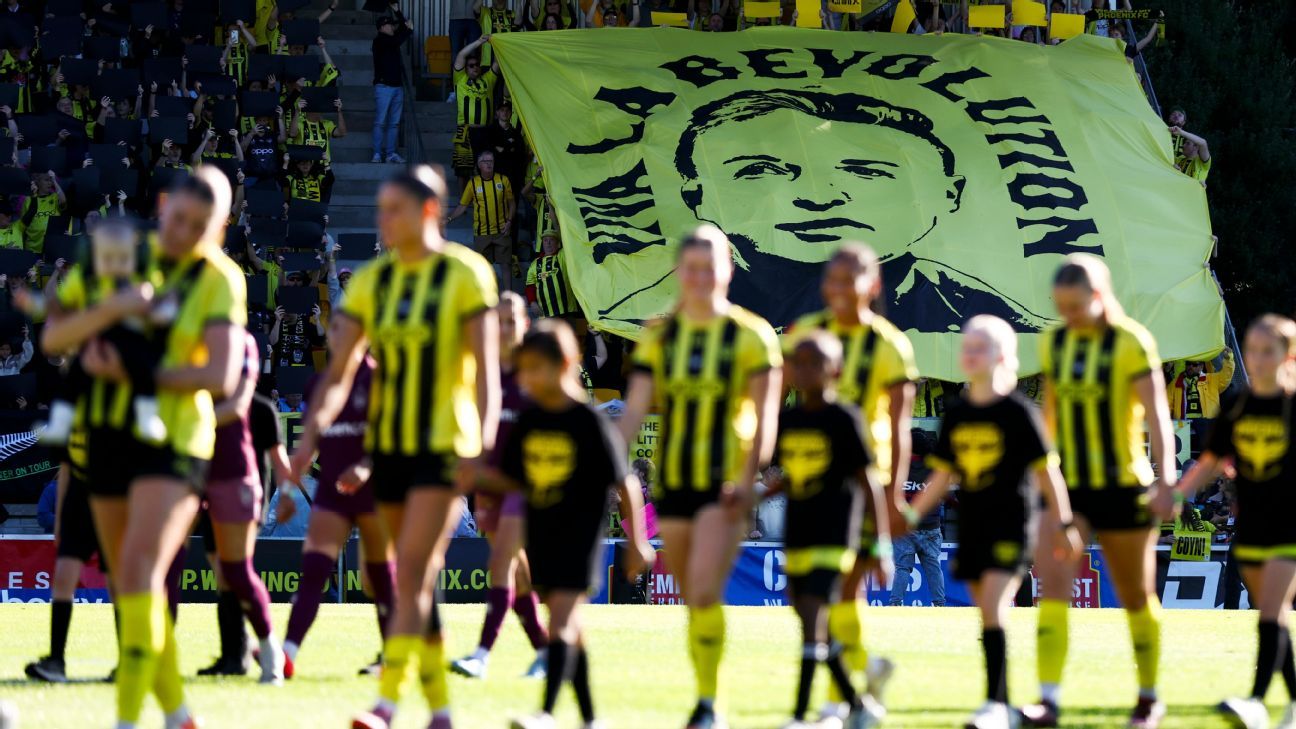
As Bev Priestman prepares to take her place on the sidelines at AAMI Park this Saturday, her primary focus will be on guiding the Wellington Phoenix to their inaugural A-League Women championship.
Standing in her way is a determined Melbourne City squad eager to claim their first title since 2020 and secure their second trophy of the season before heading to South Korea for an AFC Women’s Champions League semifinal just four days later in pursuit of an unprecedented Treble.
Priestman will have a lot on her plate: choosing the right lineup, planning tactics, motivating her players, uncovering the opponents’ vulnerabilities, and attempting to secure her first win against City on her ninth attempt.
While not at the forefront of her thoughts, many are reflecting on how she found herself in the position of coaching in an A-League Women Grand Final at all.
In July 2024, during a training session for New Zealand’s national women’s team, the Football Ferns, captain Rebekah Stott spotted a drone hovering above. This was just days before their first match at the Paris Olympics against the reigning gold medalists, Canada.
The drone incident was reported to the authorities and traced back to the Canadian women’s national team, leading to the expulsion of drone operator Joseph Lombardi and assistant coach Jasmine Mander. As head coach of Canada, Priestman stepped away from the dugout for the New Zealand match and issued an apology. She subsequently did not coach for the remainder of the tournament.
Investigations were launched by both Canada Soccer and FIFA. The findings resulted in Canada losing six points in the tournament, reducing their three group-stage victories to just three points. They managed to progress beyond the group stage but were eliminated by Germany on penalties in the quarterfinals.
The coaching staff involved received one-year bans from FIFA, barring them from any football-related activities.
An investigation by Canada Soccer revealed that the drone incident was not an isolated event, but part of a broader systemic culture impacting both the men’s and women’s teams.
– A-League Women 2025-26 report cards: Sydney’s Struggles
– Watch: Shelby McMahon’s Stunner Secures City’s Grand Final Spot
– Subscribe to the Far Post, ESPN’s Women’s Football Podcast
After being officially dismissed by Canada Soccer in November 2024, Priestman and her family relocated to New Zealand, her wife’s home country, to escape the fallout from the scandal.
Simultaneously, the Wellington Phoenix were kicking off their fourth season in the A-League Women. Under Paul Temple, their third coach, the team finished ninth out of twelve, and he was not offered a new contract after two seasons.
As July 2025 approached, New Zealand’s lone professional women’s football team needed a new coach, and the gold medal-winning Priestman was nearing the end of her suspension.
The timing couldn’t have been better, and just days after her ban ended, Priestman was appointed as head coach of Wellington.
Although there were questions surrounding her appointment due to the circumstances leading to her availability, both sides recognized the situation and the path forward.
“We’re excited to welcome Bev back to football,” said Rob Morrison, chairman of Wellington Phoenix, at her introductory press conference. “We’re aware she has been away from the game, but we understand the context and are fully comfortable with this decision.”
Priestman, who had previously contributed to coach development in Wellington and with New Zealand Football, described the year-long ban as “challenging” and acknowledged, “everyone involved likely has regrets.” She and her family moved to New Zealand, feeling “unsafe” in Canada after the incident, and expressed her eagerness to achieve something meaningful for the city and the country.
The transformation Priestman has brought to the Phoenix is remarkable.
The team, once struggling at the bottom of the table, has finally lived up to its potential under her leadership.
“There was a lot of excitement initially, and definitely anticipation to see what she would bring,” Wellington midfielder Manaia Elliott shared with ESPN’s The Far Post podcast regarding Priestman’s arrival. “I don’t think anyone truly knew what kind of coach she was going to be until she joined, and we were all pleasantly surprised.”
“We don’t just have an incredible coach; she also has a fantastic personality and a great support staff that boosts the team’s morale, which is crucial and often underestimated.”
Priestman’s reputation has attracted not only players like New Zealand internationals C.J. Bott and Victoria Esson to Wellington, but also helps retain them.
“Being able to work with Bev for another season was a significant factor for me,” said forward Grace Jale upon renewing her contract.
Long-standing member Mackenzie Barry, who has witnessed the team’s ups and downs since its inception, praised the coach extensively. “Having Bev is a tremendous advantage. She’s the best coach I’ve ever had,” she stated after signing with the Phoenix again.
Undeniably, Priestman’s hiring is what has brought both her to the Wellington Phoenix and the club to this Grand Final.
While the road to this point has been unexpected, Priestman and the Phoenix now stand just 90 minutes away from an extraordinary conclusion to a remarkable journey.