



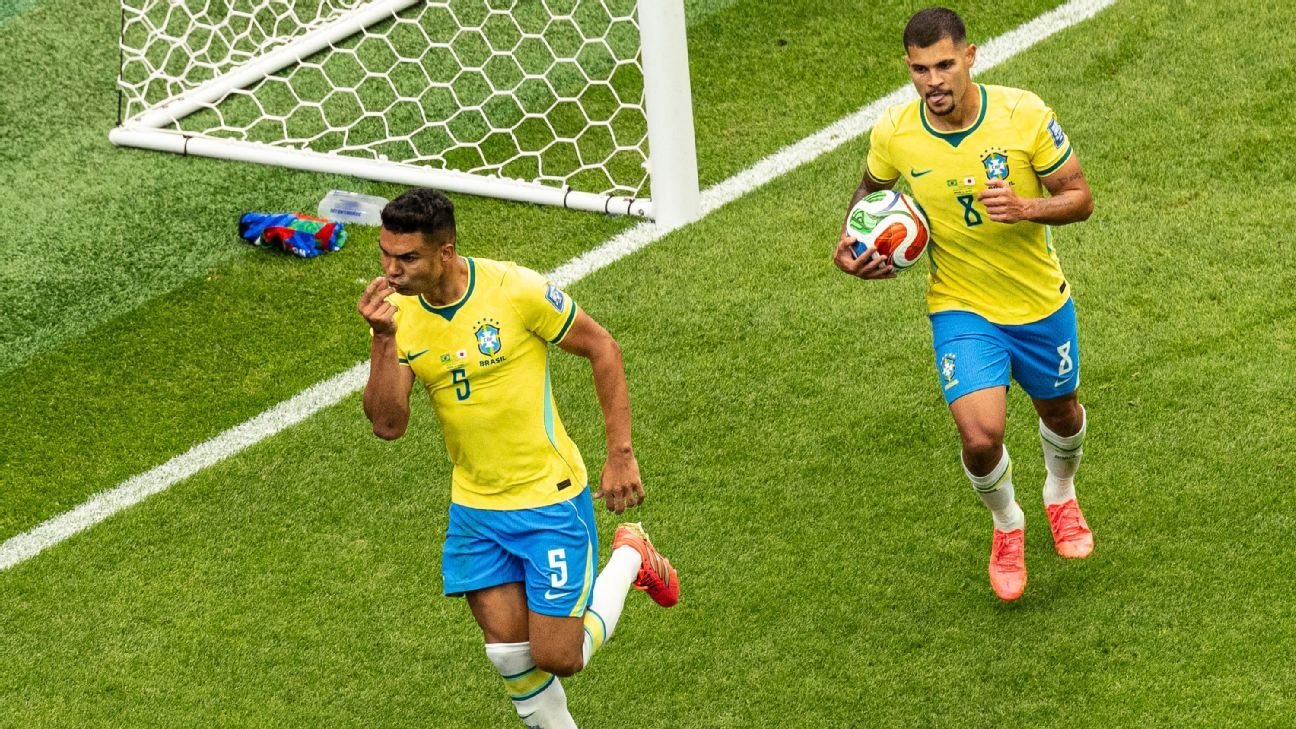
It’s halftime, and Brazil finds themselves down a goal, facing the daunting prospect of being eliminated by Japan and potentially missing out on the last 16 of the 2026 FIFA World Cup.
What will Coach Carlo Ancelotti’s move be? With attacking talent waiting on the bench and Lucas Paquetá sidelined due to injury, a sub is imminent after halftime. Who will be the first to come on? The dynamic striker Endrick is the favored option.
Time passes, and Brazil manages to equalize. As they push for the winning goal, who will be the next substitution? Many are calling for Neymar. With Brazil sending in numerous crosses against a relatively smaller defense, Igor Thiago also makes a compelling case. Ultimately, however, the choice falls on Gabriel Martinelli.
This decision took many by surprise. The strategy behind it appeared to be freeing up Vinícius Júnior, allowing him to explore space while the new player anchored the left side. Instead, the opposite unfolded. As Vinícius stretched the Japan defense on one flank and Rayan mirrored that on the other, Brazil found the opening for the winning goal, scored by Martinelli just before the end of regular time for a 2-1 victory.
Ancelotti truly pulled off a masterstroke. Most coaches would have substituted Casemiro at halftime, especially considering the 34-year-old midfielder was easily outmaneuvered for Japan’s goal and struggled to make an impact on the match.
With a yellow card, he seemed vulnerable as Brazil pressed forward; Japan could exploit him on the break in the second half. Yet, surprisingly, Ancelotti kept him on. Shortly after having a header cleared off the line, Casemiro then equalized for Brazil with a nod in at the far post.
That is often Ancelotti’s brilliance. Appearing calm with his chewing gum, the Italian coach maintains his composure, 信任ing his players and opting not to act, even when inaction is the toughest decision. As the World Cup intensifies and occasionally exposes Brazil’s midfield weaknesses, the handling of Casemiro will certainly be pivotal.
Since taking charge of Brazil over a year ago, one of Ancelotti’s primary choices was to reinstate Casemiro, who had been out of the national team picture for 18 months. The squad needed stability and balance, and he aimed to recreate the successful partnership he had with Casemiro during their time at Real Madrid. This decision allowed Casemiro to act as Ancelotti’s on-field extension.
The return of Casemiro has undeniably paid off, particularly in enhancing Bruno Guimarães. Brazil struggled during World Cup qualifying, and Guimarães faced significant challenges.
After his final match under ex-coach Dorival Junior, Guimarães exited the field expressing the need for improved strategies in transitioning the ball from defense. Now, this task rests with Casemiro. With defined roles and strengthened structure, Guimarães has been empowered to venture forward and integrate more with the attack.
From a broader team perspective, Casemiro’s inclusion has clearly benefitted Brazil.
However, vulnerabilities persist. Ancelotti’s original strategy—with four forwards and Casemiro alongside Guimarães in central midfield—proved effective against Japan in the second half when they dominated. But to initiate matches in this manner poses considerable risk.
In late May, Brazil played a warm-up match in Rio de Janeiro against Panama. During the first half, with a nearly full-strength squad, the midfield duo was alarmingly bypassed as Panama navigated around Guimarães and Casemiro with ease. Ancelotti noted this and adjusted his approach, introducing Paquetá as the third midfielder.
Now, with Paquetá out, likely for the duration of the tournament, the critical decision is who will fill in against Norway in New Jersey this Sunday. Is Ancelotti prepared to revert to a four-forward system? That seems improbable. More likely is the addition of Danilo Santos, the agile left-footed midfielder who has recently emerged as a contender.
Nonetheless, Casemiro remains a question mark. He will be matched against Martin Ødegaard, a remarkably skilled provider for the dangerous Erling Haaland.

0:27
Haaland and Gabriel rivalry arrives at World Cup round of 16
This matchup is crucial—despite Casemiro’s strong response in the second half against Japan, the weaknesses from the first half linger. His current yellow card status also raises the risk of suspension, echoing past experiences when Brazil lost to Belgium in 2018.
If he needs to be substituted, Fabinho is the immediate choice—a seasoned midfielder known more for his passing prowess than defensive skills. Ancelotti might rethink not selecting Chelsea‘s Andrey Santos, who could provide more energy.
Interestingly, only five midfielders were included in the original squad, a clear oversight that Ancelotti tried to amend when right-back Wesley was ruled out due to injury, resulting in late call-up for Manchester United‘s Éderson.
Now, Ancelotti will ponder his strategies: when to act and when to hold back, how to maximize Casemiro’s strengths while mitigating his weaknesses, and how to find the right balance he believes is essential to Brazil’s quest for a sixth World Cup title.