



-

Emily Keogh
Multiple Authors
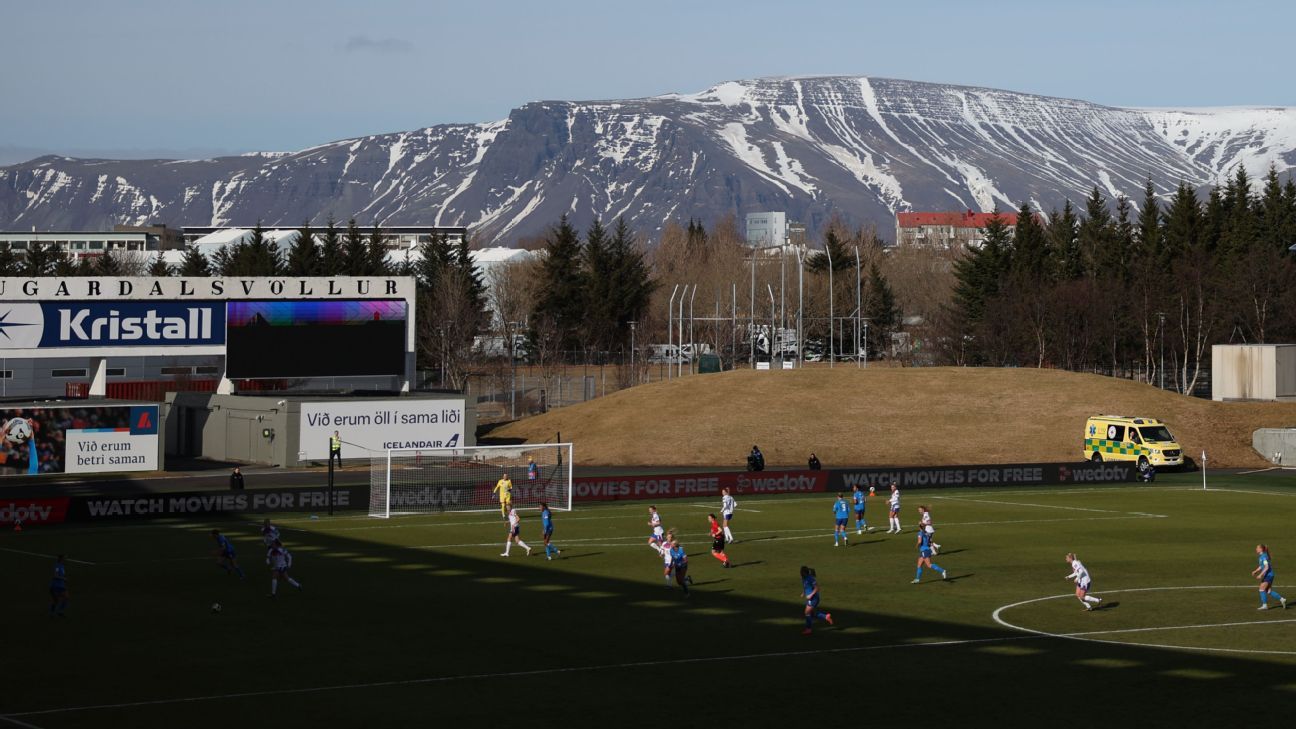
REYKJAVÍK, Iceland — Iceland’s national stadium, Laugardalsvöllur, is perched on the edge of Reykjavík, surrounded by mountains on one side and the North Atlantic on the other. It’s soccer played on the outskirts of the Arctic Circle.
With a total population exceeding 390,000—similar to Arlington, Texas (394,000)—almost two-thirds of the Icelandic population resides in and around Reykjavík, creating a soccer talent pool comparable to that of Boise, Idaho. This limited demographic faces the challenge of competing against Europe’s top teams.
Yet, during a World Cup qualifying match, held on a sunny evening in mid-April 2027, the distance between Iceland and reigning European champions England was barely evident. Iceland challenged the Lionesses fiercely, ultimately succumbing to a narrow 1-0 defeat. Although England claimed victory, the hosts demonstrated their potential by generating scoring chances and defending resolutely, coming close to walking away with a point, or even a win.
This performance left Iceland’s World Cup aspirations hanging by a thread. However, it was remarkable given the numerous obstacles they faced, including geographic isolation, long and frigid winters, and a small population that limits their ability to compete with larger football nations.
Traditionally, Iceland’s profile in women’s football doesn’t suggest success. Yet, during the early 2000s, it flourished.
Leading the Charge
In 2003, former England goalkeeper Rachel Brown-Finnis found an unexpected opportunity at a club in Iceland. Many of women’s football’s most prominent nations were just waking up to the concept, including England, where decades of neglect had left the sport struggling.
Iceland, however, offered something unique: the chance to be compensated for playing football.
After five years in the U.S. on a college scholarship, Brown-Finnis returned to England and joined Everton, but the contrast was stark. Her scholarship experience felt like a full-time job—with expenses covered and football as the primary focus—while England’s women’s game lagged behind.
Despite representing England at the international level, the opportunities in women’s football were limited. Clubs were unable to afford housing or salaries, and national team representation brought no financial reward. After moving in with her parents, Brown-Finnis balanced benefits with her training commitments, making a full-time job while pursuing football impractical.
Everton had connections with Íþróttabandalag Vestmannaeyja (ÍBV) in Vestmannaeyjar—a small archipelago off Iceland’s southern coast. Several players were heading there for the summer season, and the club required a goalkeeper; seizing the chance for a unique experience, Brown-Finnis packed her bags.
“I thought it was on the mainland,” she recalls. “When we landed and took a ferry, I thought, ‘Where are we going?'”
Vestmannaeyjar, home to roughly 5,000 residents, featured striking volcanic landscapes, and the team’s manager was also the island’s only dentist.
“They were passionate about handball and football,” Brown-Finnis reminisces. “[ÍBV] had a men’s professional team and a women’s semi-professional side. I was earning more there since I got no pay in England. It was a chance to play football in a new environment while having a unique adventure.”
Her time in Iceland also enriched her experience culturally.
“It was an exciting opportunity,” she remarks. “The accommodation was covered, and I had a part-time job maintaining gardens alongside my Everton teammate, Sammy Britton. We were assigned to garden duties, and each week we would set out to cut grass around the island. It was fun and let us explore and connect with the community.”
Every away game felt like a journey. It frequently involved flights or ferries, often requiring them to board a tiny six-seater plane to the mainland, with gear piled into a compartment barely larger than a car boot. Long ferry rides were the alternative. “Our runway was about 100 yards long,” she remembers. “The tiny planes had bench seating on each side and one seat next to the pilot. Every trip felt like an adventure.”
Once on the mainland, navigating to training sessions would sometimes add several hours of travel. One of Brown-Finnis’ first training sessions even involved climbing a volcano before practicing drills on its slopes.
“They told us, ‘We’re going to walk to the top of the volcano,'” she laughs, recalling her disbelief. They weren’t joking. Slalom poles were set up on the volcano, and players had to maneuver around them while outfield players tackled and goalkeepers dove—running, diving, and sliding down the mountain. “This unique training was exhilarating compared to the often monotonous routines I’d experienced before,” she remembers fondly.
At that phase of her career, England felt stifling compared to the diverse opportunities she found in Iceland. Conditions would eventually improve in England, with players beginning to receive better salaries and comprehensive training programs; however, Iceland had etched a significant chapter in Brown-Finnis’ life, leading her to return the following summer without hesitation.
Iceland’s proactive approach to providing playing opportunities and fostering a semi-professional environment was ahead of its time. Yet, neither its domestic league nor national team developed into a consistent powerhouse capable of competing with nations like England, Germany, or Spain.
Today, the trend of sending players abroad to develop talent has become key in women’s football across Europe, particularly in leagues like Sweden. Meanwhile, Iceland has lagged behind.
Once at the Top
At the dawn of the new millennium, the Nordic countries—a cultural region including Denmark, Finland, Iceland, Norway, Sweden, and Greenland—stood at the forefront of women’s football.
Sweden was one of the original powerhouses, clinching the first European Championship in 1984 and competing in numerous major finals throughout the late 20th century; Norway claimed victory in the 1995 World Cup and Olympic gold five years later, while Finland also made significant international strides.
On the club level, Swedish teams set the benchmark, with Umeå, led by the legendary Brazilian Marta, winning the UEFA Women’s Cup in 2003 and 2004.
“In that era, Nordic countries were ahead in women’s football,” Brown-Finnis notes. “Participation levels were exceptionally high in Sweden, Norway, and Iceland, where girls played football without hesitation.”
For years, this cultural attitude gave these nations the edge, as participation rates soared and established pathways into the sport long before many larger nations devoted substantial resources to women’s football.
However, while the Nordics laid the groundwork, these countries have struggled to maintain momentum in the professional era. Though still competitive internationally, the prospect of a Swedish, Norwegian, or Icelandic club lifting the Women’s Champions League trophy feels increasingly distant. As investment floods into England, Spain, France, and Germany, the power dynamics have shifted southward.
This decline has been gradual rather than dramatic. Each year, the financial disparity between Nordic leagues and Europe’s elite widens; wealthier clubs are building state-of-the-art facilities, expanding professional academies, and significantly increasing player salaries. Nordic leagues, with their smaller markets and limited commercial avenues, face challenges in staying competitive. Nonetheless, they’ve adapted.
Sweden and Norway have emerged as two of Europe’s most fruitful talent producers. Unable to compete financially with leagues like the Women’s Super League (WSL) or Liga F, their clubs focus on developing young players who subsequently move on to more lucrative opportunities abroad—an essential strategy for survival.
Scandinavian players are highly sought after in England, where their technical skills, tactical awareness, and competitive experience make them appealing prospects. Government Body Endorsement (GBE) regulations support this by easing the pathway for players from established football nations into the WSL.
This dynamic is mutually beneficial: English clubs access skilled players, and those players gain opportunities to compete in highly professional settings. However, this comes at the expense of the clubs in their home nations.
Over the past decade, Sweden’s Damallsvenskan and Norway’s Toppserien have increasingly become feeder leagues for the WSL, NWSL, and other top European competitions. Clubs frequently lose their star players before they reach their primes, often due to transfer fees that are too enticing to pass up.
These clubs identify talent, provide first-team chances, and enhance player market values before financially powerful leagues come knocking. While transfer revenue helps sustain operations, it also limits clubs’ ability to create competitive squads capable of challenging elite teams in Europe.
The inaugural Women’s Europa Cup in the 2025-26 season featured two Swedish teams—Hammarby and BK Häcken. Although Häcken emerged as champions, the €450,000 ($522,472) prize money fell short of covering the costs incurred, yielding no financial boost to the club.
This positions Nordic football precariously. The region continues to produce top-tier athletes, yet retaining them becomes an uphill battle. Without the financial resources available elsewhere, clubs must strike a balance between developing talent and losing it.
What Lies Ahead?
For Iceland to replicate Sweden’s success model will be challenging. Its small population significantly limits the ability to cultivate a talent pipeline comparable to Sweden’s.
While Icelandic players possess the physical characteristics that have drawn European attention, the lack of comprehensive developmental opportunities has perpetuated a cycle of stagnation against more established football nations.
In many respects, Iceland is still in the early stages of its journey. The women’s league, which originated as an indoor competition in 1971 and transitioned to an eight-team outdoor league a year later, remains semi-professional. Only a handful of players can make a living solely from football, necessitating second jobs for many.
Currently, most players on Iceland’s national team are with solid yet modest mid-table European clubs like FC Cologne, Madrid CFF, and Inter Milan. Only two players compete for recognized top-tier clubs: captain and record appearance holder Glódís Perla Viggósdóttir at Bayern Munich, and rising star Sveindís Jónsdóttir at Angel City. The scarcity of players at the highest level complicates Iceland’s efforts to elevate women’s football and inspire the next generation.
Progression for leading Icelandic clubs in European competitions is equally challenging. Valur frequently enters UWCL qualifying rounds but hasn’t advanced to the main competition since 2012. This year, however, Breiðablik reached the quarterfinals of the inaugural Europa Cup, only to be halted by Sweden’s BK Häcken, the eventual champions.
This context underscores the necessity of UEFA’s introduction of a second European tournament aimed at countries with lower coefficients, helping nations with limited resources evolve—an encouraging development for the sport’s growth.
Qualification for the 2027 World Cup—marking Iceland’s first appearance in a final tournament since entering qualifications in 1995—would significantly elevate the stakes. After securing a third-place finish (following a 1-0 victory over Ukraine last Friday night), Iceland will enter the playoff draw on June 18, where two rounds of games will determine seven World Cup spots.
While realistically reaching the World Cup won’t instantly transform Iceland’s football landscape, it could act as a catalyst. Participation rates for girls are already high; international success might convert that enthusiasm into a robust talent pipeline and lay a foundation for a more sustainable model long-term. Although it will require time, if Iceland aims to build on past achievements, this is the logical next step. The only challenge left is taking it.