



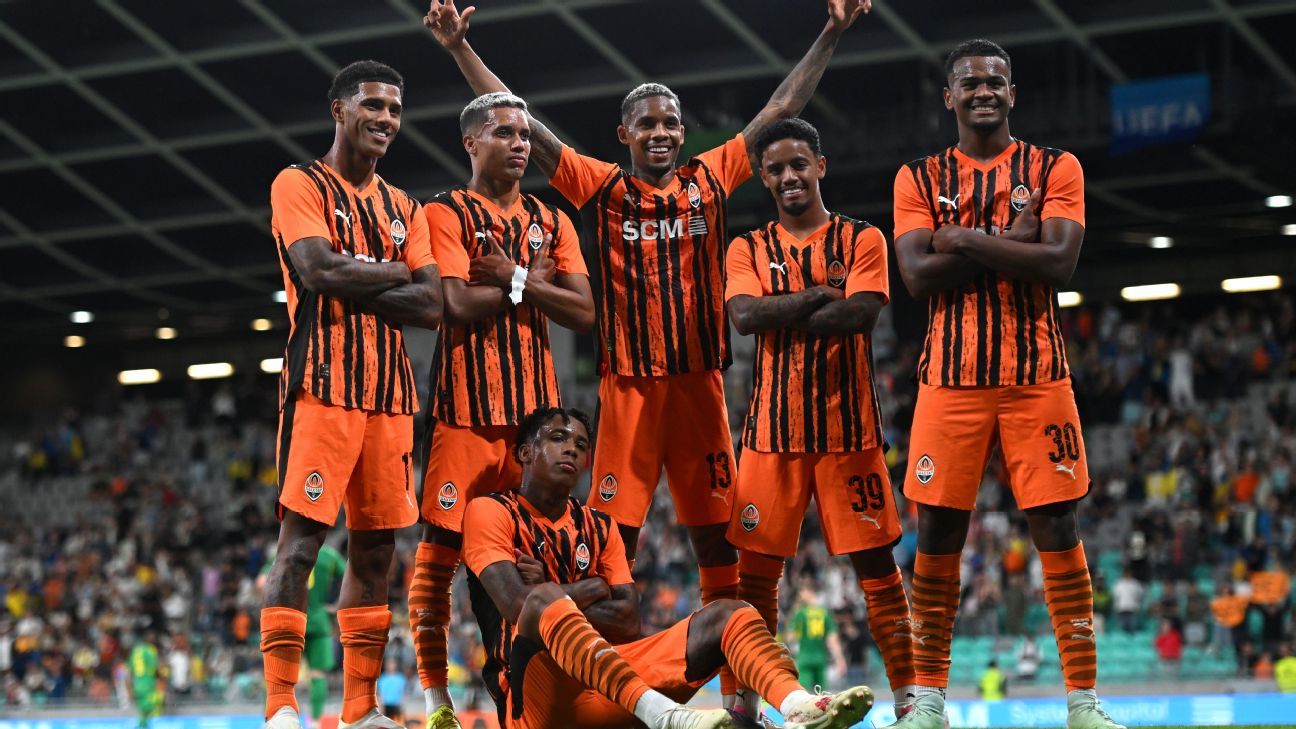
Darijo Srna, sporting director of Shakhtar Donetsk, recalls moments when players and staff had to gather in their hotel lobby, notified of an impending drone strike, anxiously waiting for the instruction to move to the air-raid shelter. One instance occurred on matchday itself. “We all stayed in reception until 6 a.m. but didn’t go to the shelter, and afterwards we managed to sleep until noon, had a meeting at 2, and played our game at 4 p.m.,” Srna shared with ESPN. “We lost, but this is our life now.”
Tuesday marks four years since the onset of this harsh reality. Russia’s invasion of Ukraine began on February 24, 2022, and according to The Center for Strategic and International Studies (CSIS), it’s now regarded as the deadliest conflict since World War II. The estimates of casualties vary, but CSIS reports that approximately 140,000 Ukrainians and 325,000 Russians have lost their lives. Furthermore, the UN High Commissioner for Refugees estimates that 5.9 million Ukrainians have fled the country.
Despite such dire circumstances, Shakhtar has strategically focused on enhancing its sustainability as a club by continuing to heavily rely on the transfer market, particularly by acquiring young talents from Brazil.
– Shakhtar Stalevi: The ‘made of steel’ soccer team in Ukraine
– The Story of Shakhtar Donetsk to Be Adapted into a Hollywood Film
– Ukraine’s Chief Criticizes FIFA President Infantino for His Comments on Russia
This approach traces back over 20 years, stemming from Shakhtar president Rinat Akhmetov’s appreciation of Brazil’s dynamic football style. The club established a robust network in Brazil, leading to a steady influx of Brazilian players who would join Shakhtar before advancing to prestigious European teams.
Prominent figures like Willian (Chelsea), Fernandinho (Manchester City), Douglas Costa (Juventus), Fred (Manchester United), and Luiz Adriano (AC Milan) are notable examples of this trend. Most recently, winger Kevin moved to Fulham last September for a record transfer fee of €40 million.
Overall, club sources informed ESPN that Shakhtar has recruited 47 Brazilian players since 2002, who have collectively scored over 1,000 goals. Luiz Adriano remains the club’s all-time top scorer with 128 goals from 2007 to 2015. The revenue generated by player transfers has become essential, particularly during wartime, with officials indicating that sales of Brazilian players have exceeded €350 million.
“Right now, our two main sources of income are UEFA competitions and player sales,” Shakhtar CEO Sergei Palkin tells ESPN. “That’s our reality. We almost have no sponsorship, matchday revenue, or TV revenue. To survive in this environment, we needed to rethink our club’s progress.”
Shakhtar’s journey also illustrates the prolonged impact of conflict in Ukraine, which started as Russia seized and annexed Crimea in 2014, leading to the club’s relocation from Donetsk. Since then, Shakhtar has hosted its “home” European matches in six varying cities, currently based in Krakow, Poland, for this season’s UEFA Conference League, while domestic matches are played in Lviv, located in western Ukraine. Given the airspace limitations, the team travels by bus to Poland for away games, often undertaking trips that can last up to 16 hours. In the previous Champions League season, they made long journeys across Europe to play teams like Arsenal and PSV Eindhoven.
This winter has been particularly severe in Ukraine, compounded by Russian strikes on infrastructure, which have left millions without power, water, and heating. The European Union has supplied nearly 10,000 generators to Ukraine since the invasion began in 2022.
“If anyone had told me in early 2022 that the war would persist for four years, I wouldn’t have believed them,” Palkin reflects. “Four years represents a significant portion of life.”
“Our players live in a hotel, with a training pitch located right across from it. Maintaining pitch quality in Europe is typically straightforward, but in Ukraine, it has proven challenging due to power outages. Extended blackouts spanning one to three days create difficulties in keeping the pitches in playable condition, especially after such a harsh winter with temperatures plummeting to -25 degrees Celsius (-13 degrees Fahrenheit).
“I don’t remember facing temperatures this extreme in my life. Our training camp is in Kyiv, where we manage to maintain our pitches, as they are crucial for our practice before games. The entire approach to pitch management requires a overhaul since the challenges of wartime have created a unique set of circumstances.
Moreover, modern medical history doesn’t provide examples of how to fully recover players after enduring 16 hours of travel before a match.”
Notably, Brazilian players continue to flock to Shakhtar in significant numbers. The current squad features 12 Brazilians, most of whom joined in the past four years. Palkin explains the allure: “They recognize that we offer a remarkable platform that can lead them to elite European football.”
“Every player can see the successful examples. The most recent is Kevin. At the onset of the war, we sold David Neres for €15 million, despite him not playing a single match for our club before being sold to Benfica for more than we paid (€12 million). They take the risk for the chance to make it in top European football,” he added.
“I’m spending about 70% of my time engaged in negotiations, trying to convince players to join us in these incredibly difficult times. I have to demonstrate to them where they will live, what to expect when air raid sirens sound, and the myriad of safety concerns they might encounter.
“Transparency is key in my discussions, but existing players play a significant role in the persuasion process as they share their personal experiences about life here.”
Marlon Gomes took the extra step. At 22, he transferred to Shakhtar from Vasco da Gama in January 2024, seeking guidance from his experienced teammate Alex Teixeira, who had made the same move in 2010. Teixeira spent six years in Ukraine before returning to Vasco in 2022 and then moving to Greek club Panserraikos last month.
“Shakhtar has always been a well-known club, particularly in Brazil,” Gomes conveyed to ESPN. “It has established a reputation among young talents as an ideal platform to advance to top-tier leagues.”
“Alex and I are good friends. We chatted frequently during my time at Vasco, and he shared valuable insights about Shakhtar’s approach towards young Brazilian players.”
“When I learned of the history of Brazilian players transitioning to Shakhtar, I was inspired and had been dreaming of this journey and the titles they secured. Alex recommended that I consider Shakhtar a great choice. Not a single day have I regretted my decision.”
While Gomes’ family, including his 7-year-old daughter Maite, remains in Brazil, his mother is understandably worried, glued to news reports about the ongoing conflict.
“She’s constantly watching news and reading articles, and it’s causing her great anxiety,” Gomes shares. “I try to reassure her and explain that it’s not as dreadful as represented in the media. Yes, attacks could occur even in Lviv, where we currently are, but the club is committed to ensuring our safety.”
“During the season, we oscillate between Lviv and Kyiv. When friends in Brazil inquire about my life here, I choose to share only positive experiences. I genuinely adore Kyiv; it’s among the most beautiful cities I’ve ever visited. Even amidst turmoil, I’m enjoying my stay in Ukraine.”
“There are times when I hear or see drones attacking Ukrainian cities, which is tragic, and the media can often paint a dark picture of life in Ukraine. However, that depiction doesn’t capture the resilience and daily life inside the country. Despite the devastation, life persists and that spirit is truly inspiring for all.”
According to Palkin, ensuring proper adaptation for new arrivals is crucial: “When a Brazilian player joins us, we facilitate introductions to others, explaining the current climate, our culture, and the realities we face regarding travel and living conditions.”
“New players can encounter personal challenges, particularly during wartime. Therefore, we have dedicated staff to assist with these adjustments, ensuring they are comfortable and supported.”
“We’ve established a structure enabling rapid adaptation; during wartime, however, this process is expedited. In the past, we might have afforded two years for players to reach their peak. Nowadays, they adapt in one to two months and are integrated into the main squad quickly.”
Nevertheless, Shakhtar’s established method of attracting and nurturing talented Brazilian players has been challenged. Top clubs are increasingly inclined to acquire directly from Brazil, bypassing teams like Shakhtar. Chelsea, for instance, completed a deal for Estêvão from Palmeiras in 2024 and Andrey Santos from Vasco the previous year, while Denner will arrive from Corinthians this summer.
“Chelsea has reshaped the Brazilian market,” Srna observes. “They are not only acquiring talent from Brazil but also from Argentina and Ecuador at ages 16 and 17. Manchester City is also in the mix.”
“This makes it increasingly challenging for us, but the talent in Brazil remains abundant. Estêvão, for instance, was on our radar, but competing against clubs like Chelsea is tough.”
Palkin elaborates on how Shakhtar has adapted: “This means we are shifting our focus to younger players, specifically targeting 16- and 17-year-olds, and we need to act swiftly. If we hesitate, we risk losing out. Quick decision-making is critical in this Brazilian market.”
“Our president is decisive and isn’t hesitant to invest significantly in young Brazilian talents. He believes in our strategy, and despite the ongoing war, we remain competitive in the market. Esteemed clubs like Chelsea, City, and others pose threats to teams like Shakhtar, Benfica, and Porto due to their financial strength. They can afford to pay substantial sums, thus making competition difficult.”
With Shakhtar not participating in the Champions League this season, financial implications are felt more acutely. Revenue is significantly lower from the Conference League, yet there’s more at stake: representing their nation.
“It serves as a crucial humanitarian platform to maintain international focus on Ukraine and offer positive experiences to our supporters,” Palkin states. “For individuals living in Ukraine, 90% of news reported is negative and it creates emotional strain. Our participation in European competitions provides a welcome distraction and joy for many.”
“All our coaches who remained with us throughout these four years have always emphasized the impact of competing in Ukrainian and European tournaments on the lives of people in Ukraine during their team preparations.”
Srna emphasizes the importance even further: “Playing in Europe represents more than just football; when we succeed, it sends a powerful message to the world: We are here, and we will fight until the end.”
2:06
Vitali Klitschko honored to receive Arthur Ashe Courage Award
Vitali Klitschko expresses gratitude for receiving the Arthur Ashe Courage Award, emphasizing the importance of achieving peace in Ukraine.
Shakhtar feels overlooked by FIFA, especially in light of Article 7—an annex allowing foreign players in Russia and Ukraine to suspend contracts unilaterally post-invasion. The club estimates this has resulted in €60 million in losses. Recently, FIFA President Gianni Infantino suggested he favors lifting the ban on Russia from competing in international sport.
“I advise Infantino to visit Ukraine to witness the devastation firsthand, instead of making irresponsible statements from afar,” Palkin argues. “To consider re-integrating Russia while Ukraine suffers is a betrayal to the sport’s ‘one family’ principle.”
“Instead of contemplating the re-integration of Russia, he should focus on establishing a fund to assist in rebuilding Ukraine’s sports infrastructure. Our football system is critically threatened as it stands. His priority ought to be our recovery rather than assimilating a country that has invaded Ukraine and harmed our people.”
Through it all, Shakhtar perseveres, mirroring the resilience of Ukraine. Akhmetov has donated over $300 million to the government since the war began and has provided 13 million food kits and 700,000 medical units to those in need. The club is also involved in rehabilitating severely injured soldiers, supporting amputee teams for veterans, and offering shelter to refugees. Shakhtar matches serve as a brief escape, promoting joy amidst adversity.
“Each domestic game brings smiles to fans in the stands, offering them a momentary reprieve from their difficult realities,” Gomes comments. “If I were to leave Ukraine, whether for another club or back home, I’d cherish the experiences and lessons learned here, carrying them with me always.”