



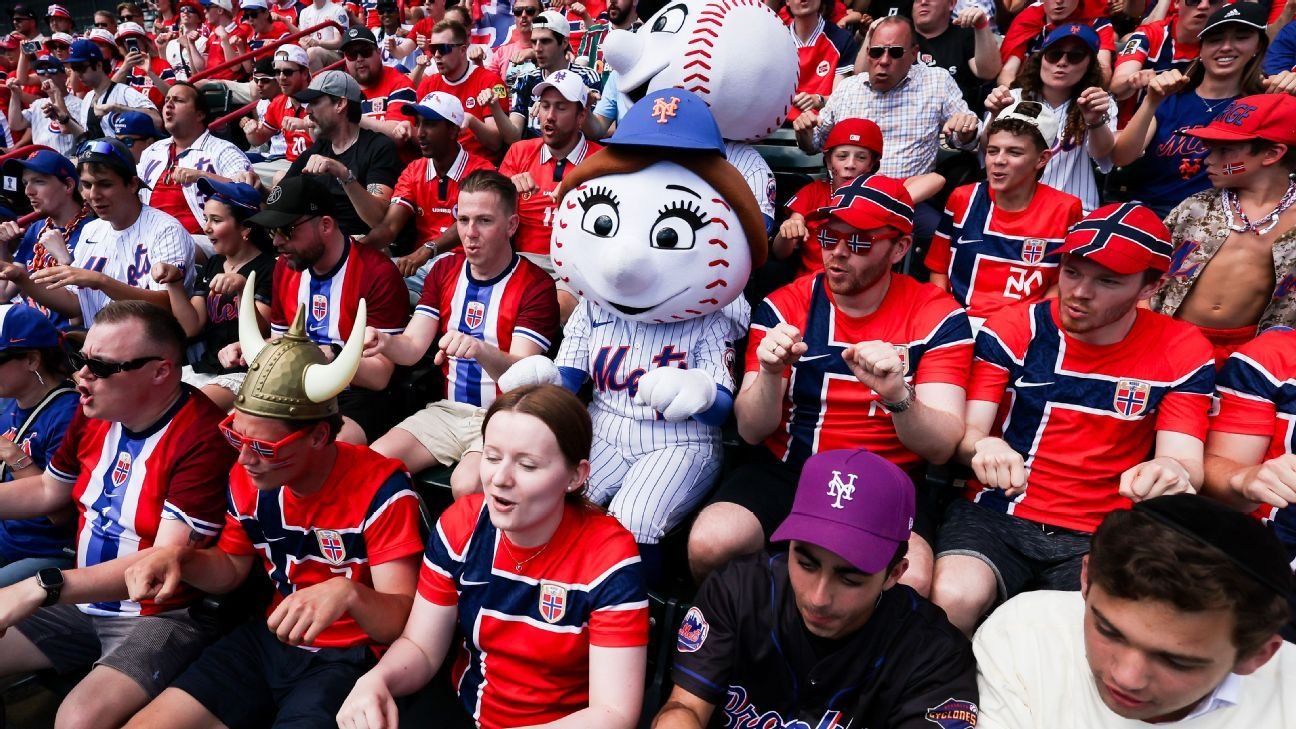
EAST RUTHERFORD, N.J. — When did you first catch sight of the now-famous “Viking Row” by Norway fans?
Perhaps it was when a handful of supporters rowed up an escalator in Boston, when thousands joined in Times Square, or during one of Norway’s three group matches.
Maybe it caught your attention when rowers broke the rhythm of polite applause at the recent Traveller’s Championship on the PGA Tour, as Norwegian golfers Vikor Hovland and Kristoffer Reitan were cheered on. (Hovland was inspired by the “electric” chants, leading him to victory in a playoff against Scottie Scheffler.)
– World Cup Match Schedule: All Fixtures, Results, Features
– Overreactions to the R32 Bracket: Does USA Have an Easy Run? – Marcotti: Best XI of the World Cup Group Stage
The performance usually kicks off with the blowing of a traditional Norse horn, followed by fans sitting in a formation that mimics a Viking longboat. The leader then starts to beat a drum—beginning slowly, but speeding up with every strike—while fans row their arms in unison and chant, “Row!”
Players from Norway have taken note, too. The “Viking Row” has appeared on the social media of star striker Erling Haaland, and the team even engaged in a rowing chant after defeating Senegal 3-2, an outcome securing their knockout stage spot, led by captain Martin Ødegaard drumming.

0:22
The viral World Cup Viking Row reaches the Norwegian Parliament
Having qualified for their first World Cup in nearly three decades, the Norwegian team emphasizes that their primary goal is simply to enjoy the experience.
The “Viking Row” has undoubtedly made waves at the World Cup, echoing the excitement created by Iceland’s “Thunder Clap” at Euro 2016. Chants in soccer often evolve organically, while this particular row has a more defined inception.
The tale of its creation began less than six months ago in a bar, where one devoted Norwegian fan aimed to craft a chant to put his country on the footballing map.
On a chilly winter night, Ole Frøystad, an elementary school teacher, strolled into a bar in a northern suburb of Oslo, armed with a list of chants he’d crafted over several weeks, each meant to ensure that Norway’s return to the World Cup would not be forgotten.
Among these chants was the “Viking Row,” which he held in high regard. He eagerly shared it with Torstein Hamran, a museum coordinator and a key figure in the Norwegian supporters group, who would later be the one by the drum during matches.
“I went through all the chants with them, but I felt like, ‘This one is really special,'” Frøystad recounted. “Creating an epic chant became my goal; I researched various chants and absorbed music, thinking about what might make a significant impact.
“I wanted it to be concise, accessible, and impactful while capturing our culture—something that would truly resonate.”
Frøystad withheld details on other chants he had in mind, planning to unveil them later, yet he was confident that the “Viking Row” was his standout creation.
His inspiration struck when he recalled a match he watched over a decade ago featuring the Norwegian club Rosenberg. Fans had alternated chanting the club’s name—“RO!” “SEN!” “BERG!”—creating a powerful atmosphere. He also remembered Iceland’s “Viking Clap”, which gradually built up from a slow rhythm into rapid clapping.
Combining the idea of rowing with this, he felt a spark of creativity.
“I realized that the Vikings literally rowed into battle,” Frøystad noted. “They’d set their sails, pull out their oars, and land ashore. The imagery clicked for me. The movement mirrors what happens at a stadium, creating a wave-like effect that would be incredible.”
It didn’t take long for the leaders of the supporters group to embrace this idea. They first tested it out during a friendly match against Switzerland—one of Norway’s final games before the World Cup. Initial reactions were lukewarm.
“It went okay,” Hamran recalled. “Some people commented that it looked silly.”
Frøystad understood why. Fans needed to perfect their rowing technique.
“For our second game after Switzerland, we knew we had one more match in Norway [against Sweden] before heading off to the World Cup,” Frøystad said. “It was our last chance to refine it.”
Working alongside Hamran and other supporters, they produced instructional videos for fans to demonstrate proper rowing techniques, which gained traction on local news outlets.
“We detailed everything: ‘Start by reaching forward, bend slightly,'” Frøystad explained. “‘If you neglect your back, the rowing won’t be visible—only audible.'”
The results of these efforts were remarkable.
“After that game, I shared a video of the chant simply for fun on my Instagram, which had few followers,” Frøystad said. “To my surprise, it exploded—38 million views and almost 3 million likes before the World Cup even started.
“That made me realize how exciting this could be once we reached the World Cup.”
The “Viking Row” may have been propelled by Norway’s successful start, or perhaps it was the other way around.
In recent years, the Norwegian Football Association has actively sought to strengthen connections with supporter groups, creating a representation that resonates with fans. Norway’s star player, Haaland, epitomizes this spirit. In March, he purchased a rare 16th-century Viking history book for 1.3 million Norwegian Kroner ($136,000) to display publicly in his hometown of Byrne. Prior to the tournament, Norway’s players posed as Vikings on the shore, donning full battle attire.
This theme, while playing on a stereotype, has faced criticism from some commentators in Norway who argue against idolizing the Vikings, whose historical actions can hardly be considered commendable. However, connections can be drawn, as noted by Terje Leiren, a retired professor who was knighted for his contributions to researching Scandinavian history.
“The term ‘Viking’ itself describes a verb that evolved into a noun, rooted in the act of venturing out to raid,” Leiren explained. “Those who engaged in this became known as Vikings.”
Leiren believes the Viking spirit epitomizes Norway’s World Cup squad, symbolizing a team leaving their home in pursuit of triumph (with far less violence).
“It serves as a metaphor for their journey,” Leiren said.
The “Viking Row” represents a fitting emblem for a team aspiring to surpass its best achievement from 1998, when Norway reached the round of 16. Their first challenge in the knockout rounds is against the Ivory Coast.
However, not all share the enthusiasm. While Ødegaard and Haaland have promoted the chant, Norway’s coach, Ståle Solbakken, curbed the excitement.
“It’s entertaining for the fans,” Solbakken commented following the victory against Senegal. “We won’t be doing it post-World Cup, but it adds a bit of fun during the tournament.”
Frøystad and Hamran acknowledge this sentiment. Both are in the United States for the tournament, hoping Norway achieves its best-ever performance. Yet, they admit the “Viking Row” might not endure beyond this World Cup.
After all, Frøystad has a plethora of chants still on his mind and another 14 awaiting their turn on his notepad.