



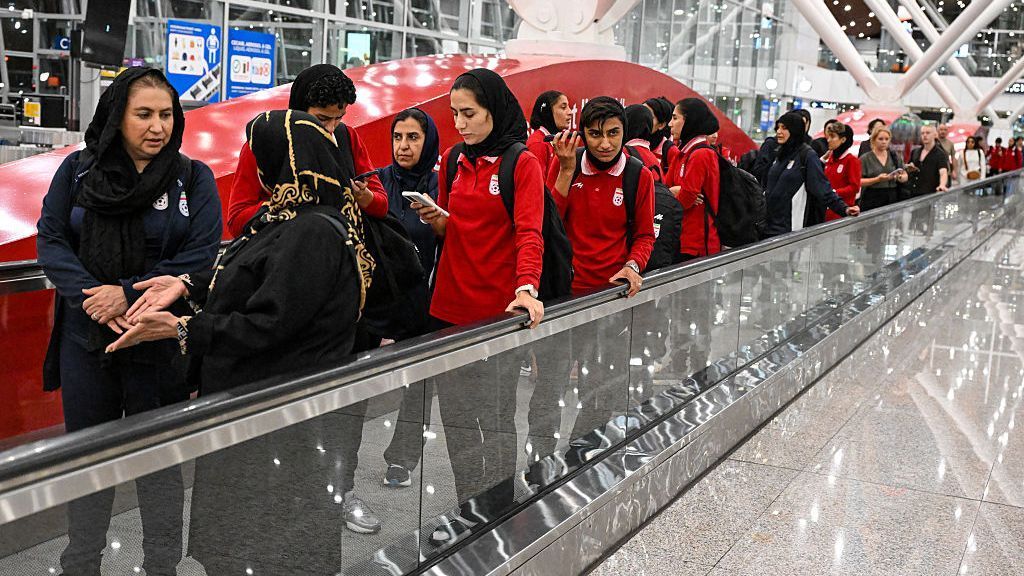
SYDNEY — A member of the Iranian women’s soccer team, who was granted asylum in Australia, has opted against seeking refuge, leading to the relocation of the remaining six players.
This player received a humanitarian visa on Tuesday evening, along with a support worker, bringing the number of Iranians seeking asylum in Australia to seven. However, by Wednesday morning, she changed her mind and reached out to the Iranian embassy, as confirmed by Home Affairs Minister Tony Burke.
“In Australia, individuals have the right to change their mind and travel freely,” he stated in parliament. “We respect the circumstances surrounding her decision.”
As a result of the player’s decision, the remaining six women had to be moved to a more secure location, as her contact with the embassy revealed their whereabouts.
“Regrettably, she was advised by her teammates and coach to reach out to the Iranian embassy,” Burke explained.
Previously, Burke emphasized that government officials did not pressure the women when deciding whether to accept the humanitarian visa after the team’s exit from the Women’s Asian Cup.
The team’s departure from Sydney to Iran occurred amid intense protests from the Iranian Australian community, who sought to prevent the women from leaving due to fears for their safety upon returning to a country where they had been labeled “wartime traitors” by Iranian state media for not singing the national anthem before their match.
According to Burke, as the women passed through airport security, they were individually approached by Australian officials and interpreters, away from any minders, and offered asylum.
“They were given a choice,” he stated. “We ensured that there was no rushing or pressure involved.”
Some players reached out to their families in Iran to discuss the asylum offer, but none of the other members of the delegation chose to stay in Australia.
“Our focus was on preserving their dignity in making this choice,” he remarked. “We were unable to eliminate the context and pressures they might have faced from prior discussions or concerns for family members.”
Those who sought asylum received temporary humanitarian visas, which provide a pathway to permanent residency in Australia, Burke noted.
The players confirmed to remain in Australia include captain Zahra Ghanbari and players Fatemeh Pasandideh, Zahra Sarbali, Atefeh Ramezanizadeh, and Mona Hamoudi.
Ara Rasuli, an advocate for Iranian refugees involved in the asylum process, stated that the Australian government made every effort to ensure the girls could stay safe and protected.
She warned that players returning to Iran could face severe consequences, including execution and retaliatory actions against their families. “There are numerous threats that exist, including detention and asset seizures, which explain why many girls opt to return home despite the risks,” Rasuli said.
The team arrived in Australia for the Women’s Asian Cup last month, shortly before the Iran war broke out on February 28. After being eliminated from the tournament over the weekend, they confronted the grim prospect of returning to a war-torn country.
While the exact number of individuals in the delegation remained unclear, a list identified 26 players and additional coaching staff. Burke dismissed suggestions that Australian officials should have intervened more forcefully to prevent the women’s departure.
“Australia’s goal was never to coerce anyone into a specific decision,” he affirmed. “That’s not how we operate as a nation.”
Burke acknowledged having seen widely circulated footage that appeared to show one woman being led by her teammates from their hotel to the bus. Whether this amounted to coercion would be assessed by local Australian law enforcement, he noted.
The Iranian team garnered significant support during the tournament in Australia. The Brisbane Roar football club even extended an invitation to the remaining players to train with them.
This situation has drawn international attention, including from U.S. President Donald Trump, who criticized the Australian government for not offering the women asylum. Reports indicated that discussions between Australian officials and some of the players had already been taking place privately, and Trump later praised Prime Minister Anthony Albanese following their phone conversation on the issue.
In response, Iranian state television stated that the country’s football federation requested international soccer organizations to review what it termed Trump’s “direct political interference in football,” warning that such comments could disrupt the upcoming 2026 World Cup.
This article incorporates information from AAP and The Associated Press.