



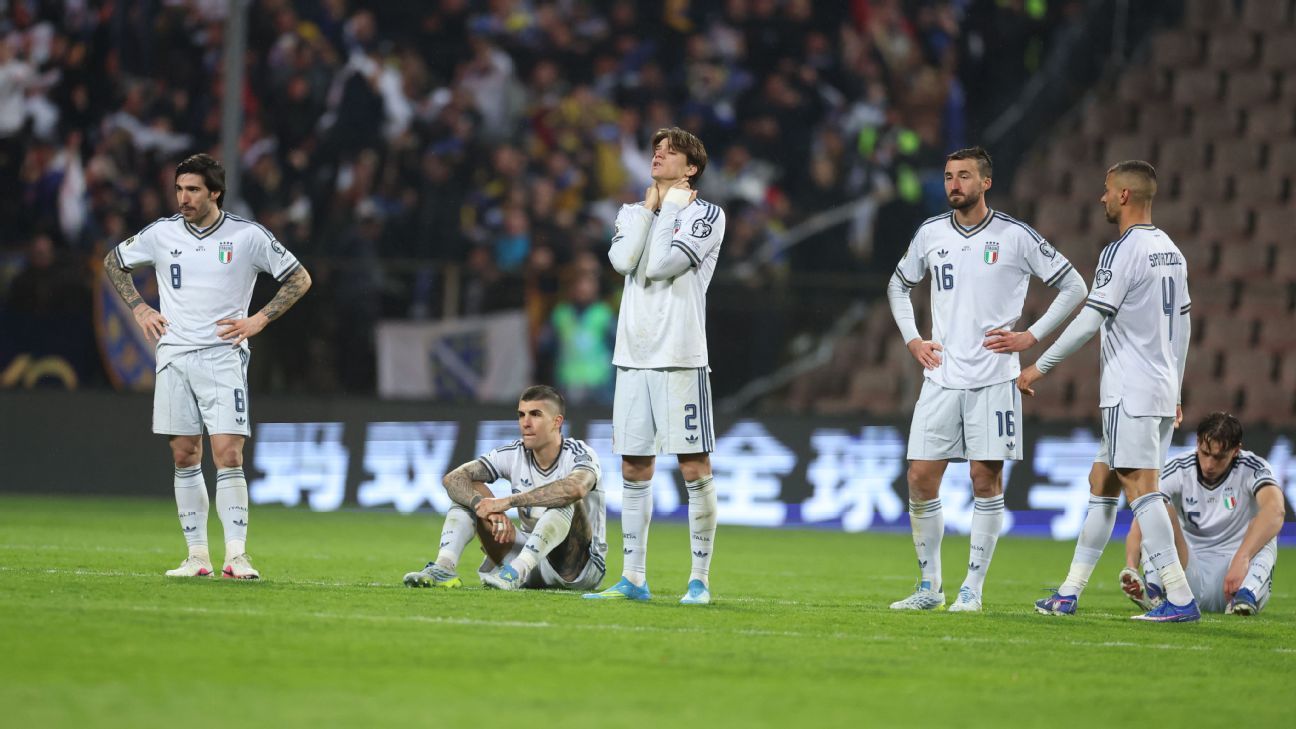
I could say, “This isn’t amusing anymore,” but I already used that line previously. I even joked about “giving someone else a chance to win a World Cup, considering we have four at home—just like England, Spain, and France combined,” back in 2018.
But where do we turn now that Italy has failed to qualify for three consecutive World Cups—an unprecedented feat for a nation that has won the tournament? This comes especially at a time when the World Cup expanded from 32 to 48 teams.
I’m uncertain about the future, but I’m absolutely sure about what you don’t need after Tuesday’s penalty loss to Bosnia and Herzegovina.
– Introducing World Cup debutants: Curacao, Uzbekistan, Cape Verde, Jordan
– O’Hanlon: Ranking the 2026 World Cup teams
– Karlsen: One tactical insight to know about all 48 World Cup teams
What you don’t need is lengthy articles discussing the decline of Italian football and calls for comprehensive overhauls. It’s not that Serie A isn’t as strong as it was in the 1990s that led to their failure to qualify. After all, Serie A was arguably in a weaker state when Italy reached the Euros finals in 2012 and 2021, even winning the latter.
You also don’t need Gennaro Gattuso, the current coach of Italy, to extol his players’ heart and determination, claiming they didn’t deserve to lose. While their effort was commendable, Bosnia displayed equal, if not greater, tenacity—despite the fact they had just come off a grueling match against Wales with a 40-year-old up front. (Want to talk about “heart”? Look up Edin Dzeko.)
Furthermore, Gattuso’s expressions of frustration over missed chances don’t provide solace. Had Moise Kean converted his chance or Fede Dimarco connected with his weaker foot or if Francesco Pio Esposito’s header had gone in, Italy might be celebrating qualification today. Perhaps a different outcome could have occurred had Tarik Muharemovic received a yellow card instead of a red. And, in a cruel twist of fate, if Gianluigi Donnarumma hadn’t parried Dzeko’s shot into the path of Haris Tabakovic, Italy would have advanced due to a handball. But the reality is Donnarumma had to make ten saves, several of which were spectacular. Bosnia attempted 30 shots and squandered many opportunities, themselves.
The truth is, it’s not that complicated. While Italy may not have the depth of talent like France, Spain, or England, they had sufficient quality to qualify. They are ranked 13th in the FIFA standings! This is not an aging squad (only one starter, Matteo Politano, is over 30) nor are they disinterested (commitment was not lacking).
The reality is they put themselves in a difficult position early in the qualifying process, suffering a loss to Norway due to some poor decisions, leaving them with limited options to escape the playoffs. Once in a knockout stage, anything can happen, and individual moments can take on immense significance.
Alessandro Bastoni may be among the finest defenders, but his reckless red card after 41 minutes played a significant role in Italy’s absence this summer. With both teams at full strength, you might have favored Italy’s chances—not because they were playing particularly well (up to that point, the Azzurri had managed just two shots on target with an xG of 0.15) but because they were leading 1-0, creating a clear pathway to control the game.
Keep possession, force Bosnia to chase, wear them down, and leverage experience. That’s the strategy Gattuso typically employs effectively: straightforward plans focused on percentages, combined with fervor and enthusiasm from the sidelines.
However, reduced to ten men, their plans unraveled. Italy adopted a defensive stance, inviting pressure from Bosnia, leading to an 80-minute ordeal for the players and millions of Azzurri fans, orchestrated by Esmir Bajraktarevic and Kerim Alajbegovic. Gattuso’s coaching capabilities were limited to being an enthusiastic sideline cheerleader, contributing very little as head coach.
It’s worth noting that Gattuso had only 15 training sessions with his players throughout his 10-month tenure. While one might argue that additional time could lead to errors, it’s clear that Gattuso didn’t do himself any favors.
When your squad is more talented than the opposition, the ideal strategy is to let that talent shine, taking the initiative. Gattuso, unfortunately, either chose to play it safe due to the early lead or was frozen by the fear of the red card’s impact.
Are there systemic issues hindering the growth of Italian football? Certainly. Critics point to an overemphasis on immediate results and tactical discipline over skill development in youth football. There’s also reluctance from Serie A clubs to trust local talent, creating a blockage in the pathway to the first team, along with a lack of support from clubs for the national side (evidenced by Gattuso’s struggle to even arrange a brief training camp).
However, these factors are not the reasons for Italy’s failure to reach the World Cup. Poor choices and disappointing performances during qualifiers left them with less room for error than necessary. Bosnia and Herzegovina’s determination, resilience, and some missed penalties filled the remaining gaps.
Nonetheless, this doesn’t lessen the pain of the situation. When you’ve celebrated four World Cup victories, the sting of missing out hits even harder.