




-

Graham Hunter
Given his nickname, it’s unsurprising that Julián Álvarez‘s current standing, performance, mindset, and future seem shrouded in uncertainty. Known as La Araña (The Spider) since childhood, he has crafted dreams but now appears to be ensnared in a predicament.
A myriad of questions arises: Why has he been struggling to score or impact Atlético Madrid‘s game of late? Why is he unable to establish a solid connection with teammate Alexander Sørloth? Will Arsenal be able to meet his buyout clause [reportedly] and would he consider a return to the Premier League? Or might Barcelona attempt to lure him away from Atlético to stand in for Robert Lewandowski?
In addition, Álvarez must be concerned: Will his lackluster performance jeopardize his standing with Argentina coach Lionel Scaloni as the Albiceleste prepare to defend their World Cup title in the U.S., Canada, and Mexico this summer?
Though he cannot voice these fears, I will for him: As he approaches 26 on Saturday, his ideal birthday gift would be confirmation of a transfer to a club whose playing style suits him, where the coach has unwavering faith in his abilities and maximizes his contributions, and where the prospect of winning trophies is more tangible than it currently is with Atlético. His visible discontent, confusion, and, most critically, ineffectiveness have led Andrea Berta from Arsenal and Deco from Barcelona to ponder whether they could entice him away from Atlético.
To illustrate that this once elite, dynamic, and prolific scorer is currently off his game, consider this evidence:
In 20 starts (plus one substitute appearance) in LaLiga, La Araña has accrued just seven goals and three assists. Atlético appears unlikely to compete for the title this year, and as we analyze how Álvarez meshes with the ultra-conservative approach of coach Diego Simeone, the situation appears increasingly grim.
Regionally, Álvarez has made only 13 passes to fellow striker Sørloth this season, while receiving the ball from him 18 times. This is hardly indicative of a meaningful partnership.
Álvarez has shot at goal 41 times, resulting in a 17% scoring success, clearly a sign of being off form.
While not advocating for physicality against a nimble striker, it is surprising that Álvarez has only been fouled 14 times. If he were more frequently in dangerous scoring positions and managing to score, this number would undoubtedly be higher.
His heat maps reveal a troubling pattern, stretching nearly the entire pitch (covering 70% of his Liga matches). Such a distribution is not typical for a prolific forward. Although he’s gaining admiration from supporters and teammates for his defensive contributions, that is not the role for which he is being paid.
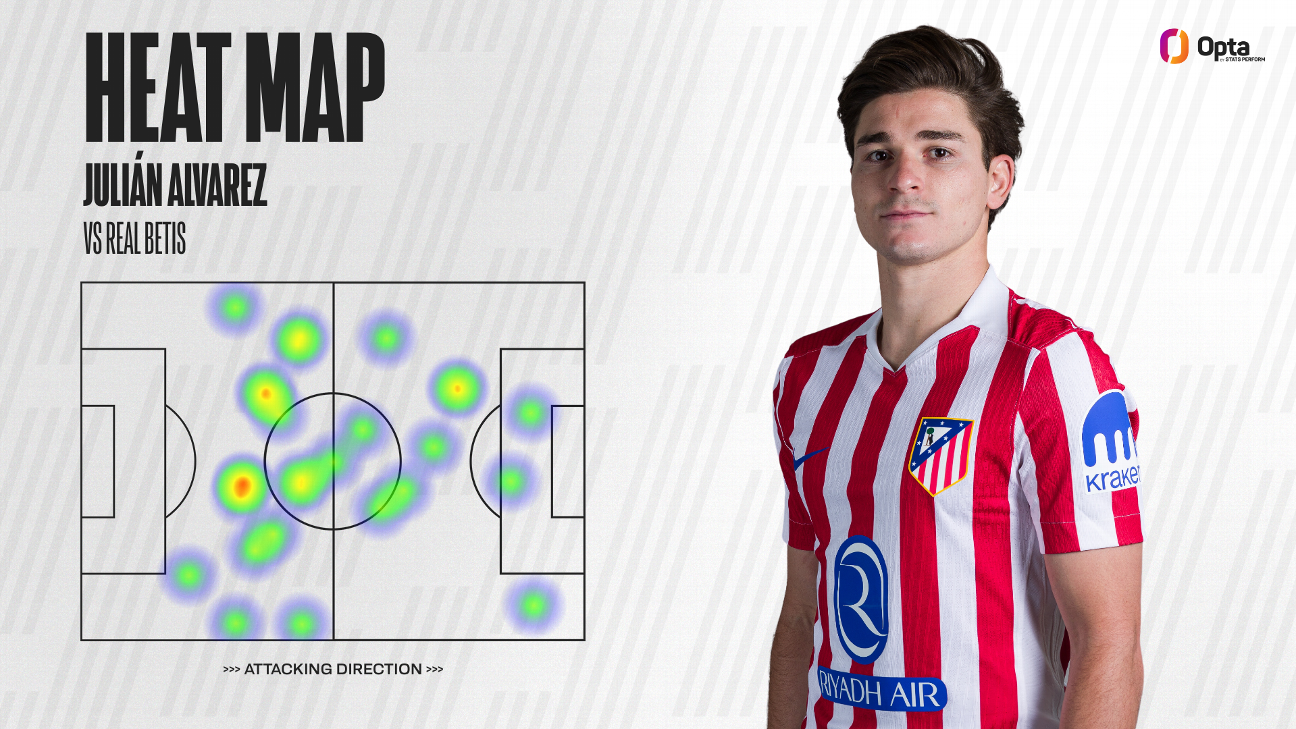
His mid-length high-intensity running ranks him 217th in LaLiga, and his sprints—crucial for a successful striker—place him 9th within the Atlético squad and 235th in the entire league. In terms of ball-winning, entangled in back-and-forth movements across the pitch, he’s positioned at 403rd in LaLiga.
To top it off, he hasn’t found the net domestically since November 1. Given his overall impressive stats of 40 goals and 13 assists in 86 appearances for Atlético, it is clear: he is in a crisis.
He embodies the essence of an unfulfilled, underperforming star who, if given a fresh start at an ambitious, attacking-oriented team like Arsenal or Barcelona, could more likely regain his impressive form.
In the Champions League, however, the narrative shifts. Weaker teams such as Eintracht Frankfurt, Union St.-Gilloise, and PSV Eindhoven, unfamiliar with Atlético’s style, have succumbed to their focus on creating pivotal moments, where Álvarez has netted four goals in six matches. His strike during a 2-1 victory against Inter Milan, last season’s finalists, showcased what he is capable of accomplishing on a consistent basis.
It’s crucial that Atlético defeat Bodo/Glimt in Madrid on Wednesday to have a strong chance of finishing in the top eight, or else they may face pressure; Álvarez is a talented, committed, disciplined, and resourceful player on the brink of entering the prime of his career.
However, challenges await.
Not only is Álvarez contracted to Atlético until June 2030, but his buyout clause stands at an astronomical €500 million—a figure beyond reach.
Financially, does Atlético need to part with the 25-year-old? The answer is no.
Atlético has already generated nearly €148 million from Champions League revenue over the past season and a half, with prospects for even greater earnings if they advance to the later stages. Additionally, the club is undergoing a significant ownership transition that has brought newfound financial stability—thanks to a buy-in by Apollo Sports Capital.
In interviews, Álvarez has responded well to suggestions of a potential move away from Los Colchoneros.
Recently, while promoting a sponsorship, he was queried by Marca: “You’re often associated with a move to Camp Nou. Does that concern you?”
Álvarez replied: “Honestly, it doesn’t bother me. I try to ignore that kind of speculation, even though I’m aware of it. Social media drives much of it, but I focus on myself, my growth as a player, and achieving wins.”
This, in my opinion, isn’t a denial. Most significantly, Álvarez plays like a burgeoning superstar who increasingly feels he is in the “wrong place at the wrong time.”
Clear solutions are at hand: accept that the golden handcuffs of that €500 million release clause are unbreakable and adapt, or express to his employers a desire to move to either Arsenal or Barcelona, potentially making it known that he is willing to agitate for that transfer, a strategy similar to what Antoine Griezmann once pursued to negotiate an exit.
Mikel Arteta and Hansi Flick will be watching developments with great interest in the coming weeks and months while Álvarez navigates this challenging chapter.