



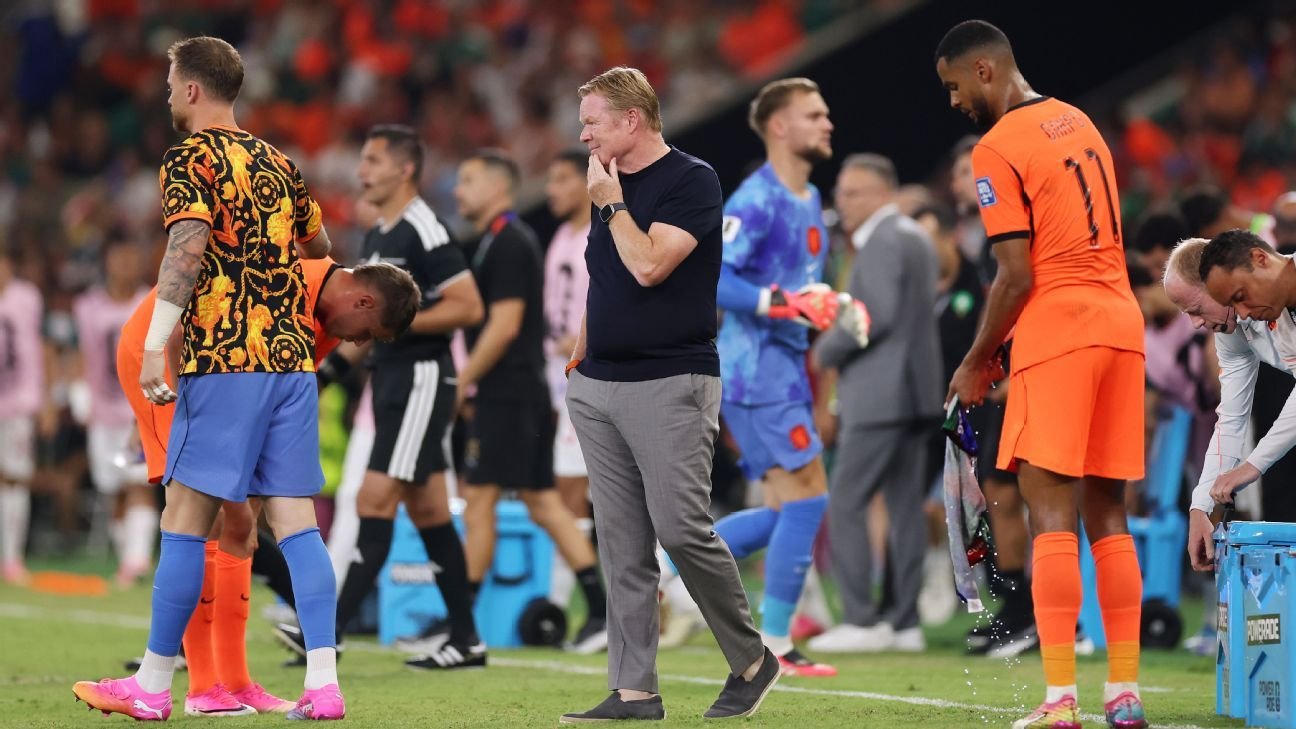
On Monday night in Monterey, justice prevailed under the watchful eye of Cerro de la Silla—specifically, footballing justice. This wasn’t just about Morocco’s spirited play; it underscored the Netherlands’ failure to deliver. In knockout tournaments, the goal is not merely to win, but to progress at any cost. Often, playing defensively and seizing chances on the counter is the most effective strategy. However, if that’s your approach, it has to be executed intelligently. Ronald Koeman’s team, unfortunately, failed on both fronts.
Don’t let the extended 120 minutes of the match, with injury time, hydration breaks, and penalty kicks, deceive you regarding Morocco’s eventual 3-2 shootout victory. The Dutch were even leading as the second-half injury time approached, thanks to an improbable square pass from Crysencio Summerville to Cody Gakpo, who, while on his backside, managed to convert one of only two shots on target that the Dutch managed in over 120 minutes. (The other was a header from Micky van de Ven, with an xG of 0.01, for those who are curious.)
– As it happened: Germany, Netherlands pay the penalty of KO soccer
– Dawson: It’s official, Germany are no longer a soccer superpower
– Ogden: Which World Cup front-runner needs its superstar more?
Koeman’s tactical choices leaned heavily towards a robust, defensive strategy that showed little flexibility. His back three, composed of Jan Paul van Hecke, Virgil van Dijk, and Nathan Aké, along with physically imposing full-backs like Denzel Dumfries on the right and the towering Van de Ven on the left, set a clear defensive tone. The midfield duo of Ryan Gravenberch and Frenkie de Jong were tasked with holding the fort, while Gakpo and the powerful Brian Brobbey spearheaded the attack, with Summerville representing a faint hope for flair.
If Johan Cruyff was watching from wherever he may be, one can only imagine his dismay—and perhaps a tear or two as he pondered the state of his footballing legacy. Is this truly the next generation carrying on his vision?
Executing such a strategy requires either physical dominance over the opponent or the ability to create danger on the counterattack. Sadly for the Oranje, they achieved neither. Morocco’s Achraf Hakimi struck the woodwork twice, while Azzedine Ounahi delivered moments of brilliance and tenacity. Brobbey, seemingly overwhelmed by defenders Issa Diop and Chadi Riad, managed a paltry amount of touches in the box, contributing to a meager xG of 0.23 throughout a match that extended to extra time—an impressively low figure for a team playing for so long.
Yes, this is a low-scoring sport, and the unpredictability of football is part of its charm. Koeman might argue that his blueprint was close to working. But truthfully, it didn’t.
You can’t prepare to be outmatched like that. Nobody anticipates a relentless onslaught. And while it’s worth noting the extraordinary luck Verbruggen had when Soufiane Rahimi shot at an open goal, only to see the ball ricochet off the Dutch keeper’s thigh and onto his arm, such moments are rarely part of a sound game plan.
Koeman’s failed strategies were exacerbated by questionable substitutions, like bringing on the immobile Wout Weghorst instead of genuine scorers like Memphis Depay or Donyell Malen. Furthermore, as Morocco pressed for an equalizer, he replaced his tallest defender with a significantly shorter player, which only compounded the errors.
But none of this should overshadow Morocco’s commendable performance.
They were composed and resolute, showcasing superior quality throughout the match. Coach Mohamed Ouahbi, who appeared somewhat out of place on the sidelines like an accountant at a wet T-shirt contest, has transformed his team from a reactive outfit into an assertive force that capitalizes on its attacking capabilities far better than his predecessor, Walid Regraoui, ever could. Looking back at Morocco’s journey to the World Cup semifinal in Qatar, one can see a marked evolution. The players may be similar, but the tactical approach is significantly improved, allowing them to play with confidence and take the initiative against their opponents.
While it remains uncertain whether they will replicate their success from four years ago and reach the World Cup final again, they have already made an undeniable statement. Their current FIFA ranking of No. 7 globally is not coincidental; they are among the elite in world football, demonstrating that fact on Monday.
This is why fate favored them in the penalty shootout, finally recognizing the deserving team. Ultimately, the footballing deities were on their side, eager to see the best team advance.