



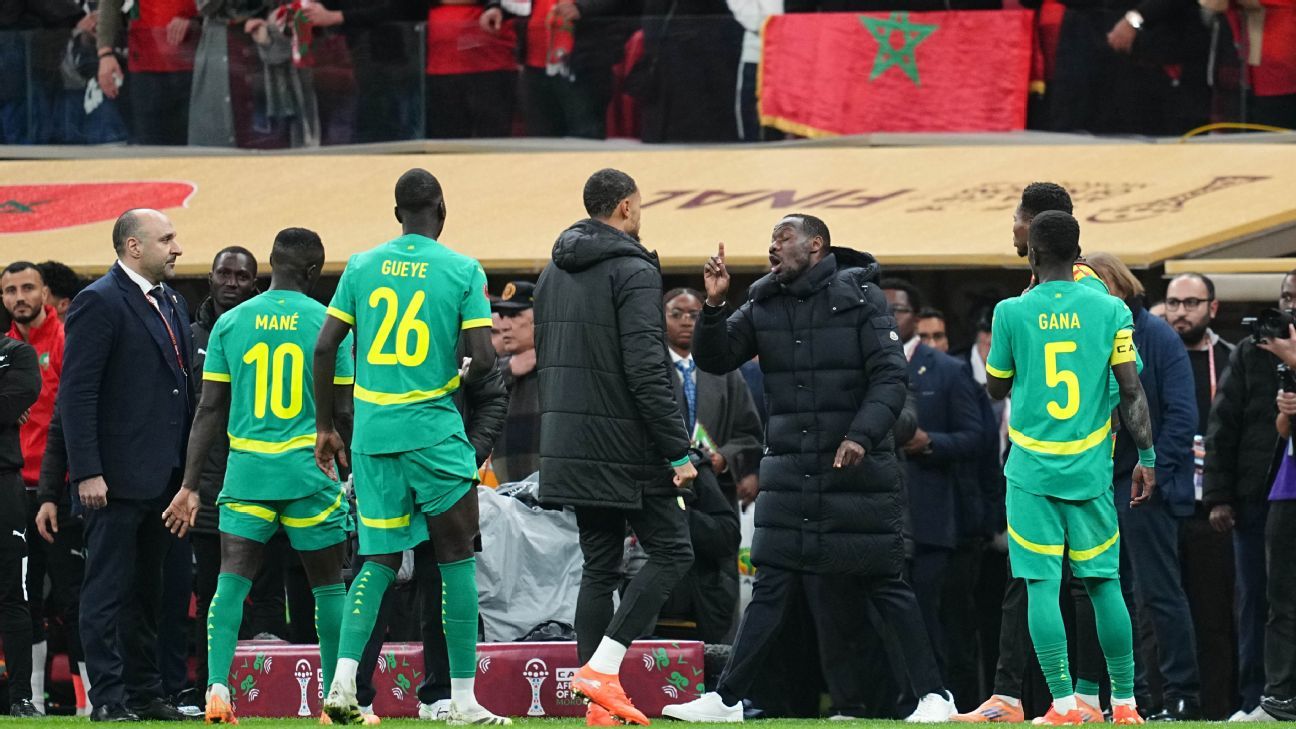
On Tuesday night, a significant shift in football history occurred when Senegal was officially stripped of the Africa Cup of Nations title that they — along with the majority of the globe — believed they had won in January. Fifty-eight days later, the African championship crown is set to be awarded to Morocco, following an official ruling by the Confederation of African Football (CAF) appeal body.
The final match was fraught with controversy, with critical decisions including a disallowed goal that went against Senegal. Additionally, Morocco, as tournament hosts, received a highly debated penalty awarded through the Video Assistant Referee (VAR) during stoppage time. In the wake of this decision, Senegal’s players protested and nearly all exited the field, led by their coach, Pape Thiaw, only to return approximately 10 minutes later, reluctantly resuming play.
After a lengthy pause of 17 minutes, the game resumed, with Morocco’s Brahim Díaz attempting a poorly executed “Panenka-style” penalty that was easily saved by Senegal’s keeper, Édouard Mendy, necessitating extra time. During the first overtime, Pape Gueye netted the decisive goal, securing a 1-0 victory for Senegal against a backdrop of fan unrest and chaos, characterized by player altercations with ball boys and heightened tensions.
Now, with the ruling in place, the situation highlights a straightforward interpretation of both the tournament regulations and the Laws of the Game: it’s the correct call. While justice may have been delayed, it has ultimately been served. Article 82 of the CAF rules explicitly states: “If, for any reason whatsoever, a team… leaves the field before the match’s regular end without the referee’s authorization, it shall be considered a loser and shall be eliminated from the current competition.” Article 84 further dictates that if a team violates Article 82, they shall “lose [the] match by three-nil.”
This is clear-cut: abandoning the field during a match without permission leads to forfeiture. Regardless of external factors like refereeing mistakes or crowd behavior, such actions do not justify leaving the pitch.
The pertinent question is not whether CAF’s appeals body made the right decision; it certainly did, given the regulations. Rather, it is why this matter escalated to this point and why it took so long to resolve.
On match night, referee Jean-Jacques Ndala Ngambo could have declared a forfeit. He should have issued yellow cards as players left the field without permission and had the authority to abandon the game if they did not return promptly. The lack of a definition of “reasonable time” leaves some ambiguity, yet logic suggests it should have been much shorter than the 17 minutes that transpired.
Why did the referee not take action? The reasons remain unclear; he had already made questionable decisions during the game. Perhaps he hesitated to end such a significant event in African football. During those tense moments, he appeared quite isolated.
What should have occurred — though it may remain a mystery — is that someone from within CAF, whether the head of referees or another official, should have intervened to remind him to enforce the rules appropriately. If that didn’t happen, it’s hard to fault the referee for attempting to conclude the contest.
However, this does not absolve CAF of responsibility for the ensuing events.
The day following the match, Morocco submitted an appeal to the CAF disciplinary board, urging a forfeit from Senegal. Nine days later, their ruling was announced, imposing suspensions and fines on several players and officials, including a five-match ban for Senegal’s coach Thiaw, while notably rejecting the Moroccan request for a forfeit.
The reasons for this remain unclear, but it seems that amidst the chaos, and amid accusations of favoritism toward the hosts, Morocco may have felt inhibited in enforcing their own rules.
A week later, on February 3, Morocco formally submitted their appeal to the CAF appeals board. It took them six weeks to arrive at a decision: Senegal forfeits the match, and Morocco is crowned champions, though they might want to temper their celebrations.
Senegal has already filed their appeal with the Court of Arbitration for Sport (CAS). This move was anticipated, as Senegal could argue that since the referee chose not to abandon the game after the walk-off and the players returned, Article 82 may not apply; furthermore, the 17-minute delay may not justify stripping them of the title. This appeal could extend the process by another two to three months.
Regardless of the final decision, it will likely be binary. There is unlikely to be a CAS ruling that satisfies both parties or that will be universally acknowledged as “fair.” (As noted by one CAS arbitrator, Raymond Hack, the ruling may ultimately favor Senegal.)
For now, it is crucial for CAF to consider a couple of lessons.
Firstly, disciplinary measures should not take this long to resolve. The situation is not overly complex; the evidence is relatively straightforward. It’s either a forfeit for Senegal’s walk-off, or it isn’t, since they did return and the referee chose not to abandon play.
Secondly, refereeing under such circumstances is exceptionally challenging and can feel isolating. Future protocols must ensure that match officials are supported in making these critical decisions.