



-

Emily Keogh
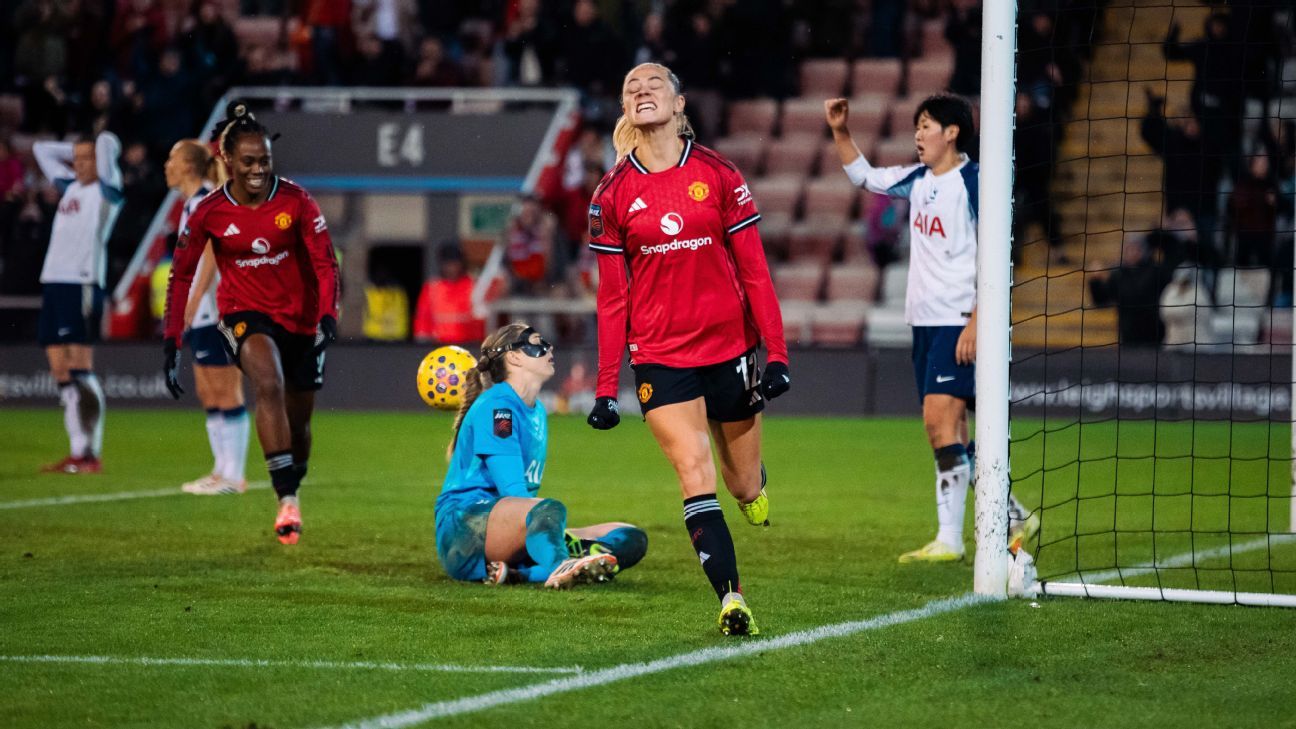
At the 60-minute mark at Leigh Sports Village, Manchester United found themselves in a precarious position, facing a potential historic defeat against Tottenham Hotspur. The visitors were ahead 3-0, having demonstrated clinical efficiency with three of their four shots on target resulting in goals.
Defensively, Tottenham excelled at frustrating United, who by half-time had already made 15 attempts—slightly above their season average of 14.5 shots during the Women’s Super League (WSL)—but struggled to convert opportunities into goals.
The game changed dramatically in the second half with the introduction of Fridolina Rolfö. The 32-year-old’s immediate impact was undeniable; after Ella Toone scored in the 74th minute, Rolfö almost single-handedly led United’s comeback, netting twice—including the equalizer at the very end—to secure a 3-3 draw.
By full-time, United registered a staggering 34 shots (the highest single-game total in the WSL this season), with 11 on target, achieving an Expected Goals (xG) tally of 4.38 while hitting the woodwork four times. In contrast, Spurs finished with an xG of only 0.78 and managed just five shots, four of which were on target.
The match exemplified the contrast between the two halves. Spurs initially showcased their striking efficiency but retreated too quickly, allowing a determined United to rally. Despite salvaging a point from a seemingly lost situation, the performance revealed their vulnerabilities.
Following a promising start in the UEFA Women’s Champions League (UWCL), United faced a heavy 3-0 defeat to OL Lyonnes just days prior, failing to register a single shot on target. Their previously reliable defense appeared shaky, and weaknesses in attack began to manifest throughout their game.
Where does this leave both teams? United sits nine points behind WSL leaders Manchester City (now in fourth place) and approaches the final UWCL matchday on Wednesday with a playoff spot secured. However, it is evident that United is not currently equipped to contend for both the WSL and UWCL simultaneously.
Yet, the resilience that has been lacking in previous seasons, particularly when compared to the consistent winning mentality of teams like Chelsea, is beginning to take shape.
Manchester City, Arsenal, and Chelsea have demonstrated the challenges of maintaining competitiveness on multiple fronts. Despite having a six-point lead over Chelsea in the WSL this season, City struggled last year with European qualification and momentum in both competitions due to injuries. Arsenal, for their part, compromised their domestic title chase after heavy losses to Aston Villa and Brighton but ultimately secured their first continental title in 18 years.
Chelsea exemplifies the sacrifices sometimes necessary; they have secured the WSL title for the past three seasons but at the cost of European success, as evidenced by their latest 8-2 aggregate defeat to Barcelona in the semifinals, marking their third consecutive elimination at that stage.
This season marks the first time United has juggled the demanding schedules of two incredibly challenging competitions, and their recent performances illustrate this learning curve. As they prepare for a pivotal Champions League match against Juventus on Wednesday, there are noteworthy takeaways from the draw with Spurs: the strategic timing of substitutions and the resolve displayed in overcoming a challenging scenario.
However, the vulnerabilities showcased by United cannot be disregarded. Their lack of clinical finishing has put additional strain on a defense that was previously among the league’s best. Consequently, United appeared exposed, and tactically astute opponents willing to capitalize on mistakes will consider this match a guide on how to contain and ultimately overcome them.
Injuries have undoubtedly exacerbated these issues; Celin Bizet is unavailable due to pregnancy, Hannah Blundell has only recently returned from maternity leave, and Millie Turner has been out since her injury against London City Lionesses. As a result, United has only two central defenders available, limiting their tactical options.
While the absence of depth can justify struggles against a formidable opponent like OL Lyonnes, who possesses one of the deepest squads in Europe, it is less valid against Spurs. Other than two recent signings, Spurs used a squad largely unchanged from last season, which United managed to beat comfortably twice. Furthermore, Spurs had only one attacking substitute available, making United’s squad depth appear relatively substantial in comparison.
Thus, a proactive January transfer window is crucial for United if they hope to remain competitive for the title and have a realistic chance of advancing in the UWCL. Significant investment will be essential for United to find success in both competitions, making this January arguably the most crucial transfer window in the club’s history.