



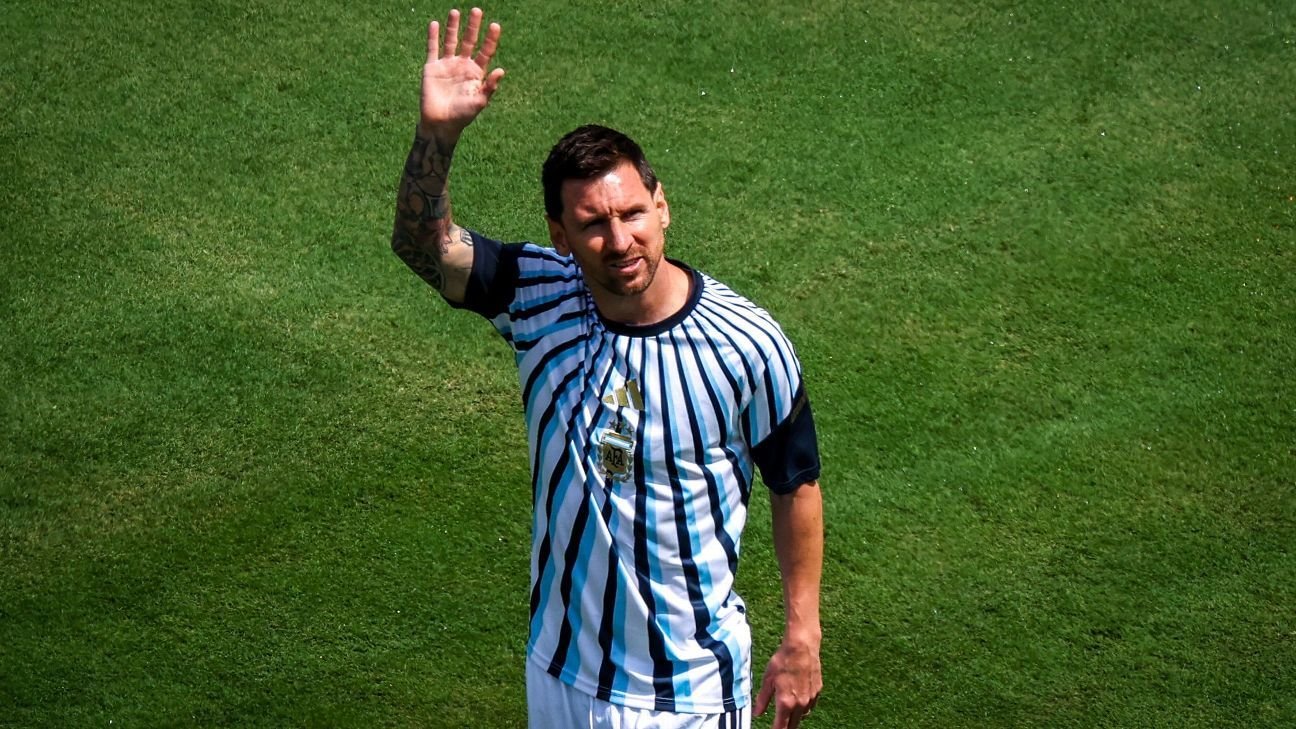
When a legendary figure steps back from the arena that defined their legend, it often feels like an obituary, a summarizing record for the public that encapsulates their identity, accomplishments, and significance. I prefer not to frame this in such a manner, particularly since Lionel Messi is still active—having announced his retirement from the Argentina national team on Monday while continuing to enchant fans in Major League Soccer. Just this past weekend, he netted four goals against Montreal, with the third one particularly striking.
There’s no need for me to recount his accomplishments in an Argentina jersey (though, to clarify, they are nothing short of remarkable: 21 years of international service, 207 caps, and 125 goals, ranking him second all-time in men’s soccer). He’s led his country to the most World Cup and Copa America finals and his triumph in Qatar four years ago arguably settled the GOAT debate with Cristiano Ronaldo.
Instead, I want to highlight the sentiments expressed in his farewell statement.
Words never flowed as smoothly for him as football did, yet there’s a certain charm in the image of his handwritten notes accompanying his farewell post—a reminder that, at 39, he belongs to the last generation that largely completed their assignments with pen and paper.
“It was a decision that hurt—and still hurts—deep in my soul, but I realize that the time has come,” he wrote. “I swear that I always gave my all—not just in recent years, but throughout my career. I always fought hard for this shirt, to bring you joy and make you proud to be Argentine through football.
“There’s not much time left and various chapters are closing; this one pains me deeply,” he added. “I love, have loved, and will always love being part of the national team.”
“I depart with the contentment and pride of having given you, alongside my teammates, moments we could only have dreamed of.”
In his 318-word post, he devotes considerable attention to how he consistently gave his all, even during difficult periods, and his love for playing for Argentina, finding solace in his contributions with the Albiceleste.
If you’re familiar with his journey, you understand why those reflections hold weight and recognize the toll it may have taken on him throughout his career—perhaps haunting him, causing unnecessary guilt. Messi’s early professional years were filled with extraordinary triumphs, yet all he had to show at the international level was individual honors—five Ballon d’Ors before turning 29—and club successes with Barcelona, where he secured eight La Liga titles and four Champions League trophies prior to the summer of 2016.
Having established himself as Argentina’s all-time leading scorer, he remained without a major senior title, suffering four final defeats. Additionally, Messi faced intense scrutiny—some criticisms now seem absurd. For instance, accusations that he was more invested in Barcelona than Argentina or that his composed demeanor indicated a lack of passion for the national side when compared to the legendary Diego Armando Maradona’s fiery leadership during the 1986 World Cup tilt. Who could overlook claims about his disinterest in singing the national anthem? (Yes, really.)
Ridiculous. Ignorant. Downright idiotic. (Especially the comparisons to Maradona, a unique talent who should never be juxtaposed with anyone else. Period.)
But it was also deeply hurtful. Following a Copa America Centenario final loss to Chile on June 24, 2016—his third consecutive defeat in a major final—he announced his retirement, stating “it is evident that this is not for me.”
Within two months, he rescinded that retirement, joining other key players in returning to the national squad. However, his recent statement hints that the shadows of that dark period, when he believed he was unable to assist his country and when some fans doubted his commitment, still linger.
Given his 70 goals in 91 appearances, two Copa America titles, and a 2022 World Cup victory since that brief retirement, one would think any Argentine fan who once criticized him has had a change of heart and repented.
You hope Messi has found it in himself to forgive them, but it’s clear he hasn’t forgotten. The weight of those past accusations still lingers, like an innocent person falsely accused.
As Messi transitions from international soccer, one hopes he also lets go of this burden. Everyone else has moved on. No one doubts his passion and connection to Argentina. His choice to address this in his farewell message reveals that, despite his extraordinary on-field talent, he is still human, grappling with insecurities like the rest of us.
The humanity he exhibited in his goodbye is nearly as heartwarming as the joy he has brought to soccer fans across the globe. Almost.