



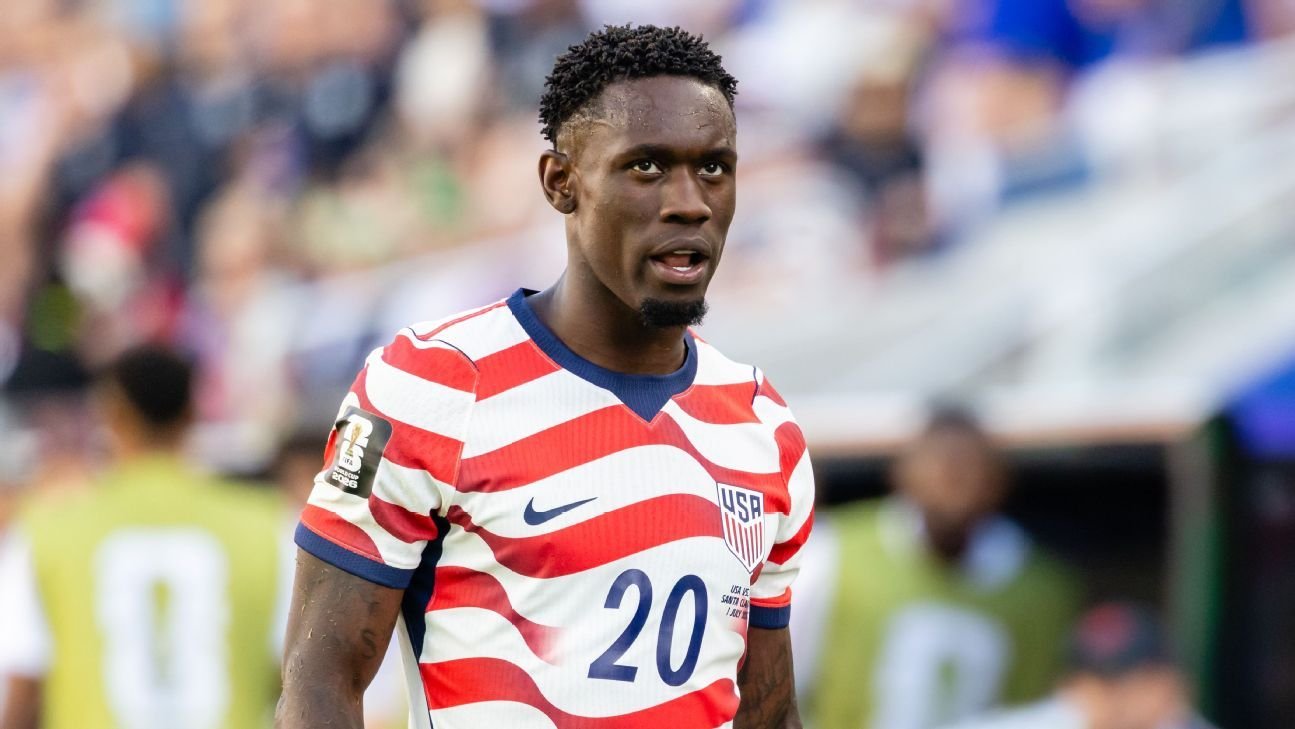
The United States men’s national soccer team celebrated a significant victory on Sunday without even stepping onto the field. Thanks to a surprise suspension reversal for Folarin Balogun, he is now eligible to participate in Monday’s crucial round-of-16 match against Belgium. However, this decision raises concerns for the World Cup integrity and could ultimately backfire on Mauricio Pochettino’s squad. When victories come under the cloud of questionable decisions made in secrecy, it diminishes their value.
Just four days earlier, FIFA clearly stated there would be no appeals process for Balogun’s red card suspension, leaving no room for debate. This approach often appears to bend the rules for players from high-profile nations—such as the co-hosting U.S.—to secure favorable outcomes.
A low-key announcement from FIFA on Sunday, notably absent from their social media channels, declared that Balogun’s one-match suspension would now be postponed for a year. As a result, Balogun, the U.S. team’s top scorer with three goals in the World Cup, is free to play in one of the team’s most critical matches in years on Monday night in Seattle.
“According to Article 27 of the FIFA Disciplinary Code, the automatic match suspension for U.S. player Folarin Balogun has been suspended for a one-year probationary period,” the statement said.
In an almost casual announcement, Balogun and the U.S. team seemingly reaped the benefits of what has come to be known as FIFA’s unofficial Cristiano Ronaldo Rule. When Ronaldo was sent off for elbowing an opponent during a World Cup qualifying match against Ireland last November, he faced a three-match ban. Yet, citing Article 27 allowed FIFA to reduce his suspension to just one game—against Armenia—leaving two matches suspended for a year. This decision enabled him to participate in the World Cup.
Balogun now sits at three goals alongside Ronaldo but also shares the unsavory distinction of dodging a suspension.
Belgium is understandably outraged.
The Royal Belgian Football Association (RBFA) expressed disbelief at FIFA’s decision to let Balogun play in the match. They hinted they might pursue legal action, stating that they are “exploring all possible options.”
While the comparisons to Ronaldo are not Balogun’s fault, the AS Monaco forward finds himself embroiled in a decision that raises suspicions of favoritism.
Reportedly, U.S. President Donald Trump contacted FIFA President Gianni Infantino prior to the decision about Balogun’s red card, and shortly after FIFA’s announcement, Trump took to Truth Social to celebrate, writing, “Thank you to FIFA for doing what was right and reversing a great injustice!” Infantino has previously shown a willingness to court Trump’s favor.
Many, including Trump, believe Balogun was unjustly given a red card after his challenge against Bosnia’s Tarik Muharemovic. Former Premier League referee Andy Davies told ESPN he believes the right decision ultimately has been made with Balogun’s reprieve.
“In my review of the match, I noted that not only was the original decision incorrect, but the VAR process did not adhere to protocol, as only slow-motion and still images were shown to the referee during the review process,” Davies explained. “Real-time footage should have been taken into account, but it was overlooked.
“I suspect FIFA has internally examined the incident and concluded that either the judgment to send off Balogun was wrong, or that the VAR process was improperly executed. Regardless, this outcome suggests FIFA is trying to use the regulations to lend credibility to their reasoning. However, the lack of transparency raises questions about the rationale behind essentially overturning a red card.”
0 – Since the introduction of yellow and red cards at the 1970 World Cup, no player has ever received a red card and gone on to play in his team’s next match at the FIFA World Cup.
Unprecedented. pic.twitter.com/mqPXgUBju3
— OptaJohan (@OptaJohan) July 5, 2026
This situation implies that the U.S. may be enjoying preferential treatment, with the standard process seemingly disregarded to favor the co-host. It sets a troubling precedent: If eminent players like Lionel Messi or Kylian Mbappé receive red cards in upcoming matches, will they also be exempt from discipline?
The response should categorically be “no,” but the Balogun ruling has altered the landscape, compromising fairness for everyone, including the USMNT itself.