



-

Jeff Kassouf
The NWSL’s Board of Governors, comprised of team owners and commissioner Jessica Berman, is currently engaged in advanced discussions regarding a new roster mechanism. This would enable each team to pay standout players significant salaries that exceed the existing salary cap, according to multiple sources for ESPN.
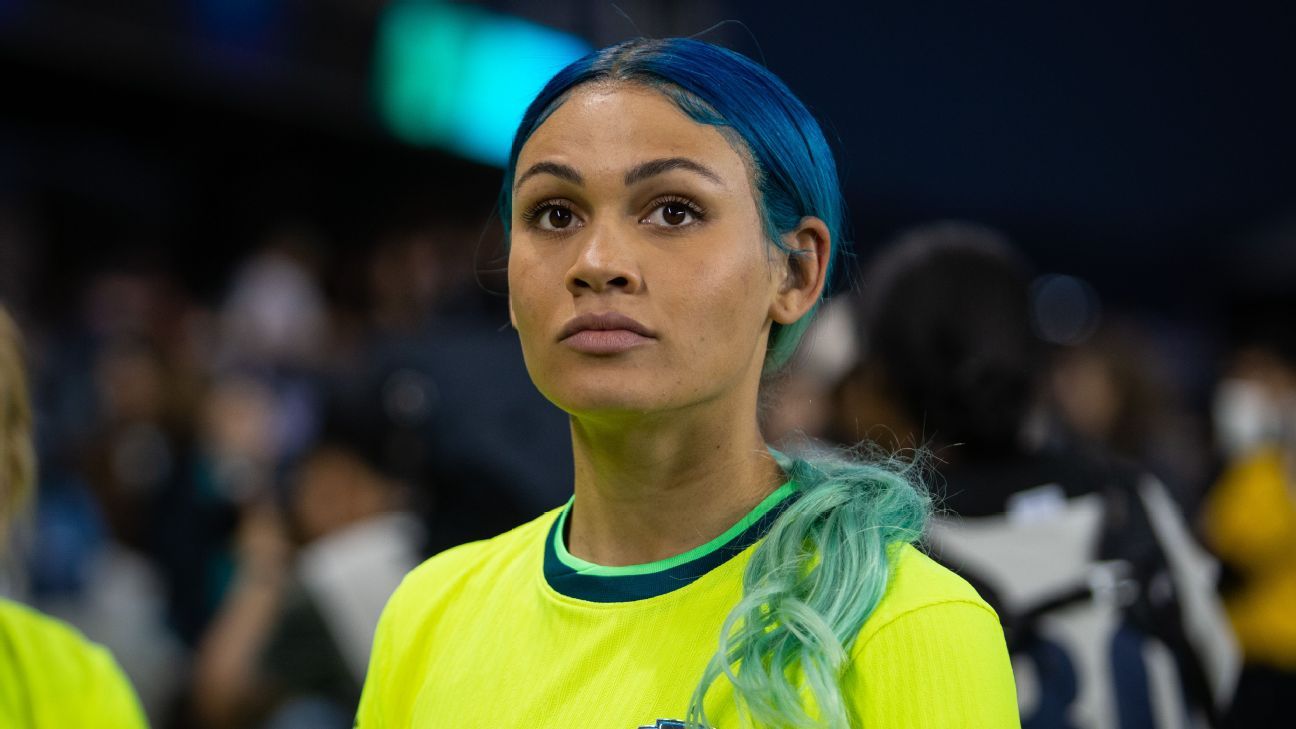
If approved, this change would represent a major shift in the NWSL’s long-term strategy, primarily aimed at retaining Washington Spirit forward Trinity Rodman within the league.
The proposed framework would allow each team a designated amount of money above the current salary cap to allocate to select star players who meet specific criteria; these funds could potentially be shared among multiple players. A version of this proposal is currently under consideration for a vote by the league’s board and may receive approval ahead of the scheduled board meeting next week.
Discussions surrounding this mechanism and other proposals have taken place almost daily among board members recently. Earlier in the year, there were discussions about it, albeit with less urgency. Debates have included considerations on which types of players should gain access to the proposed new funds, though the exact definitions remain unclear at this time.
The NWSL board believes that this rule could resolve the ongoing situation regarding Rodman’s free agency, as her contract is set to expire at the end of December. The goal is to keep her with the Spirit by offering a salary that would likely exceed $1 million, enabling them to compete against overseas offers. This change is also intended to provide NWSL teams with a similar financial advantage in comparable situations in the future.
Under the proposed framework, teams would not be permitted to allocate unlimited funds to any player due to a cap on the available additional funds.
Sources indicate that this solution could enable teams to distribute new funds to more than one player as long as those salaries surpass a specified threshold, although that amount has not yet been defined. The expectation is that this rule will allow teams to sign elite players at salaries that are increasingly reaching and exceeding the $1 million mark annually.
Previously, the NWSL utilized mechanisms such as allocation money—which is being phased out—to help teams offer additional compensation to players.
The salary cap for the NWSL in 2025 was set at $3.5 million, adjusted for revenue sharing. This figure will be the base salary cap for next year before accounting for revenue distribution, and it is likely to increase.
In MLS, teams can bring in Designated Players whose total compensation, along with transfer fees, exceed the maximum budget charge; the club is then responsible for funding the compensation beyond that maximum, which for 2025 was $743,750.
During a media conference on Tuesday, the new president of soccer operations for Washington Spirit, Haley Carter, mentioned that innovative solutions are being discussed regularly within the league, emphasizing the board’s “immediate and urgent attention” to the matter. She expressed optimism about finding a viable solution.
“Trinity is certainly a driving force behind this, but this is not just about one player,” Carter stated regarding the ongoing discussions. “We’ve lost several players in two transfer windows to overseas for substantial transfer fees. Our aim is to retain top athletes, build a competitive roster sustainably, attract more elite talent, and create an environment where world-class athletes want to play. Achieving this will require some innovative strategic approaches to roster construction that we haven’t fully explored yet.”
Rodman’s future has been uncertain for months as her contract expiration date approaches. Berman indicated prior to the league’s championship in November that they would “fight” to keep Rodman in the league, while also stressing the importance of maintaining the salary cap, stating that the NWSL is “not a charity.”
The situation reached a standstill last week when the National Women’s Soccer League Players Association filed a grievance against the NWSL, claiming that the league violated the collective bargaining agreement (CBA) by rejecting the Washington Spirit’s significant contract offer to Rodman.
The NWSLPA submitted the grievance on behalf of Rodman on December 3, asserting that the league’s refusal to accept the agreed-upon terms between Rodman and the Spirit represented a “flagrant violation” of her free agency rights and several sections of the CBA.
Rodman and the Washington Spirit had agreed on a multiyear contract that would have backloaded compensation in the final years, according to the grievance.
Sources familiar with the contract noted it was expected to be a four-year deal with escalators that would push the average annual compensation over $1 million, potentially making it the largest contract in NWSL history.
The league has 14 days to respond formally to the grievance.
If an agreement is not reached within that timeframe, a grievance committee—composed of one representative appointed by the league and one by the players’ association—will evaluate the case.
If the committee fails to resolve the issue, the matter will advance to arbitration, which both parties can choose to proceed to directly.
A league spokesperson provided the following statement to ESPN last week: “Our goal is to ensure that the very best players in the world, including Trinity, continue to call this league home. We will do everything possible, utilizing every resource at our disposal within league rules, to keep Trinity Rodman here.”
Rodman has been with Washington since being selected as the No. 2 pick in the now-defunct draft in 2021.
As a rookie, she contributed to winning Washington’s first NWSL Championship that year. The Spirit were runners-up in both 2024 and 2025. After her rookie season, she signed a new four-year deal worth a total of $1.1 million.
Earlier in the year, she mentioned to ESPN’s Futbol W that she “always envisioned playing overseas at some point in my career” and that it was “just a matter of when.”
ESPN previously reported that Rodman has received several offers from European clubs that surpass what NWSL teams are able to pay her due to the salary cap constraints.
The CBA, ratified in the summer of 2024, stipulates that the NWSL’s team salary cap will increase annually through 2030. By 2029—the last year of Rodman’s proposed four-year deal—the base salary cap is set to be $4.9 million.
Currently, there is no defined maximum salary in the CBA. The league’s intervention in Rodman’s case could effectively create one, as argued by the NWSLPA in the grievance.
In a recent anonymous survey conducted by ESPN among general managers, there was widespread concern that the NWSL would struggle to attract top players under the current salary cap structure.
Rodman’s possible departure to a foreign league would represent yet another setback for the NWSL, following the unexpected exit of USWNT forward Alyssa Thompson from Angel City FC to Chelsea in September.
Establishing a new rule for world-class players could help retain elite talent and attract new players from abroad, who are currently out of reach due to exorbitant salaries.
“We were in discussions with a top player from Europe who was willing to take a pay cut in this last window, but the pay cut was so substantial that it was difficult for her to justify,” stated one GM in our recent survey. “Players are even open to accepting slightly lower salaries [to play here], but we’re talking about a significant reduction of a third off their salary.”