



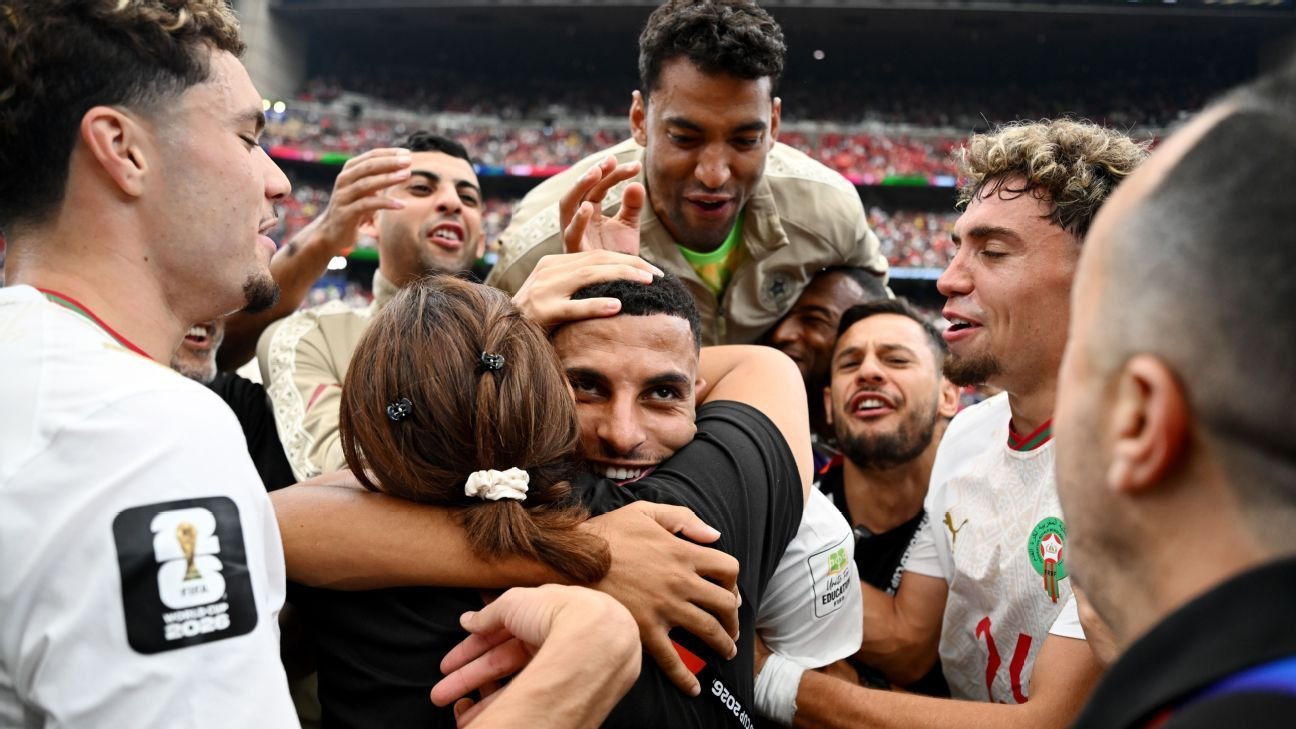
HOUSTON — On the Fourth of July, as the United States celebrates Independence Day, Morocco made a significant statement of their own.
The World Cup semifinalists from four years ago, now firmly established among the tournament’s elite, took their time to ignite the action against Canada in the round of 16. However, with two brilliantly executed goals from Azzedine Ounahi and a third in stoppage time by Soufiane Rahimi, Morocco emerged with a convincing 3-0 victory in Houston.
Their quality, highlighted by Ounahi’s performance, proved crucial at critical moments, setting up a challenging quarterfinal matchup against France or Paraguay.
In contrast, the co-hosts Canada were left pondering missed opportunities. As the quieter of the World Cup host nations, the only ones now competing away from home, they showcased their ability to compete at this level for at least 45 minutes of the match.
Coach Jesse Marsch asserted afterward, “We were the better team. [Morocco] executed a couple more plays than us. The intensity wasn’t the problem; they simply had a little more quality in the final third.
“Regarding our match plan and how we wanted to play, we took a top team that hasn’t lost in a long time and pushed them to the limit.
“We were the superior side in both the first half and at the start of the second half. It was just one moment that made it 1-0. Otherwise, the game was in our hands.”
– World Cup bracket: Every team’s route to the final
– World Cup Power Rankings: Who’s No.1 in round-of-16 field?
– Grades for every eliminated World Cup team
Morocco’s coach, Mohamed Ouahbi, had a different perspective. “In terms of intensity, [Canada] were commendable,” he responded to Marsch’s statements. “They performed well for 98 minutes.
Was their performance superior? It’s tough to say, especially after a 3-0 defeat. We were stronger in the second half.”
Canada’s spirits were dampened by Ounahi’s opener in the 50th minute, set up by Achraf Hakimi, who exploited a defensive mistake from Canada. Ounahi’s late second goal, courtesy of Brahim Díaz‘s agility, and Rahimi’s third goal—scored during a late counterattack as Canada pushed forward—sealed the inevitable outcome.
Ultimately, Canada couldn’t reclaim their first-half rhythm. It was a lost opportunity and a valuable lesson learned. In a World Cup knockout match, simply being the better team and creating more chances isn’t sufficient. Morocco has demonstrated, across consecutive World Cups, their killer instinct.
“It was challenging for us,” Ounahi reflected afterward. “They posed many problems for us in the first half. There are no easy matches in this tournament.”
Morocco’s fans were notably energized ahead of the match, accustomed to supporting a top team that has shed its surprise status. Throughout this World Cup, they have witnessed Morocco compete fiercely with Brazil in the group stage and eliminate the Netherlands on penalties.
However, they were momentarily stunned by Canada’s unexpected dominance in the first half. Morocco may have held 65% possession, but they were ineffective, managing only one shot resulting in an xG (expected goals) of 0.02 for the half. Morocco made merely 11 passes in the attacking third before halftime, while Canada completed 38.
Canada had opportunities through Jonathan David and Tani Oluwaseyi, both thwarted by goalkeeper Yassine Bounou, who was born in Montreal before his family relocated to Morocco. Bounou’s consistent excellence often goes unnoticed.
Morocco faced an early setback with an injury to rising star Ismael Saibari
. While two of their key players, Hakimi and Díaz, remained largely uninvolved in the first half—Díaz recorded just 14 touches, the least of any of his teammates. Morocco’s most notable first-half contribution came from referee Michael Oliver’s notebook, as they accumulated four yellow cards.
Not long after halftime, all of Canada’s first-half efforts were undone. As they prepared to take a free kick in an advanced position, Hakimi spotted Ounahi unmarked at the edge of the box. Ounahi then expertly guided the ball through the crowd and into the bottom corner.
Although players like Saibari, Hakimi, and Díaz tend to capture the spotlight, Ounahi has proven himself just as talented. Four years prior, he impressed as Morocco eliminated Spain on penalties at this same stage. “My word, where did this boy [Ounahi] come from?” exclaimed then-Spain coach Luis Enrique. “He surprised me.”
Ounahi is no longer a surprise to anyone. Last season, he was outstanding for Girona in LaLiga, even as his team faced relegation. Following Saturday’s standout performance, it seems likely he won’t remain in Spain’s second division for much longer.
In the 82nd minute, Ounahi extended the lead to 2-0, finishing emphatically after a clever touch from Díaz that evaded two defenders. Díaz also assisted Rahimi’s third goal. Having had a slow start to the match, the Real Madrid player now boasts four assists in this World Cup.
However, Ounahi was the standout performer. He has now featured in 12 World Cup matches; only one African player, Hakimi, has more appearances. Morocco is through to consecutive World Cup quarterfinals, while Canada must contemplate how to improve for 2030.
“Despite our performance, [Morocco] bent but did not break,” Marsch concluded. “On another occasion, we might have taken the lead and secured the win.”