



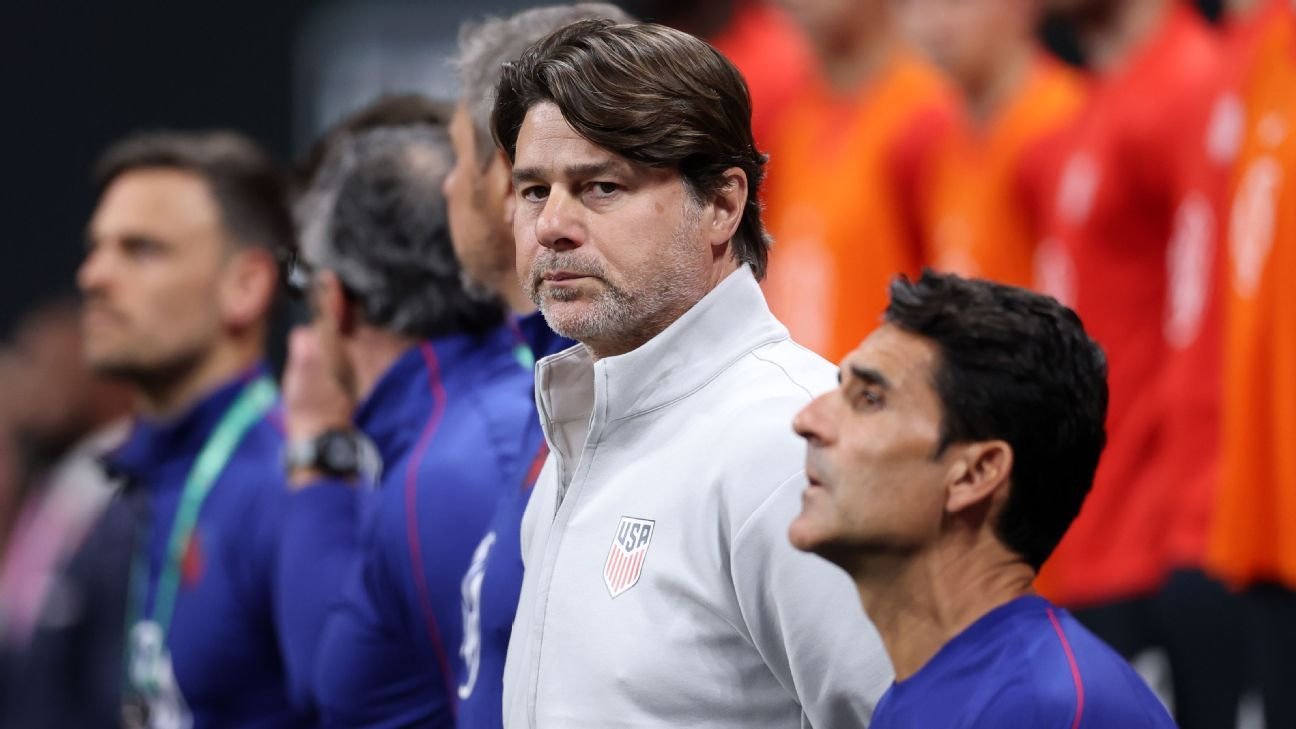
U.S. Soccer confirmed on Monday morning that Mauricio Pochettino has extended his contract to remain as the manager of the U.S. men’s national team. His new agreement will extend until the end of the 2030 World Cup.
Joining him will be his long-time assistants: Jesus Perez, Miguel D’Agostino, and Toni Jiménez, along with more recent team members Sebastian Pochettino and Silvia Tuyà.
U.S. Soccer CEO and Secretary General JT Batson shared in a statement, “Mauricio and his staff have a strong belief in the future of soccer in the United States. This new initiative will help us build on the progress of the USMNT and harness the growing momentum of U.S. Soccer. There’s significant work ahead to meet our goals, including winning Men’s World Cups and making soccer the most popular sport in every community. I am thrilled that Mauricio and his team are committed to collaborating with us to realize these ambitions.”
According to U.S. Soccer, Pochettino’s continued tenure, along with a broader investment in the USMNT, has gained support through a significant philanthropic contribution from Kenneth C. Griffin, the founder and CEO of Citadel, along with additional backing from Scott Goodwin, Adam Freede, and several commercial partners.
In recent weeks, there were hints of Pochettino’s reappointment. Telemundo broadcaster Andres Cantor was the first to report progress in renewal talks, and U.S. Soccer president Cindy Parlow Cone informed Apple TV before Wednesday’s MLS All-Star Game that discussions with Pochettino and his staff had been very positive.
“Mauricio has fostered a culture where players trust one another and the process,” Cone stated Monday. “We witnessed the importance of that trust in how the team grew, competed, and performed on the grandest stage. This culture and the staff who nurtured it are vital for our continued investment in the Men’s National Team, both now and in the future.”
Conversations between the two parties began before the World Cup and intensified in recent weeks.
Pochettino expressed, “Working alongside U.S. Soccer over these last two years, we’ve recognized the vast potential to further strengthen the Men’s National Team program. The passion we felt from fans during the World Cup only deepened our belief in the possibilities ahead. We are eager to leverage our experience and knowledge to enhance various aspects of U.S. Soccer while bolstering pathways for players, coaches, and teams within the Federation.”
Since taking the helm in September 2024, following the USA’s disappointing exit in the group stage of the 2024 Copa América, Pochettino has seen a mix of results. However, he guided the U.S. to the round of 16 at the 2026 FIFA World Cup, where they faced Belgium and lost 4-1. The Americans reached the knockout stage after topping Group D, celebrating victories against Paraguay and Australia, and defeating Bosnia and Herzegovina 2-0 in the round of 32, finishing with a record of 17 wins, 12 losses, and 2 draws (W-L-D).
While the round-of-16 outcome was consistent with pre-World Cup expectations, there had been aspirations for the U.S. team to capitalize on home-field advantage and progress further in the tournament. The defeat to Belgium, however, was disheartening.
Pochettino had previously hinted at a desire to return to European club football, citing a longing for its daily challenges. He had been linked to positions at AC Milan and Real Madrid, leading to speculation that he would leave after this World Cup cycle. However, U.S. Soccer leadership recognized significant progress under his management and was eager to retain him. One source within the federation highlighted Pochettino as “a world-class manager who shares our ambitions and loves our fans and country. The cultural foundation is well established within the program concerning both on- and off-field standards, emphasizing that the crest’s significance transcends any individual player.”
Pochettino also saw reasons to remain. He noted that his reappointment is an opportunity to “make a lasting impact on soccer in this country, which has welcomed us so warmly, and for that influence to reach beyond just on-field results,” while also engaging with a new generation of talented players. The support of fans and the organization played a significant role as well.
“The connection we felt during the World Cup, both with the people and the entire organization, was a key factor in this decision,” Pochettino remarked in a roundtable with reporters.
He believes that the gap between the USMNT and the top global teams is narrowing, and he sees his task as bringing the U.S. closer.
“I believe we can approach things differently. Reducing that gap is feasible. We have the talent, the organization, the ability to create a great atmosphere on the pitch, and the backing of our supporters,” he stated.
While reappointing Pochettino offers potential, it’s not without risks. Historically, U.S. managers who have embarked on their second World Cup cycle haven’t always fared as well as in their first. Bob Bradley, Jurgen Klinsmann, and Gregg Berhalter were all dismissed before reaching a second World Cup, while Bruce Arena could not navigate the U.S. beyond the group stage in 2006 after reaching the quarterfinals in 2002.
Pochettino will also need to face the challenge of World Cup qualifying, something he bypassed in the 2026 cycle, since the U.S. was a co-host with Canada and Mexico. Nonetheless, with six Concacaf teams qualifying for the 2030 World Cup, the U.S. should have a favorable chance of securing a spot. Whether this prospect appeals to Pochettino is yet to be determined.
There are concerns regarding Pochettino’s commitment, as he might still yearn for a return to Europe and leave before the contract cycle concludes. However, a source with direct insight into the discussions mentioned there is “mutual protection” if their partnership ends before the contract is complete.