



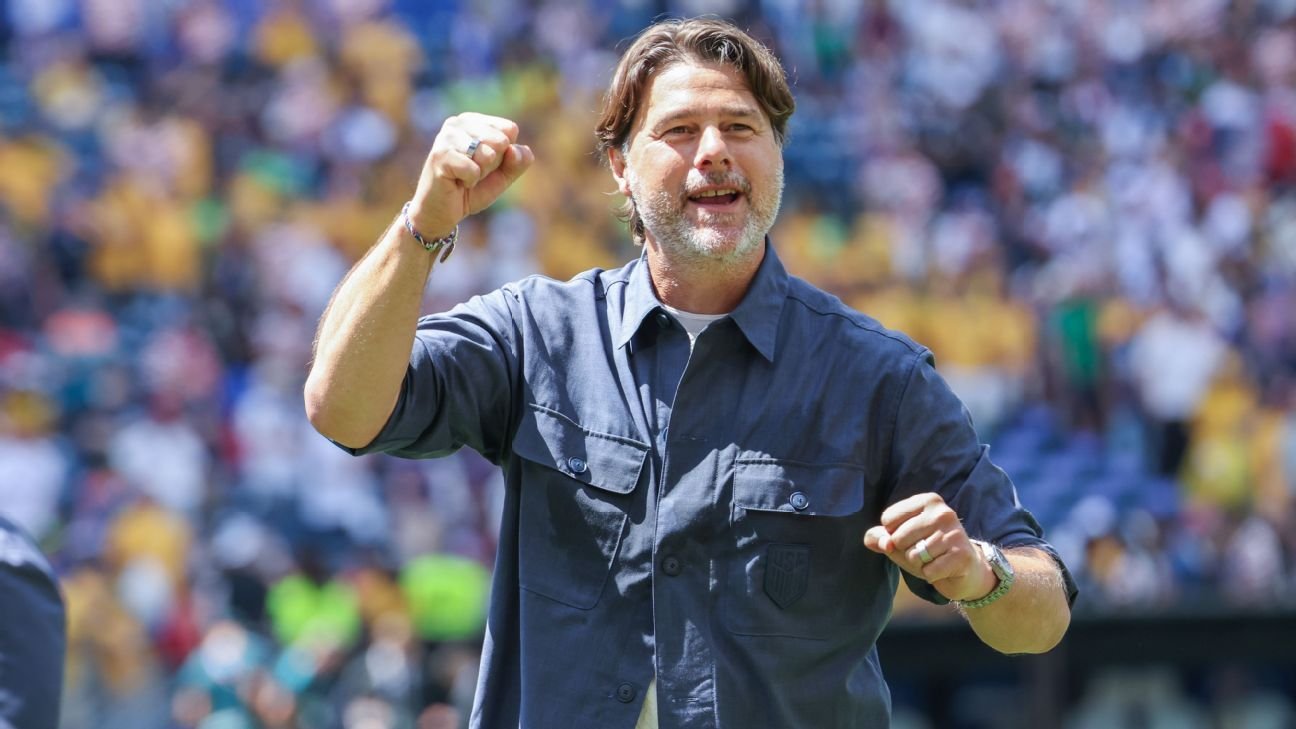
LAGUNA NIGUEL, Calif. – United States men’s national team manager Mauricio Pochettino admitted that he and his staff were “naïve” when he initially signed with the U.S. Soccer Federation in 2024, feeling that the complacency surrounding the program was like receiving a “big punch.”
Pochettino and the USMNT are riding high at the World Cup, having already secured the top position in Group D with one game remaining, which will be against Turkiye on Thursday. The team’s performance has been impressive, marked by a commanding 4-1 victory over Paraguay and a solid 2-0 win against Australia.
However, upon arriving after the team’s elimination in the group stage at the 2024 Copa America, Pochettino was taken aback by the absence of enthusiasm within the program.
“We were so naïve when we signed our contract,” Pochettino reflected during a roundtable discussion with reporters on Tuesday night.
“What we discovered after signing was a misjudgment of the situation. It was worse than we anticipated.” He noted that he expected people to be eager to assist and engage with the national team, but instead found the opposite was true. “We took a big hit… We said, ‘What the f—?'”
Speaking from his office at the team’s hotel, adorned with motivational phrases like “Believe. Work. Compete” and “Now Is Our Time,” along with a prominent “Why not U.S.” sign, Pochettino explained that once the initial shock wore off, he and his team embarked on what he terms “a process.” They focused on analyzing the roster, scouting new talents such as defender Alex Freeman and midfielder Sebastian Berhalter, and reigniting a passion for the USMNT.
Despite doubts arising from poor results, including two losses in the 2025 Concacaf Nations League final, Pochettino remained committed to his approach. He suggested that the setbacks were necessary for development. “I think it was a plan to absorb a painful lesson that was essential,” he stated. “It helped players realize that without the right effort, success at the World Cup is unattainable.”
Pochettino aimed to foster a culture where no spots were guaranteed, where reputations mattered little, and where every achievement had to be earned. Yet, this transformation required time.
“It’s hard to analyze the process… at first, when you plant a seed, nothing is visible, but then the tree begins to grow,” Pochettino explained. “It’s difficult to articulate the plan because progress isn’t as apparent as in a football club where games are played every few days.” He added, “The entire process was necessary for change.”
Throughout this journey, Pochettino cultivated a sense of self-belief within the squad. He recounted a team meeting in November 2025, where he drew parallels to South Korea’s surprising semifinal run in the 2002 World Cup and Morocco’s unexpected success in 2022. He felt the U.S. team could achieve similar feats.
“At that moment, I thought, ‘Okay, why not us?'” he recalled. “Their response was shock. ‘Why not us?’ became our motto: ‘We can. If we believe we can, we can. If we work hard, we can. If we change our mindset, we can succeed.’
Pochettino also observed a growing bond with the fans. Reflecting on the painful experience of having 70,000 Mexico supporters fill the stadium during the 2025 Gold Cup final, he noted how the atmosphere has shifted. The crowd’s support for the team, including the two World Cup matches and pre-tournament friendlies, has been remarkable. The players were particularly touched when Seattle fans serenaded them with “Take Me Home, Country Roads,” prompting Pochettino to learn the lyrics himself.
“It was heartwarming to hear our culture reflected in Seattle,” he said. “This connection between the national team and its fans is the most important legacy.”
While Pochettino has been linked to various European coaching positions during his time with the U.S., he has not dismissed the possibility of returning to the national team. However, in the roundtable, he emphasized that his current priority is the present.
“If we want to stay, we have months, days, or weeks to talk; the next World Cup is four years away,” he said with a smile. “We have informed the Federation that we are open to discussion, but now is not the time to be distracted. All our energy needs to focus on my players.”