



MACCLESFIELD, England — Sam Heathcote is on the practice field, distributing training bibs on a chilly January morning. At 28 years old, he’s been involved in football since he was a teenager, navigating the lower tiers of English soccer. His most cherished moment took place just weeks ago when he played a pivotal role in helping Macclesfield, a non-league club in the sixth tier, pull off a sensational upset by knocking out Premier League giants Crystal Palace in the FA Cup.
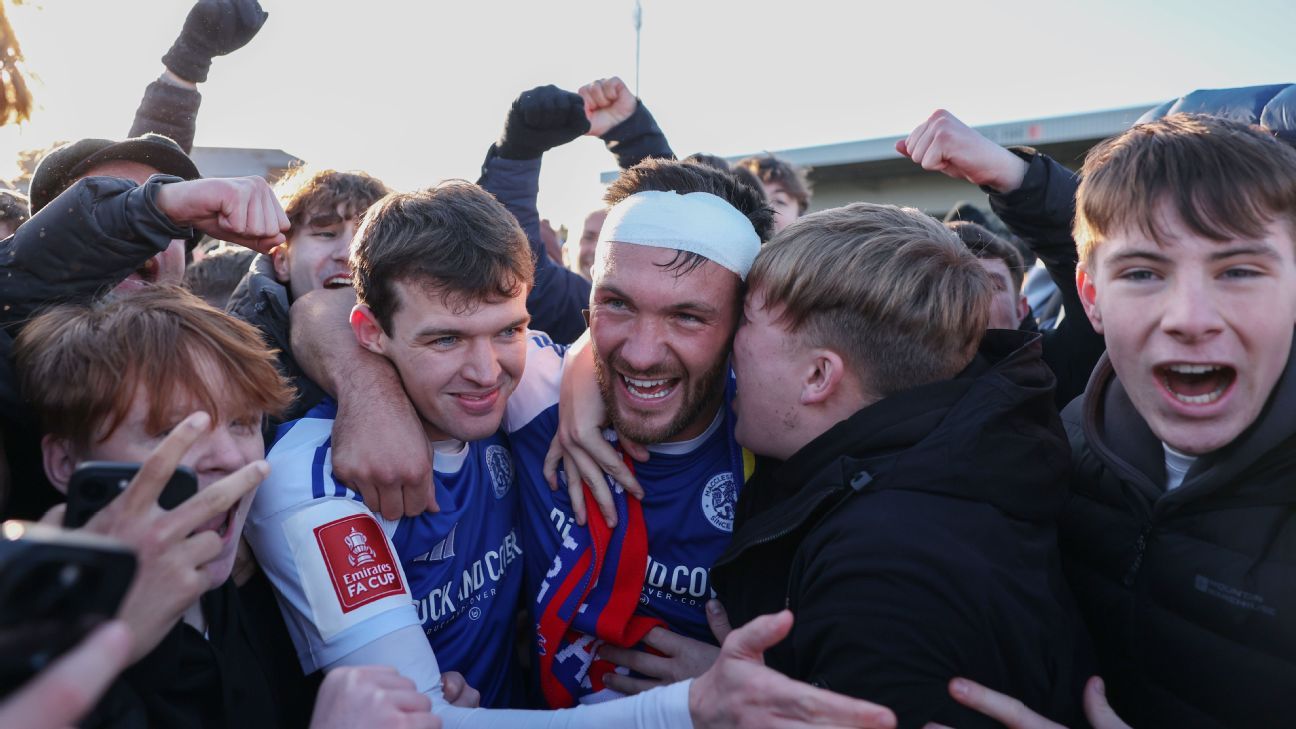
That match was a fairy tale moment in football history—truly a Cinderella story. The disparity was staggering: 117 places separated Macclesfield from Palace in the football hierarchy, and Palace were the defending FA Cup champions. Never before in the 154-year history of the FA Cup, renowned for its thrilling upsets, had such a result occurred. The ecstatic crowd flooded the pitch at the final whistle, hoisting players on their shoulders. It’s a moment that every Macclesfield supporter, including Heathcote, continues to relive.
On this brisk morning, the memories of that magical match remain vivid for Heathcote, though today’s training is far from typical. The session takes place on a concrete field at a primary school near Manchester, with all participants being just 10 years old. Most players on the Macclesfield squad juggle multiple jobs: there’s a property developer, a lawyer, a podcast host, and a gym owner. Their captain, Paul Dawson, manages to supplement his income by packing boxes for a friend’s candle business.
– Ogden: From Wrexham to Macclesfield, FA Cup is why we love soccer
– Olley: The job was too big for Frank, but Spurs’ problems go much deeper
– Connelly: Premier League’s 50 worst transfers of all time
Heathcote, a 6-foot-2 center-back known for his straightforward approach, also teaches gym classes, and today, he’s in the midst of that role.
“Aubrey, everyone else has chosen red. You’ve picked orange,” Heathcote observes, directing his attention to one of the children.
“I like orange!” replies Aubrey, blissfully unaware of soccer’s strict color rules.
“Fair enough,” Heathcote chuckles, respecting Aubrey’s choice. Life as a semiprofessional footballer moves quickly.
Macclesfield’s moment in the spotlight hasn’t ended. Their stunning victory secured them a spot in the fourth round of the FA Cup, where they’ll face Brentford, another Premier League team, on Monday (Watch live on ESPN+). The pressing question is whether they can replicate that iconic performance.
Brentford will certainly take notes from Palace, whose manager, Oliver Glasner, remarked that his players “never showed up.” But what can other teams learn from the journey of Macclesfield?
LESSON 1: Embrace a Purpose
If anyone in Macclesfield exemplifies resilience, it’s Robert Smethurst, the club’s 48-year-old owner. He stepped in to save the club six years ago when it teetered on the brink of collapse. English football’s breeding ground is known for its harsh realities, and Macclesfield had been through a tumultuous period, facing £190,000 ($258,554 USD) in debt and resulting player strikes from unpaid wages.
Despite living just eight miles from the Moss Rose stadium, Smethurst had never been a fan of the team, nor had he ever attended a match. He was oblivious to the extent of the crisis: debt collectors had stripped the club of all valuables, from kitchen appliances to copper piping. The team roster had vanished. Why did he decide to purchase it?
The truth is, Smethurst scarcely remembers making the offer. At that time, he was also grappling with personal turmoil. After selling his online car business for over £10 million ($13.6 million), he had lost his sense of purpose.
“What do you do when you’re bored and it’s noon? I poured myself a glass of wine,” Smethurst recounted to ESPN. “Things spiraled from there, leading to addiction. I found myself drinking more and more, losing who I was.”
It was a friend who noticed the distressed club listed online, and in a haze of alcoholism, Smethurst instructed his solicitor to place a £500,000 ($680,267) bid without a second thought.
“I don’t fully recall my state of mind,” Smethurst reflected. Once the sale went through, reality hit hard.
“I was stunned, thinking, ‘What have I just bought?’” he recalls, realizing the extent of the club’s decay when he finally visited it—he had never even seen it before.
The stadium’s condition was grim, but the overall scenario was worse. After declaring bankruptcy, a club must be reinstated from the very bottom of the league structure. Forget about competing at the sixth tier; Macclesfield had to re-enter at the North West Counties Football League—the ninth and lowest tier, where games often attract fewer than a hundred spectators.
Smethurst didn’t quit drinking until a year later. “I committed to recovery,” he said. “I followed the steps, learned about my issues, and discovered I was neglecting my purpose. Around this time, I was also diagnosed with ADHD.”
“Recovery gave me a renewed mindset,” he explained. “I was fighting for my existence while wanting to make a positive impact. All my initiatives with the club were about constructing something impactful post-recovery and positively affecting lives.”
On this path, he has invested approximately £4 million ($5.4 million) to renovate facilities, including new pitches, bars, and a gym for the community.
In their first four seasons, Macclesfield clinched three promotions and bagged three league titles, with their trophies proudly displayed in the club bar. Their ascent was largely attributed to their substantial capital investment at each level. Locals attribute their rapid rise to the club’s upgraded facilities and Smethurst’s financial support.
While Smethurst acknowledges that financial strength aided their early success, they now rely on community spirit and additional investments to propel them further after achieving stability at this level.
“I engage directly with fans, inviting them to share concerns or meet up for coffee,” he shared. “It creates a sense of unity. I’m here for everyone, always accessible, should they want to reach out.”
LESSON 2: You’re Never Alone
John Rooney, stepping into his first managerial role with Macclesfield, found himself preoccupied with something more profound than game tactics—a mere hour before the crucial FA Cup match against Palace.
The team gathered in their locker room, but one player’s space remained empty. That spot belonged to 21-year-old striker Ethan McLeod, who sadly lost his life in a road traffic accident on December 16—just one week after Macclesfield secured the chance to face Palace and less than a month before the decisive match.
Rooney had spoken to McLeod’s parents the night before the match, and they expressed their support, assuring him they would be present. Now, as the kickoff signaled approaching, Rooney grappled with whether or not to pass on that message, fearing it may heighten the emotional strain on the players.
“I pondered whether it was helpful or harmful to share that,” Rooney reflected.
Ultimately, he opted not to inform them; the grief was too raw. He recognized that his players were genuinely motivated to win for Ethan, whose presence is felt at the pitch, and whose number has been retired. Such sentiments could wait until after the match.
The incident occurred after a last-minute 2-1 victory against Bedford Town FC, in which McLeod, having just started gaining traction, was an unused substitute.
“I will carry with me the memory of his selflessness,” remembered striker Danny Elliott, Macclesfield’s leading scorer. “He was a striker like me. That evening was a turning point for him; even though he didn’t play, he celebrated my last-minute winning goal with genuine joy, despite his chances being impacted.”
McLeod usually rode the team bus back, but that night decided to drive home to Wolverhampton. Minutes behind the bus, it got caught in heavy traffic due to the accident. After returning home early due to the delay, Rooney received the terrible news, discovering it was McLeod’s vehicle involved in the accident.
Having been awake for nearly 24 hours, Rooney opted to convey the news to his players himself, reaching each one individually.
“The players broke down when I shared the news; after each call, I would inform the next,” Rooney recalled.
“I have the utmost respect for him as a manager,” Elliott noted regarding Rooney. “It was his birthday, making it even more challenging.”
The next evening, the team assembled at Moss Rose in the club bar, spending hours together in a healing space. “We gathered, shared our grief, and wept together for hours,” Elliott reminisced. “But the beauty of football is that it continues.”
Macclesfield decided to postpone their following game, prioritizing collective mourning. They suffered two losses in their next three matches. The upcoming FA Cup match would mark their fourth encounter since the tragedy.
LESSON 3: Defy the Odds
All Crystal Palace’s players only needed to glance to their left to understand the warning before stepping onto the pitch for the FA Cup match. Written above the tunnel, that poignant phrase declared: “DREAM. BELIEVE. ACHIEVE. AGAINST ALL ODDS.”
Perhaps the Palace players overlooked the message. The field itself had barely thawed from a recent snowfall. Macclesfield’s captain, Dawson, amidst juggling his various commitments, had spent hours helping to clear snow from the pitch earlier that week, much to the displeasure of coach Rooney.
“I was shoveling until the manager called me,” Dawson quipped, remarking that he had only been relaxing on a tractor instead of taking part in the strenuous work.
Dawson’s efforts had paid off, but conditions remained far below what Premier League teams typically expect. Before the match, Dawson exchanged pleasantries with his opposite number, England international Marc Guéhi, who later signed with Manchester City. Dawson recalled: “Franny [our assistant coach Francis Jeffers] remarked to Guéhi, asking if the pitch was to his liking, to which he responded, ‘Not at all.’ At that moment, I felt a surge of confidence.”
Ironically, it was Dawson who opened the scoring for the game. After sustaining a head injury just eight minutes into the match, he continued with a bandage wrapped around his forehead. During a free kick taken from 30 yards out, Heathcote assisted him in preparing for the kick, which Dawson eventually converted with a header.
“Honestly, I can’t recall that goal at all,” Dawson admits. “In moments of high tension, it seems to vanish from my memory. I had to rely on replays to relive that pivotal moment.”
Scenes in the dressing room 🍾
Macclesfield FC players and staff perform Adele’s “Someone Like You” after triumphing over Crystal Palace 🎶 pic.twitter.com/by44M82ZFx
— Football on TNT Sports (@footballontnt) January 10, 2026
What transpired next further fueled the underdog narrative. Macclesfield secured a surprising 1-0 lead going into halftime, as coach Rooney urged his players to maintain their composure to fend off any goals. Fans were left astounded when forward Isaac Buckley-Ricketts extended their lead to 2-0 in the 61st minute, executing a neat finish past the Palace goalkeeper.
With minutes to spare, Palace made a push to come back. A free kick from Palace’s Yéremy Pino, whose £26 million ($35 million) transfer fee dwarfed Macclesfield’s entire budget, closed the gap, making the score 2-1. Unfortunately for Palace, it was too little, too late. As expected, jubilant fans stormed the pitch in celebration. Dawson found himself lifted onto a pair of fans’ shoulders in triumph.
“Suddenly I was airborne,” he said, “but I was cramping up in my calf! I struggled to stretch it as everyone cheered and sang around me.”
Reuniting in the dressing room, with McLeod’s space still unoccupied, the team linked arms and sang Adele’s “Someone Like You.” McLeod’s parents joined in their celebration, and Rooney finally conveyed the message he had hesitated to share earlier.
“I’ll always remember their presence during that remarkable day,” Rooney reflected. “Having his family there to join us meant everything.”
Opta, the leading data analytics provider in soccer, maintains a global power ranking of over 13,000 teams across the globe. Before the FA Cup match, Crystal Palace ranked 19th; Macclesfield occupied the 6,879th position, sitting alongside teams like Mons Calpe from Gibraltar’s Premier League and Ghanaian underdogs WaleWale Catholic Stars FC.
Now, Macclesfield prepares for Brentford, another Premier League opponent that currently sits 13th in Opta’s rankings. They became the first team to defeat a club five divisions above them; replicating that feat is no small task.
Yet, who would dare to doubt them?
“Football has been my passion throughout my life, and the Premier League is where my heart lies,” Rooney expressed. “We’ve done our homework on them… But we won’t be complacent. Each game will be treated with the utmost seriousness, just as we did with Crystal Palace.”
“We always show respect to other teams, and I’m sure they’ll respect us in return.”