



-

Ryan O’Hanlon
Multiple Authors
Last year was a nightmare scenario.
Almost everything went awry for the Tottenham Hotspur. Injuries plagued the team, they faced extreme misfortune in closely contested matches — finishing with 64 goals scored and 65 goals conceded — and eventually shifted their attention to winning the Europa League, which they accomplished.
As a result, despite being the ninth-wealthiest soccer club globally, according to Deloitte, Tottenham concluded the last season in 17th place in the Premier League. Still, they never truly faced relegation threats, sitting 12 points ahead of 18th-place Leicester City, with a goal differential 46 goals superior to that of the Foxes.
This situation suggested that the “Big Six” clubs in England were indeed too big to fail. The substantial valuations of these teams led to this assertion, contrasting with the much lower purchase prices of others.
However, things can always take a turn for the worse. With just nine games left this season, Spurs are only one point above the relegation zone. Upcoming matches include tough encounters at Anfield against Liverpool and Stamford Bridge against Chelsea, plus a home clash against Nottingham Forest, who are currently tied for 18th place on points.
Numerous prediction models, betting odds, and general sentiments reveal a significant probability that Tottenham could face relegation and compete in the Championship next season.
This outcome would mark a historic and almost unimaginable disaster, conceivably representing the worst Premier League season of the modern era … wouldn’t it? Let’s examine the situation.
– The Premier League is becoming mundane — here’s how we can revitalize it
– Top 50 USMNT players of 2026 ranked by club performance
– Do Premier League summer transfers require more patience?
Choosing the Premier League’s ‘worst’ teams
A significant issue with the Premier League — both generally and analytically — is that the system is inherently imbalanced. The financial disparity among clubs means it’s unreasonable to directly compare Manchester City‘s points with Brentford’s. Instead, we must factor in the financial resources each team allocates and compare it against their expected performance levels.
To achieve this, I analyzed the estimated market values from Transfermarkt for all Premier League rosters since the 2010-11 season, as these figures correlate closely with the financial investment each team makes on players. Then, for each season, I calculated an expected point total based on the historical relationship between points earned and a team’s market value.
Thus, I ranked teams by comparing their actual point totals against their expected results, identifying the ten teams that finished the farthest below expectations.
10. Manchester United, 2024-25
• Expected points per game: 1.57
• Actual points per game: 1.1
During Sir Alex Ferguson’s last three years, Manchester United consistently outperformed their expected point totals by an average of 0.23 points per game, amounting to nearly 9 extra points per season. However, since then, they have underperformed by approximately 0.09 points per game, or about 3.5 points annually.
This figure may not appear alarming, but consider all the “Manchester United is back” narratives over the last ten years. Soccer is unpredictable, and despite a generally downward trajectory, United has still experienced some successful seasons. The vital question moving forward is: Are we merely witnessing a recurrence of past trends?
Last season marked United’s lowest performance in the dataset, while this season is currently their highest. This is primarily due to a roster that’s estimated to rank only sixth in league value, yet there’s an eerily familiar narrative surrounding the club.
Are they progressing towards sustainable success, or is this just another fleeting moment amidst a longer decline?
9. Southampton, 2022-23
• Expected points per game: 1.21
• Actual points per game: 0.7
Since the 2018-19 season, Stats Perform has tracked shot-stopping data, analyzing where every shot occurred on the goal, estimating its likelihood of scoring, and comparing the overall goal probabilities against the actual goals conceded.
While this data can be erratic yearly, Southampton’s goalkeeper Gavin Bazunu delivered the weakest performance observed:
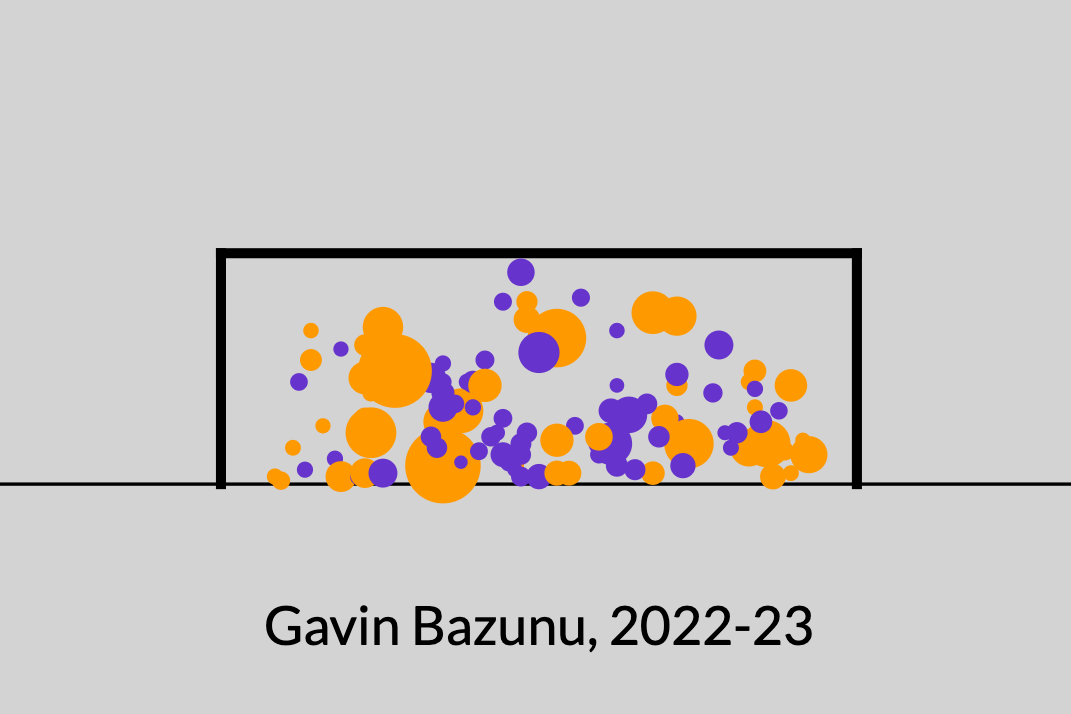
Orange dots represent goals, purple dots indicate shots, and larger dots signify higher expected goals (xG) per attempt. He had an expectation of conceding 35.42 goals, but he ended up conceding 52.
8. Huddersfield Town, 2018-19
• Expected points per game: 0.92
• Actual points per game: 0.4
During this season, Huddersfield’s 16 points and -54 goal differential were the worst recorded since 2010. Though these records have since been matched, Huddersfield’s dubious achievement of having their top non-penalty goal scorers being Mathias Jorgensen and Karlan Grant, both netting a mere three goals, remains unmatched.
7. Chelsea, 2015-16
• Expected points per game: 1.82
• Actual points per game: 1.3
Across their 16 seasons included in this dataset, Chelsea has only surpassed their expected point total once.
That incident happened during the 2014-15 season when they secured the Premier League title under Jose Mourinho but utterly collapsed the following year. In that victorious season, Eden Hazard triumphed with 11 non-penalty goals and nine assists. However, he fell to just four goals and three assists the next season, leading to Mourinho’s dismissal in December and Chelsea finishing 10th.
With ownership changes, they’ve attempted to spend conservatively within Premier League regulations yet have only genuinely contended for the title twice in the last 16 seasons, winning both times.
6. Tottenham Hotspur, 2024-25
• Expected points per game: 1.52
• Actual points per game: 1.0
While it might not seem obvious, Spurs had established a pattern of consistent performance — or at least they used to.
The following shows their non-penalty expected-goals differential across full seasons since 2010:
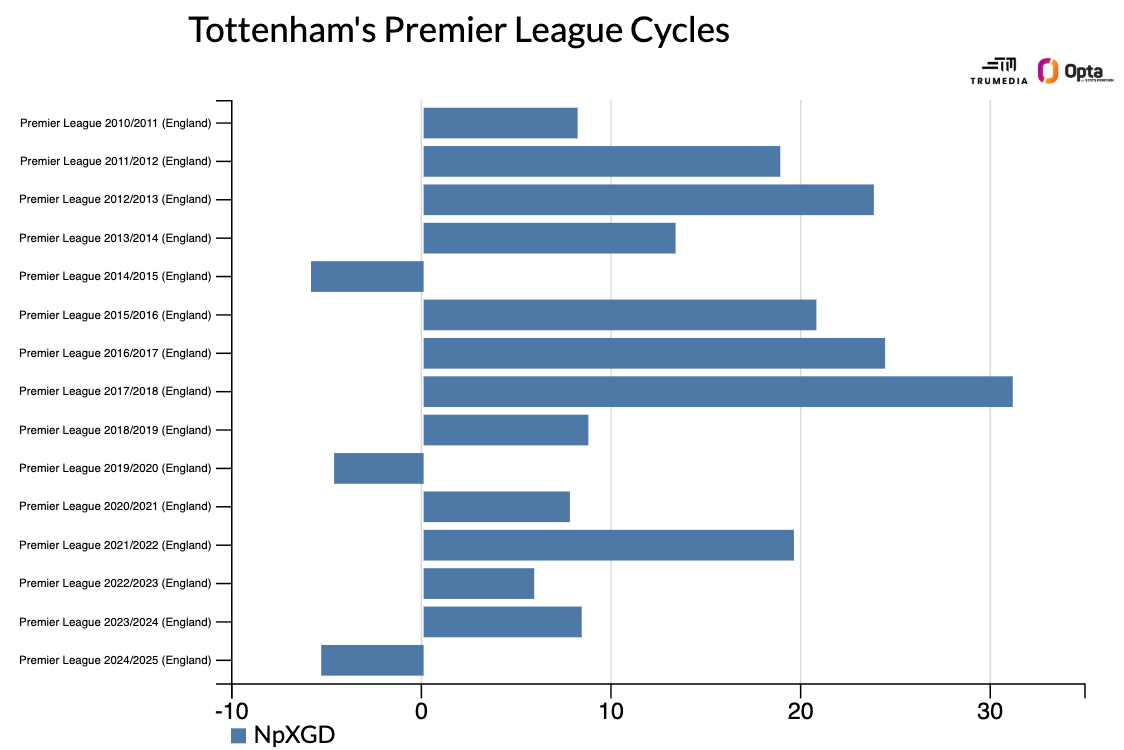
They enjoyed four successful years, experienced one downturn, then enjoyed another four successful years, and so forth.
This trend aligns with Tottenham’s approach as a selling club. They assemble promising young talent for a four-year peak, after which these players either depart for wealthier clubs or decline in performance. Now, the most recent peak was startlingly low, especially given Tottenham’s recent emergence as one of the wealthiest clubs globally. The crucial point is that the current season’s outcome isn’t represented in this analysis.
5. Wolverhampton Wanderers, 2025-26
• Expected points per game: 1.07
• Actual points per game: 0.5
The concept of “form” can often be misleading, as past performance doesn’t effectively predict future results.
That said, Wolves have accumulated 13 points out of their total of 16 since the turn of the new year. Intriguingly, their expected-goal differential has slightly deteriorated during this timeframe.
4. Tottenham Hotspur, 2025-26
• Expected points per game: 1.62
• Actual points per game: 1.0
It’s genuinely shocking that we’ve reached this point. The issues stem from a combination of injuries, a misguided team-building strategy that overlooks crucial foundational skills like passing, and the growing competitiveness of the Premier League.
What’s astonishing, however, is that one cannot solely attribute this predicament to misfortunes. If you’d have told anyone that a “Big Six” team found itself in a relegation battle with less than ten games to go, many would think luck played a role. Typically, teams undergo ups and downs in finishing and shot-stopping, but for a club with Tottenham’s resources to plummet this low seems bewildering.
As it stands, Tottenham’s current standings suggest they might be considered fortunate to find themselves in 16th place, compared to other clubs like West Ham United and Nottingham Forest.
3. Southampton, 2024-25
• Expected points per game: 1.05
• Actual points per game: 0.3
Echoing thoughts from economist John Maynard Keynes on unconventional approaches:
“His behavior should inherently carry a sense of eccentricity and absurdity to standard thinking. If he succeeds, it only reinforces the notion of his risk-taking; if he fails (likely in the short term), he faces scarce mercy. Conventional wisdom infers that experiencing conventional failure is preferable to achieving unconventional success.”
While he was speaking about financial investments, the sentiment resonates with soccer coaches who often adopt similar strategies. Here’s a chart that illustrates the relationship between points earned and passing efficiencies beyond the attacking third:
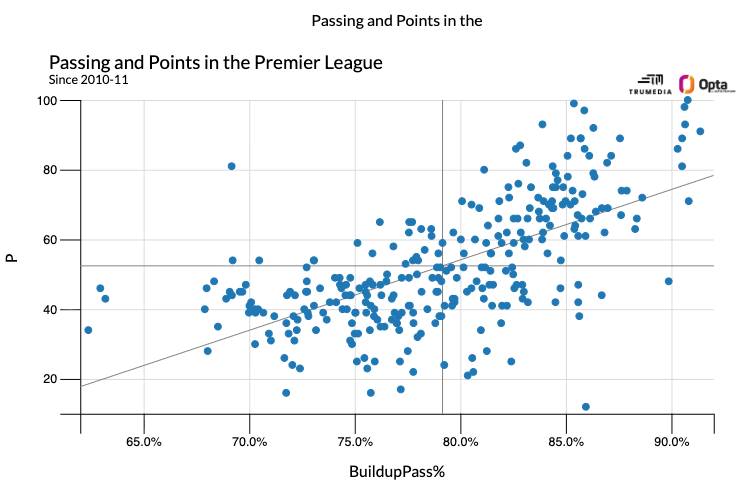
Notable outliers can be seen: at the top left is Leicester City, who abandoned conventional passing methods to claim the Premier League title in 2016, while Southampton, positioned in the bottom right, attempted to emulate Manchester City’s style and consequently recorded one of the league’s worst performances ever.
2. Chelsea, 2022-23
• Expected points per game: 1.95
• Actual points per game: 1.2
In their inaugural season under Clearlake Capital and Todd Boehly’s ownership, Chelsea dished out over €600 million in transfer fees, acquiring the following players:
- Enzo Fernández: €121.00 million from Benfica
- Wesley Fofana: €80.40 million from Leicester
- Mykhailo Mudryk: €70.00 million from Shakhtar Donetsk
- Marc Cucurella: €65.30 million from Brighton
- Raheem Sterling: €56.20 million from Manchester City
- Kalidou Koulibaly: €41.90 million from Napoli
- Benoît Badiashile: €38.00 million from Monaco
- Noni Madueke: €35.00 million from PSV
- Malo Gusto: €30.00 million from Lyon
- Carney Chukwuemeka: €18.00 million from Aston Villa
- Cesare Casadei: €14.86 million from Inter
- Andrey Santos: €12.50 million from Vasco da Gama
- Pierre-Emerick Aubameyang: €12.00 million from Barcelona
- David Datro Fofana: €12.00 million from Molde FK
- João Félix: €11.00 million loan from Atlético Madrid
- Gaga Slonina: €9.09 million from Chicago Fire
- Denis Zakaria: €3.00 million loan from Juventus
Despite these significant investments, not only was there a lack of immediate success — leading to the dismissal of two managers — with the team finishing 12th and accruing 44 points — but long-term success also proved elusive. Most of these players have since departed the club, with only Enzo Fernández and Marc Cucurella currently starting regularly.
1. Aston Villa, 2015-16
• Expected points per game: 1.15
• Actual points per game: 0.4
Tim Sherwood once claimed, “I’m at my best when I’m backed into a corner.” Following a 1-0 defeat against West Brom and four points from their initial six matches, Villa proceeded to lose the next five, resulting in Sherwood’s dismissal.
They won only two of their subsequent 27 matches and were relegated with what was previously the third-lowest point total in league history.
Aston Villa was among only seven clubs that had never faced relegation since the Premier League’s inception. Presently, only six clubs maintain this status: Manchester City, Manchester United, Liverpool, Everton, Arsenal, Chelsea, and Tottenham.