



-

Graham Hunter
Multiple Authors
It’s quite uncommon for Real Madrid to head into a UEFA Champions League knockout stage as clear second favorites. This, however, accurately reflects the state of Álvaro Arbeloa’s team as they gear up to face Manchester City over two legs in the coming week.
Amid various well-documented issues, the most significant problem remains: a profound absence of visionary and technically gifted leadership in midfield.
The departure of Toni Kroos and Luka Modric, coupled with a narrow focus in Madrid’s recruiting efforts, has left the team brimming with youthful potential and athleticism – along with a goal threat when Jude Bellingham is fit and performing well. However, there is a glaring lack of a commanding presence on the pitch who can dictate the game, set the pace, and serve as an extension of the coaching staff.
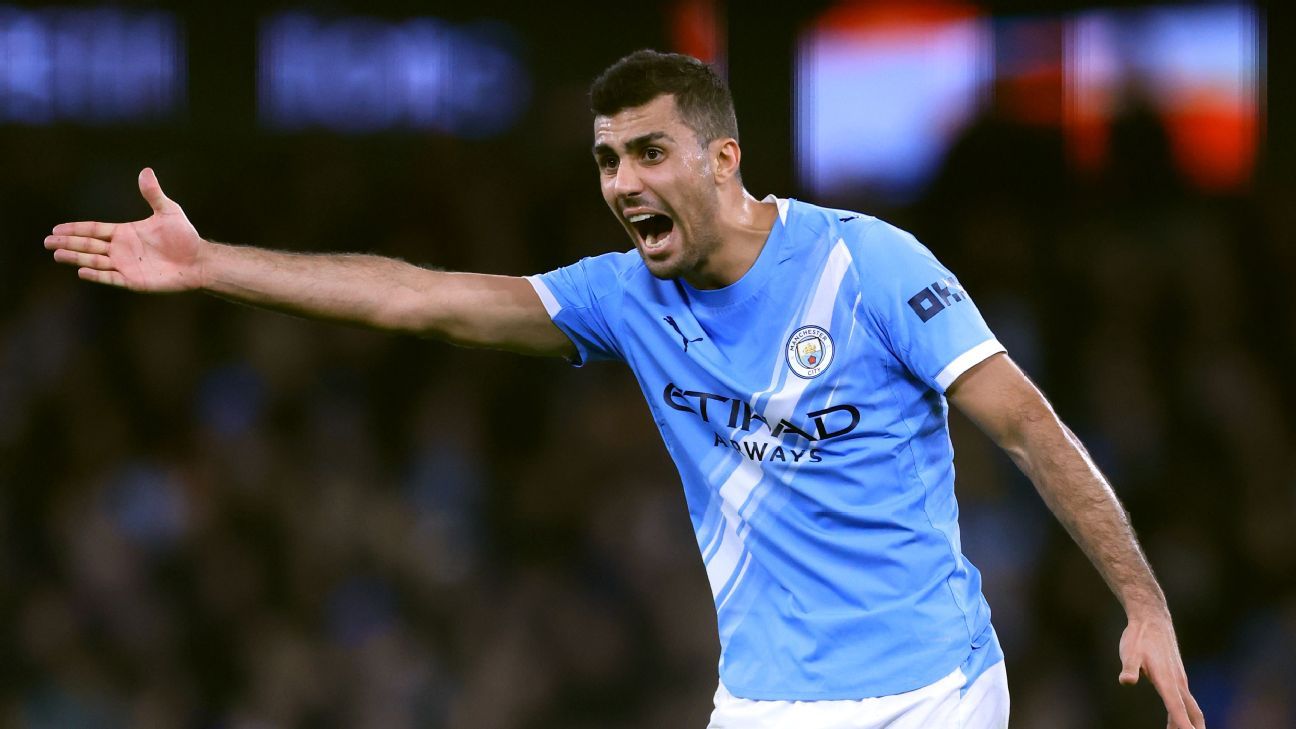
Simply put, Real Madrid lacks a player like Rodri.
In these upcoming matches, it will be particularly stinging for Real Madrid supporters to witness a player who is in his prime, hailing from the Spanish capital, who has been instrumental in guiding Spain to victories in the UEFA Nations League and the European Championship. This is particularly tough for Madrid fans, as Rodri’s idol is one of the greatest figures in Los Blancos history: Zinedine Zidane.
If one were to design the ideal midfielder in terms of talent, experience, desire for trophies, attitude, and other qualities, it would undoubtedly align with Rodri, captain of Manchester City and Spain. The irony is palpable.
The 29-year-old has just 15 months remaining on his contract, which is unusual for a player of his caliber. Real Madrid could potentially be watching closely, hoping to sign him as a free agent in the summer of 2027 or capitalize on a reduced transfer fee if City is reluctant to lose such an accomplished player without recouping some of their investment.
Rodri appreciates the environment at City; he feels indebted to the club for their support during his recovery from a serious knee injury. While he is a loyal individual, the leaders at Madrid must understand a couple of crucial points.
Firstly, it will be challenging to find a better solution to their midfield issues. Secondly, they must consider the opportunity cost: they do not want Barcelona or Atlético Madrid to acquire Rodri, allowing those clubs to benefit from his talents after Madrid has already suffered from his impact at Atlético, City, and Villarreal.
The amount of playing time Rodri gets in these two matches—marking the 12th and 13th encounters between Madrid and City in just six years—will not solely depend on his outstanding abilities or potential to challenge Aurélien Tchouaméni and Eduardo Camavinga. Pep Guardiola remains cautious regarding his on-field leader; for instance, Rodri was rested during the FA Cup match against Newcastle United. Nevertheless, it’s likely that this was a strategic move to prime him for eliminating Los Blancos from European contention.
“Finally, [Rodri’s form and consistency] is happening as we always wanted since he returned from injury—without setbacks, to achieve consistency and to keep playing,” Guardiola stated recently. “Step by step, he’s getting better and better. Everyone is aware of that.”
Rodri’s track record against Madrid should give Arbeloa some reason to worry. He led Atlético to a 4-2 triumph over Los Blancos in the 2018 UEFA Supercup Derbi and boasts six wins and four draws in 15 encounters with the most successful club in football. Following his Ballon d’Or win—one that was notably ignored by Real Madrid president Florentino Pérez, who discouraged attendance because Vinícius Júnior finished as runner-up—Rodri shared with Esquire that he dreams of one day returning to his hometown.
“Madrid is my home,” he reflected. “England has welcomed me with open arms, and I’ve been very happy here. However, LaLiga and the Premier League are where some of the best players in the world play, so I wouldn’t rule out any possibilities.”
And if Real Madrid were to reach out to you directly, would you pick up the call? was the follow-up inquiry.
“Man! Shutting doors on potential opportunities wouldn’t make much sense,” Rodri said. “Interest from top clubs is always a positive sign. When the day comes for me to decide my future, the more interest there is, the better!”
The last extensive interview I had with Rodri provided insights into his philosophies that might leave diehard Madrid fans lamenting what they allowed to slip away.
Discussing the art of dominating intense, high-stakes midfield showdowns, Rodri emphasized, “It’s crucial that the ball moves faster than any player. Many may lack physical speed but excel in quick ball movement due to their approach and body positioning before receiving the ball. If you’re astute, you can predict and outmaneuver rivals who are more physically gifted.
“One of the toughest aspects of this role is knowing what to do once you win possession: deciding when to take risks versus when to stabilize the situation. This balancing act is vital for a defensive midfielder: controlling the game’s pace. If you consistently play the ball forward, you’re ‘attacking-minded’ but can easily lose possession and face transitions. Conversely, if you only play backward or horizontally, you’re missing chances to enter scoring positions!
“It’s all about balance and understanding your opponents, whether they thrive on transition or struggle with possession—whether they sit back or press forward,” he added.
These are concepts that all involved with Real Madrid—the coaching staff, the players, fans, and media—recognize, yet they likely won’t see those tactics implemented as effectively as Rodri might across these two crucial matches.
One Madrid-born, Champions League-winning goal scorer and the best midfielder in the world when at his peak, Rodri is indeed the one that got away. Welcome back, amigo—though don’t expect a warm reception.