



-

Graham Hunter
Multiple Authors
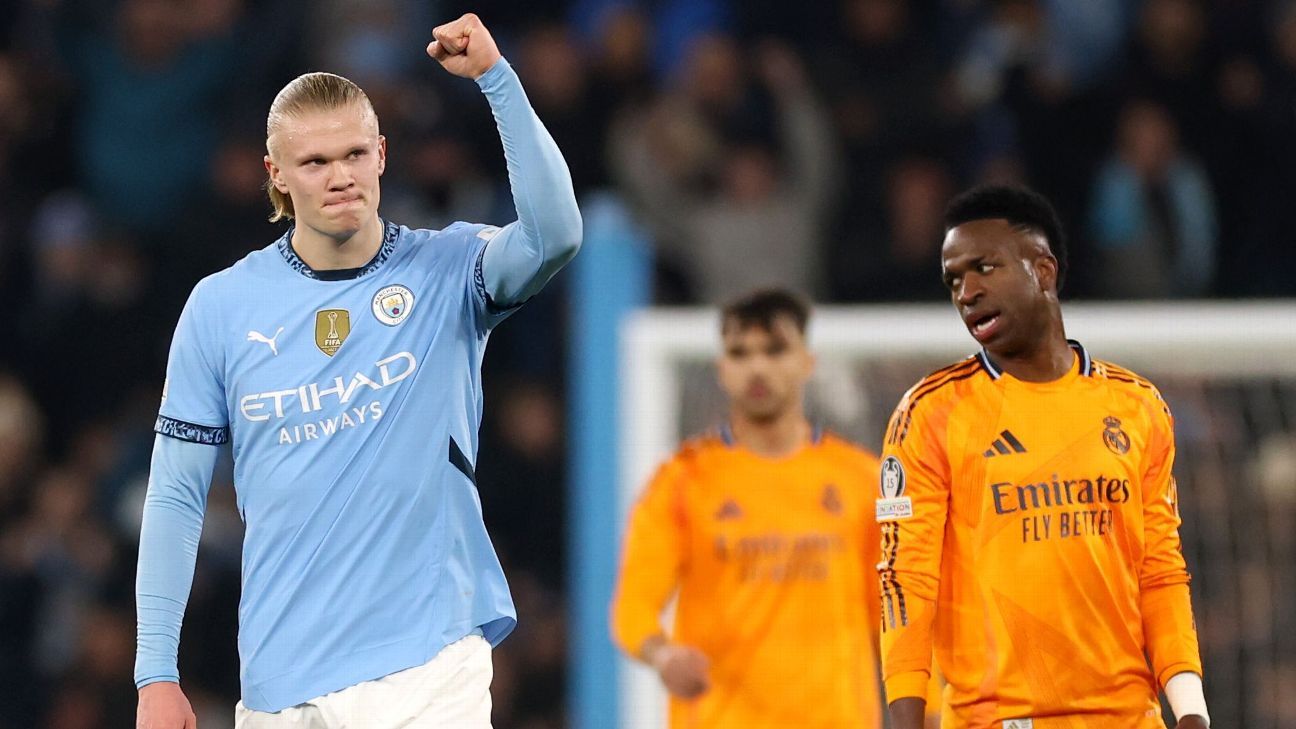
During his appearance on the popular evening talk show “El Hormiguero,” Real Madrid presidential candidate Enrique Riquelme declared that if elected on Sunday, he would secure the signings of Manchester City’s Erling Haaland and Rodri. This audacious promise grabbed headlines and echoed tactics used by Florentino Perez in his earlier campaigns.
Riquelme further reassured viewers, stating live that he would provide a notarized assurance to cover the season tickets for the club’s 100,000 members if he couldn’t follow through on his commitments.
While this bold assertion has prompted Manchester City to issue a statement asserting that such a transfer is impossible and warning of potential legal action regarding the use of Haaland’s name, it resembles the strategy Perez implemented in 2000 when he first became president.
For those who might not recall, that period captivated football fans worldwide, shattered transfer records, and deteriorated the already intense rivalry between Madrid and Barcelona.
If you missed that chapter of football history, here’s a glimpse into the pivotal events that Riquelme’s recent comments appear to mimic.
– Real Madrid unveils new home kit aimed at ending trophy drought
– The impact of Mourinho’s return on Real Madrid’s presidential election
– Why Chelsea hired Xabi Alonso now and what went wrong at Real Madrid
Back then, Luis Figo was Barcelona’s standout player, yet he felt overlooked as the club renewed contracts for other players.
Florentino Perez had previously attempted to become Real Madrid’s president but was defeated. His challenger, Lorenzo Sanz, enjoyed recent successes with Champions League victories in 1998 and 2000. Thus, Sanz seemed untouchable, drawing parallels to Perez’s current situation.
On July 11, 2000, Perez held a decisive press conference, famously stating, “I want you to know that if I’m elected president, Figo will be a player for Real Madrid!” This declaration followed a leak to the media a few days prior, sparking significant anticipation.
The circumstances behind the scenes were chaotic—Figo was unaware his agent had cut a lucrative deal with Perez and underestimated the feasibility of someone paying the “buyout” clause embedded in his contract, which was set at a staggering 10 billion pesetas, equivalent to €60 million at the time.
Figo, as he later explained, didn’t truly wish to leave Barca; he sought a better contract renewal but was ultimately persuaded by his agent and Perez to allow Madrid to buy out his contract.
1:26
Burley: Real Madrid’s current midfield is vastly different from its past
The crucial aspect back then (which may come into play if Riquelme wins) is the “rescission clause,” or clausula, which allowed the affected club (Barcelona then and possibly Manchester City now) no real power to block the move.
If a player with a “get-out” clause in their contract opts to accept an offer from a club that is aggressive in its pursuit, their current club has no means to prevent the transfer.
Whether this applies to Haaland remains to be seen, but he does have such a clause in his contract.
Interestingly, Perez was not the frontrunner during that presidential campaign, but his promise regarding Figo, along with the commitment to covering season tickets for Madrid’s members if he failed to deliver, rallied the voters in his favor. He won the election by more than 3,000 votes and ushered in an era of success known as the Galacticos.
This strategy was not novel at the time either; Perez later acknowledged that he derived the concept from the legendary president Santiago Bernabéu.
Bernabéu had promised to expand the stadium, increase revenue, and subsequently attract top players, starting with Alfredo Di Stéfano, who was nearly signed by Barcelona.
Perez explained in a 2017 interview: “I followed the same path. I committed to bringing the best talents to resolve our financial challenges, and it worked well.”
Initially, many doubted the potential transfer of Figo since a €60 million deal had never been executed, but Perez managed to persuade him.
0:46
Hislop: Florentino Pérez’s venting has only worsened matters
Another example of how such promises wield power can be seen in Joan Laporta’s campaign for the Barcelona presidency in 2003. Despite reaching an agreement for David Beckham’s transfer to Madrid, Laporta leveraged his relationship with agent Pini Zahavi to announce that a deal with Manchester United was in place.
At the press conference that afternoon, the audience was astonished as Laporta’s vice-president elect, Sandro Rosell, detailed the deal, showing how Barcelona planned to finance the transfer, thus providing Laporta with a significant advantage in the election poll through this savvy maneuver.
Although Beckham was not inclined to join, Barcelona’s additional promise to acquire Ronaldinho ultimately helped Laporta, an outsider like Perez three years earlier, secure a decisive victory.
In essence, it’s a modern twist on the transfer rumors circulating on social media, where fans eagerly anticipate shocking deals and high-profile moves—it’s a phenomenon that has become almost addictive. Riquelme’s promises of Rodri and Haaland are merely the latest iteration of this trend, creating excitement in the transfer market.
The challenge for Riquelme, assuming he wins, will be to fulfill those commitments. Whether this tactic will secure his victory remains to be seen when the votes are tallied on Sunday.