



-

Ryan O’Hanlon
Liverpool began the season as slight favorites in the Premier League, yet it’s difficult to recall a preseason favorite so riddled with uncertainties.
The shocking passing of Diogo Jota left an unmeasurable void impacting the team in profoundly complex ways. And the challenges didn’t stop there.
Liverpool also lost Trent Alexander-Arnold, potentially the best passer in football history, to Real Madrid. The dynamic abilities of Luis Díaz left for Bayern Munich. The explosive chaos and opportunities generated by Darwin Núñez transitioned to Saudi Arabia. Additionally, several dependable backups found new clubs, including Harvey Elliott to Aston Villa, Kostas Tsimikas to AS Roma, Jarell Quansah to Bayer Leverkusen, and Caoimhín Kelleher to Brentford.
Nevertheless, Liverpool brought in considerable talent as well. The club set the Premier League transfer record twice, first for Florian Wirtz from Bayer Leverkusen and then for Alexander Isak from Newcastle United. They also signed Hugo Ekitike from Eintracht Frankfurt, alongside young fullbacks Jeremie Frimpong from Wirtz’s Leverkusen and AFC Bournemouth‘s Milos Kerkez. In addition, they signed a towering center back from Parma, Giovanni Leoni, to replace Quansah, and added Giorgi Mamardashvili as Kelleher’s successor after a successful loan at Valencia.
For a team that effortlessly claimed the Premier League title and pushed the eventual UEFA Champions League champions to penalties last season, this represents a significant level of transition. The prior squad was certainly capable of winning the league and competing for the European Cup. With the new acquisitions’ reputations and Liverpool’s knack for player recruitment, there was reason to predict that the updated roster could achieve both goals, though certainty was elusive.
After five Premier League matches, it appeared we had our answer: Liverpool won all five and established a five-point lead, which matched the largest lead in league history at that stage. However, that narrative shifted quickly. After nine games, they suffered a four-match losing streak, their first in four years, and suddenly found themselves seven points behind Arsenal, the league leaders.
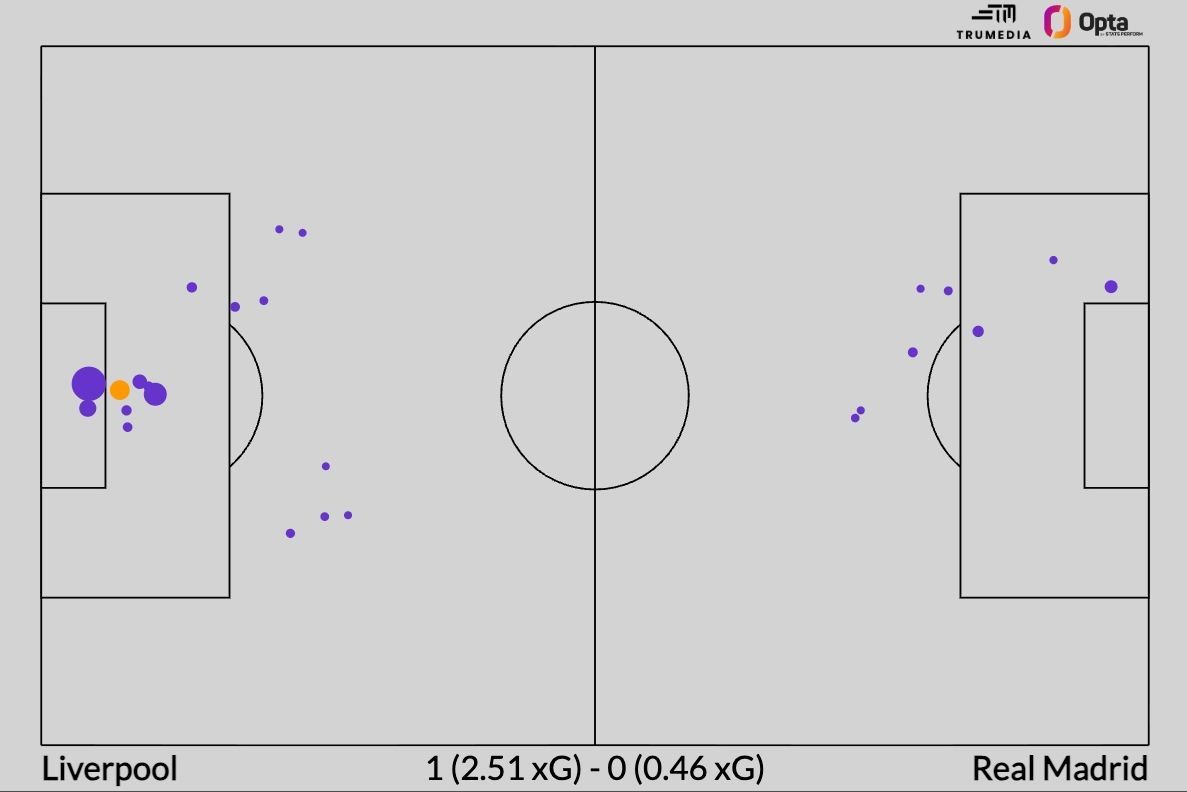
The season seemed bleak — but then they responded with their best performances, achieving a 2-0 win against Aston Villa and a 1-0 victory over a strong Real Madrid team. It seems that while the new signings laid the groundwork for the next chapter of Liverpool, a reversion to last year’s strategies may have sparked a shift in momentum.
Assessing Liverpool’s Performance
Here’s how Liverpool ranks among Premier League teams regarding adjusted goal difference, a metric I favor that combines 70% expected goals (xG) and 30% actual goals.
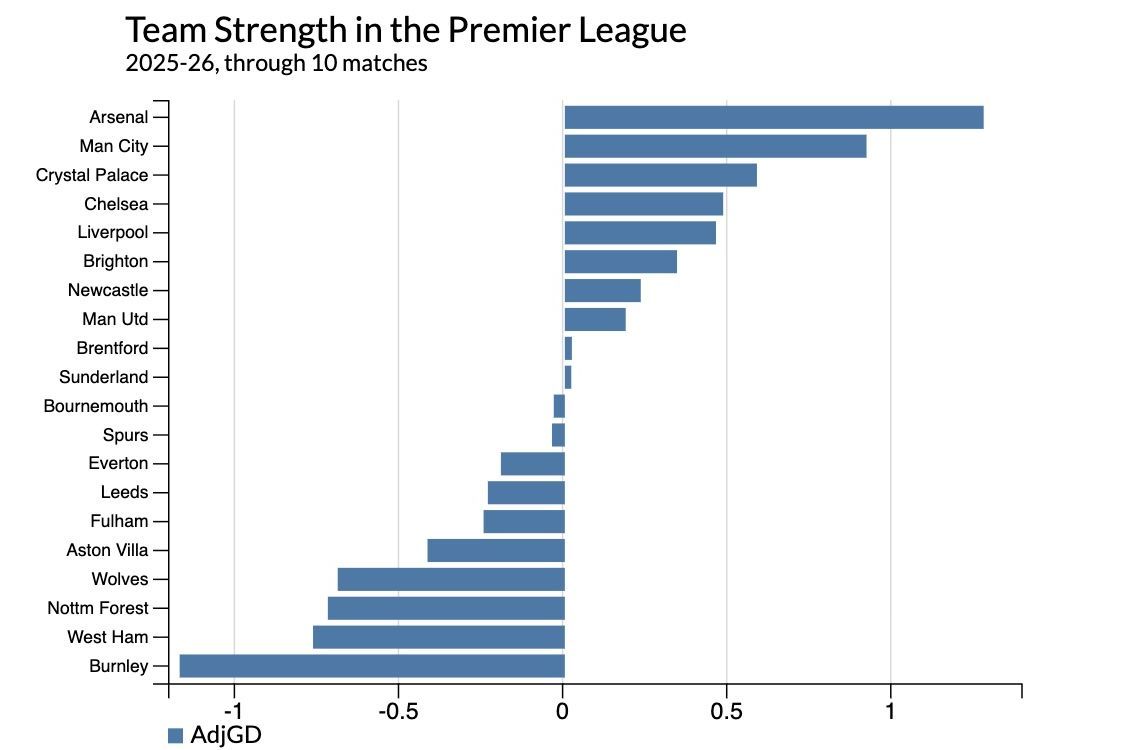
At the top, we find Arsenal alone, with Manchester City in second, followed by Liverpool grouped with teams including Crystal Palace, Chelsea, and Brighton & Hove Albion.
If we separate that into offense and defense, Liverpool’s statistics over the past two seasons are as follows:
– Adjusted goals scored: 2.22 (2024-25), 1.75 (2025-26)
– Adjusted goals conceded: 1.04 (2024-25), 1.29 (2025-26)
If we exclude the final four games of last season, during which Liverpool celebrated their title while preoccupied, their adjusted goals conceded drops to 0.88.
It’s important to note that the schedule has been challenging: According to Pitch Rank’s betting-market-implied power ratings, Liverpool faced eight of the top 12 teams in the Premier League, with their two encounters against lower-tier teams occurring away from home.
Still, this difficulty cannot fully explain the discrepancies between last season and this one. There has been a significant regression at both ends of the pitch.
What Contributed to Their Decline?
With manager Arne Slot still at the helm, we should investigate the personnel shifts driving the difference between this season and last. Here’s the percentage of Premier League minutes played by all the departed players from the previous season:
– Díaz: 70.1%
– Alexander-Arnold: 69.2%
– Jota: 35.0%
– Núñez: 33.1%
– Kelleher: 26.3%
– Tsimikas: 24.5%
– Quansah: 14.5%
– Elliott: 10.8%
Here’s how the new players have fared:
– Kerkez: 73.3%
– Wirtz: 67.4%
– Ekitike: 64.1%
– Mamardashvili: 40.0%
– Isak: 27.9%
– Frimpong: 9.6%
– Leoni: 0.0%
Moreover, significant changes also occurred among returning players. Cody Gakpo has played 88% of the minutes, compared to a little over 50% last year. Dominik Szoboszlai has played every minute this season after participating in roughly three-quarters last year. Meanwhile, Conor Bradley has seen his minutes soar to around 50% up from just over 20% last season.
Conversely, Andrew Robertson has experienced the most significant drop with just over 25% of minutes after nearly playing 75% last season. While there aren’t many other substantial declines, several players have experienced slight reductions in minutes, including midfielders Ryan Gravenberch (from over 90% down to around 75%), Curtis Jones (from 50% to just over a third), and Alexis Mac Allister (from about 75% to just over 60%).
Overall, this new iteration of Liverpool, which has notably declined, showcases an array of changes: a different left back than Robertson; a right back other than Alexander-Arnold; a midfield often without Mac Allister, Jones, or Gravenberch; consistent appearances from Gakpo on the left; and a new center forward.
While there will always be a new center forward, Alexander-Arnold’s influence has waned. The recent resurgence of form for Liverpool in the past two fixtures aligns with several of these previous alterations being reevaluated. Robertson returned for both matches, while last year’s backup right back, Bradley, also played. The arranged midfield of Szoboszlai, Mac Allister, and Gravenberch dominated the minutes, save for Jones’s temporary substitution against Madrid, and Gakpo returned to a role consistent with last season’s time on the pitch.
How Much Change Is Too Much Change?
Examining Liverpool’s major personnel decisions from the past 10 months reveals a troubling lack of cohesion. They secured contract extensions for their two veteran superstars, Virgil van Dijk and Mohamed Salah. However, they lost their 27-year-old star, Alexander-Arnold, while bringing in younger outfield players this summer aged 26, 24, 23, 22, 21, and even 18.
In essence, they have only two years left to maximize the potential of possibly the two best players at their respective positions in Premier League history while investing heavily in an incoming class that largely lacks the immediate influence of those in their prime (with Isak at 26 as the main exception).
This situation suggests a dual strategy: build for the long-term future while still relying on current greats. But the most stable teams can sustain only a limited number of changes simultaneously.
Football is inherently about interconnections—subtle relationships across the field that create what we recognize as team style or tactics.
2:01
Slot: An impressive win over an incredible Real Madrid side
Arne Slot commends Liverpool’s performance, particularly praising Conor Bradley, following their crucial 1-0 victory over Real Madrid in the Champions League.
Last season, Liverpool claimed the league title with a more measured approach compared to Jürgen Klopp’s previous tenure. They didn’t dominate possession as intensely and became a stronger defensive unit, even allowing opponents into their attacking third more frequently. Their ability to play this way was largely credited to Alexander-Arnold’s exceptional passing and Salah’s peak performance throughout the season—players capable of creating opportunities with limited possession.
However, the loss of Alexander-Arnold’s long passes, Salah aging, and the introduction of Wirtz created a more one-dimensional midfield. With Kerkez stepping in for Robertson, the team simply lacks the same passing fluidity. Gakpo transitioned from a supporting role to a pivotal starter, but the new center forward options lack the pressing intensity of Jota, Díaz, or Núñez.
Adjusting for one change—like losing Alexander-Arnold—allows a team to recalibrate; yet Liverpool simultaneously replaced Alexander-Arnold, altered Robertson’s role, adjusted the midfield mix, and switched center forwards. These sweeping transformations make it challenging to gauge how all the changes influence each other, but the outcome has been a team struggling to control the ball and defend as effectively as before. Despite possessing attacking talent, Liverpool has displayed a decline in shots and touches in the opponent’s box.
Defensively, the opposition could exploit Liverpool’s weaknesses with long balls (averaging 62 long passes faced per 90 minutes this season, marking a significant increase since last year, and the highest in the past four Premier League campaigns).
However, the lineup Slot deployed against Madrid seems to strike a balance, enhancing competitiveness. Even against a top-five team, their performance surpassed expectations.
The midfield trio of Mac Allister, Szoboszlai, and Gravenberch is positioned at or nearing their prime years, and their combined skill should remain a strength, especially with Szoboszlai emerging as one of the top players in the league. This group provides enough defensive stability for Liverpool to compete without having to monopolize possession.
With a consistent back four, the central defenders are solidified. Due to the midfield’s stability, both Bradley and Robertson showcased improved performances against Real Madrid and Aston Villa, with Bradley’s forward runs unlocking space for Salah and facilitating ball progression. While Robertson’s durability is in question, he still offers more than Kerkez, who remains unpredictable in possession.
Wirtz’s role may shift his focus from goal-scoring to ball security, but his playmaking ability proved crucial, as he created multiple chances while participating actively in Liverpool’s attacking maneuvers without attempting shots. While Salah may not replicate last year’s output, he has recently shown improvement, significantly increasing his success rate in dribbles.
It’s important to note that while the past two matches are promising, they do not signal a full recovery. There is still a heavy reliance on Gravenberch to hold together the midfield, while Frimpong’s potential impact remains uncertain. It’s still early in the season, and Salah’s output is below his previous levels. The integration of Isak or Ekitike must be managed, and injuries to key players like Van Dijk or Ibrahima Konaté could pose risks.
Furthermore, the weaknesses exposed against long balls by Villa and Madrid may not be tested again soon, especially with Manchester City on the horizon.
However, the Liverpool squad in the last couple of matches displays a more coherent identity compared to the chaotic first months of this season. While there’s still a dissonance between this iteration of the team and last year’s success, there’s an opportunity for evolution rather than complete reinvention.
This is likely not what the club’s vision was at the end of summer; otherwise, an iteration of this lineup might have been deployed from the outset. The strategy of adding two strikers and an attacking midfielder conflicts with the already occupied playmaking role, which limits space for new players. However, with Salah and Van Dijk still proving their mettle, and the previous season’s triumphant midfield intact, it’s hard not to envision this eleven as contender for another Champions League title.
Thus, Liverpool may need to revisit past strategies to pave the way forward, conceiving a version of the team that synergistically integrates its new players and excels on the pitch. As November unfolds, the search for that potent blend continues.
What we saw against Madrid indicates that many of the incumbents are more than capable.