



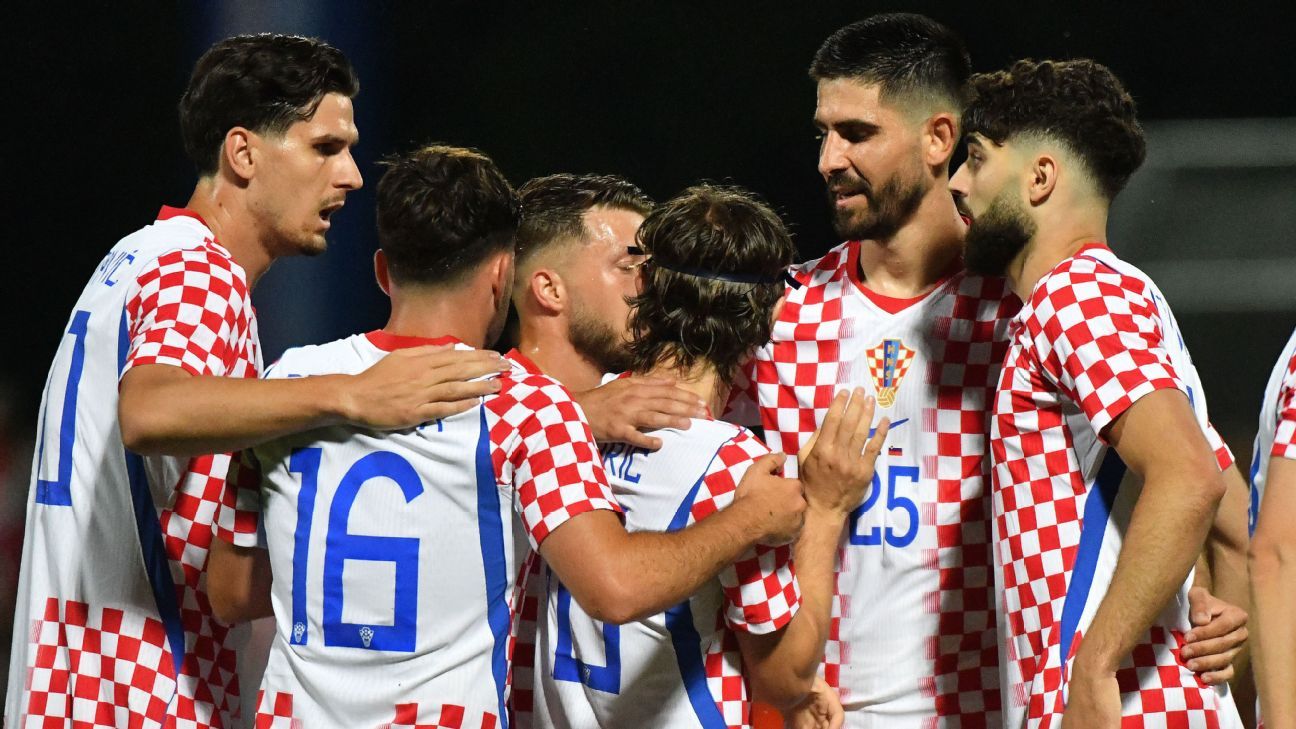
Josko Gvardiol and fellow player Ivan Rakitić are often asked the same puzzling question: how does a country with fewer than 4 million people continue to excel on the global soccer stage, particularly in the Croatian national team and at the FIFA World Cup? Even they don’t have a clear answer.
Despite its size, Croatia defies expectations by not only qualifying for the World Cup but also performing admirably once there.
This summer will commemorate the 30th anniversary of Croatia’s inaugural international tournament at the European Championship in 1996, shortly after gaining independence from Yugoslavia in 1991. It will be their fourth consecutive World Cup appearance, following a third-place finish in 2022 and a runner-up position in 2018. The enigma of how such a small nation consistently competes at such a high level is a tough puzzle to solve, even for Rakitić, a key player in 2018, and Gvardiol, who made his mark in Qatar.
When asked about Croatia’s success, Gvardiol jokingly suggested, “Maybe it’s in the food. No one seems to know. It’s hard to explain,” before adding, “All I can say is we have talented players, most of whom play for top clubs. And when we represent our country, we give our all. We receive tremendous support from our fans, despite being a small nation.”
Of the 48 teams heading to this summer’s World Cup, only Qatar, Bosnia and Herzegovina, Cape Verde, and Curaçao have smaller populations than Croatia. The Croatian domestic league ranks 20th in UEFA, falling behind countries like Cyprus and Austria.
To frame this, consider Italy, a nation of nearly 60 million with Europe’s second-strongest domestic league according to UEFA—yet they have failed to qualify for the last three World Cups and haven’t advanced past the group stage in two decades.
Croatia became a FIFA member in 1992 and has already matched England’s three semifinal appearances, despite England having competed in World Cups since 1950.
“Honestly, we don’t know how it works,” Rakitić told ESPN. “I believe it comes down to our national pride and love for our country.”
“This is football; anything can happen. The bigger teams don’t always win. We give our best, and that’s why we achieve great results.”
Rakitić played a crucial role in Croatia’s victories against Argentina and England, which led them to the final in 2018, ultimately losing 4-2 to France. While Rakitić retired from international play in 2019, many core players from the impressive squads of 2018 and 2022 are returning.
Luka Modric, formerly of Real Madrid and now with AC Milan, will compete in his sixth World Cup at 40 years of age. He holds a revered status in Croatia, regarded as one of the key figures in its post-independence history. Modric shares a collaborative relationship with head coach Zlatko Dalić, discussing tournament strategies and tactical decisions.
Other seasoned players like Dominik Livakovic, Mateo Kovacic, Ivan Perisic, and Andrej Kramaric are also set to participate in the tournament.
With Dalić having been at the helm for nine years following his initial emergency appointment in 2017, Croatia hopes that this continuity will help foster a team spirit central to their impressive World Cup history.
“The 2018 tournament was pivotal in my career,” Rakitić reflected. “The key for us was the camaraderie and the atmosphere within the team. We believed, and our coach’s messages were always clear. We realized that anything was possible.”
“Our squad was exceptionally strong at that time, with players in the world’s biggest clubs. It felt a bit magical!”
For younger squad members like Gvardiol, the World Cup serves as a stage to elevate their careers. His standout performances in Qatar led Manchester City to pursue him for a transfer from RB Leipzig six months later.
Despite suffering a broken leg earlier this year, the 24-year-old has worked hard to regain his fitness just in time for the tournament.
“Qatar was my first World Cup, and it definitely put me on the map,” Gvardiol chuckled. “I treated it like any other tournament, unaware of its significance. I was just focused on playing, treating each match as unique, regardless of the opponent.”
“Looking back, I’ve grown a lot and now recognize the immense pressure of being at a World Cup. It’s a significant achievement for our nation.”
As always, Croatia will begin their World Cup journey relatively under the radar. Competing in Group L alongside England, Panama, and Ghana, they are considered 80-1 outsiders by bookmakers, alongside teams like Switzerland and Türkiye. They will face England in Texas on June 17, eager to add to their legacy of World Cup surprises.
“The group stage is challenging—possibly the toughest draw we could have received,” Rakitić stated. “The outcome will be clearer after our first match against England.”
“We must enjoy the experience, with the primary goal being to advance beyond the group stage. In knockout games, anything is possible.”
As seen in their previous two World Cup experiences, unexpected outcomes are always on the horizon, even for one of the tournament’s smaller teams. Their remarkable resilience is encapsulated by their knockout performance in Russia and Qatar, where they triumphed in four penalty shootouts across both events.
Rakitić believes the current squad’s presence will instill a sense of unease in any teams pitted against Croatia in the knockout rounds.
“We have the quality and experience,” he remarked. “Luka is still fit, and everything seems promising. Our coach has prepared us well, as he has in the past.”
“Other teams may not relish the prospect of facing Croatia, and we need to capitalize on that. They might feel a bit anxious going into the match.”
Although Croatia may be small in size, it has cultivated a significant reputation for defying expectations.