



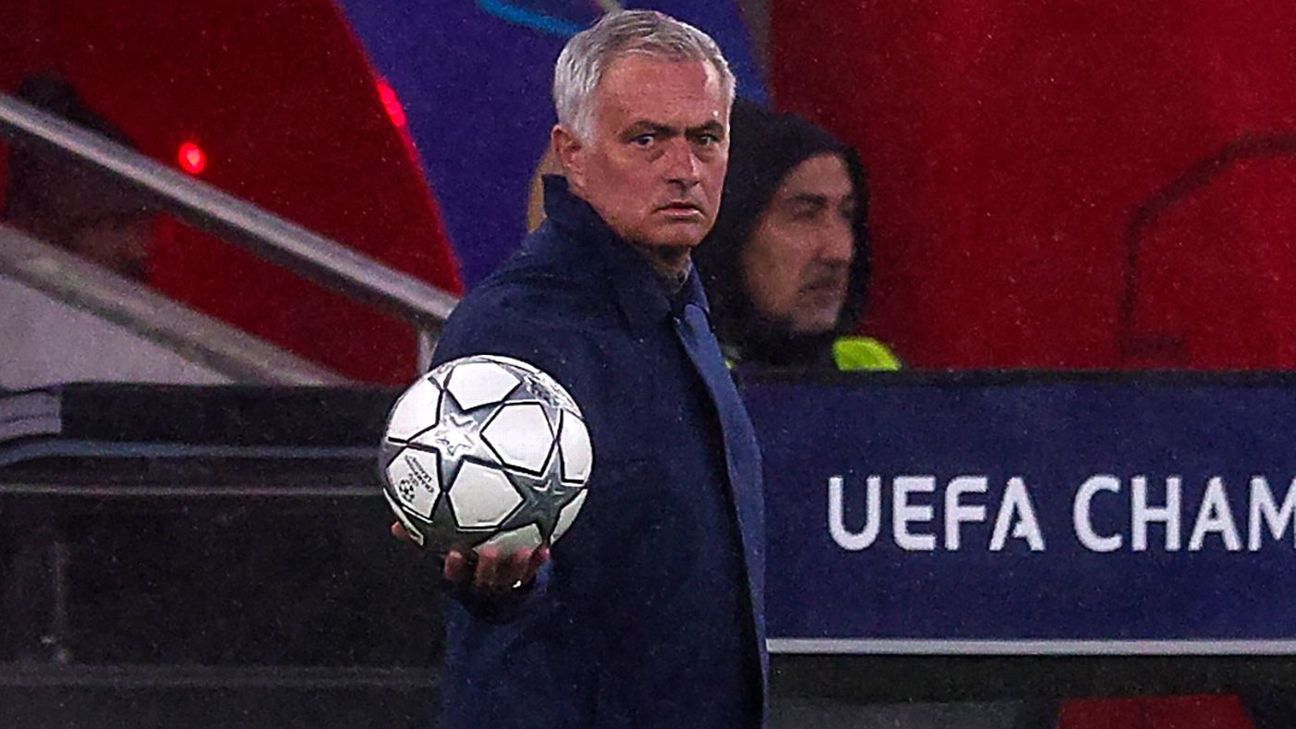
Shortly after 10 p.m. on Wednesday night in Spain, Florentino Pérez’s campaign team officially declared their plans. They shared on social media, “MOUcha historia por hacer“, translating to “MOUch history left to make.” The post, which featured a rather corny pun associated with Pérez’s reelection slogan, included a brief video of a beaming José Mourinho in a Real Madrid jersey, simply stating, “Yes.”
If Pérez secures his position as president during the upcoming vote on Sunday, Mourinho will return as the club’s coach.
Meanwhile, Pérez’s opponent, businessman Enrique Riquelme, was appearing live on the Spanish TV show “El Hormiguero,” where he announced plans to sign Erling Haaland if victorious. During the interview, host Pablo Motos informed Riquelme that Pérez had just confirmed Mourinho’s return. Caught off guard, Riquelme responded, “He’s announced him now?” before regaining his composure and acknowledging, “Well, he’s had him before. I think he’s a good coach.”
Pérez’s announcement regarding Mourinho’s coaching role starting in 2026-27 was not entirely unexpected. ESPN reported last month that Mourinho, who previously managed Madrid from 2010 to 2013, had given his assent to return to the Bernabéu. The ongoing election process had led to speculation about whether Pérez would reveal this ahead of Sunday’s vote or hold off until afterward, but those uncertainties were laid to rest.
Real Madrid has gone two seasons without securing a major trophy, with three different coaches—Carlo Ancelotti, Xabi Alonso, and Álvaro Arbeloa—failing to unlock the team’s potential. Pérez believes Mourinho is the solution.
Pérez shared in an interview on Spain’s national broadcaster TVE last week, “[Kylian] Mbappé, Vinícius [Junior], [Jude] Bellingham, [Arda] Güler, [Federico] Valverde, [Aurelien] Tchouameni… They are the best in the world. A good coach with these players will usher in another significant era in Real Madrid history.” He is convinced that Mourinho fits that bill.
Why Pérez Values Mourinho Highly
Mourinho’s lengthy record as a leading figure in football management over the past two decades speaks for itself. His first tenure in Madrid, starting in May 2010, came when he was arguably at his peak, having just won the Champions League with Internazionale.
His major challenge was competing against Pep Guardiola’s formidable Barcelona. Under Mourinho’s predecessor, Manuel Pellegrini, Madrid had achieved 96 points in La Liga during the 2009-10 season but still fell short, finishing three points behind Barça. Madrid’s struggles in Europe were more pronounced, having been eliminated in the Champions League round of 16 for six consecutive years before Mourinho’s arrival.
Mourinho transformed the team’s fortunes. During his management, Madrid reached the Champions League semifinals three times, although they fell to Barcelona, Bayern Munich, and Borussia Dortmund. In La Liga, he led the team to victory in the 2011-12 season, breaking a four-year drought and posting a record 100 points alongside a record tally of 121 goals, with a goal difference of +89. That season is often referred to as the “league of records.”
Even as Lionel Messi broke the record with an astounding 50 league goals, it still wasn’t enough to overpower Mourinho’s Madrid.
However, the subsequent 2012-13 season was less successful, with Madrid finishing 15 points behind Barcelona, leading Mourinho to label it “the worst season of my career.” He clashed with the media and had disagreements with senior players like Iker Casillas and Sergio Ramos. By May 2013, Pérez announced that Mourinho would depart “by mutual agreement,” and Ancelotti was brought in to replace him, marking a departure from Mourinho’s more confrontational style.
While Mourinho’s tenure was not flawless, Pérez looks back on it positively. “We became competitive again,” Pérez noted in a recent interview. “Then we won six Champions Leagues in 12 years.” Those titles were won under Ancelotti—in 2014, 2022, and 2024—and during Zinedine Zidane’s remarkable three-peat from 2016 to 2018. For Pérez, Mourinho’s mentality and approach laid the groundwork for that success.
Pérez has often played down the significance of coaches in his strategy. His philosophy, dating back to the Galáctico era, has focused on acquiring the biggest stars. “You know me,” he stated in an interview with Diario AS on Thursday. “As long as I’m president, the best players in the world will play here.”
While it’s challenging to envision him expressing the same regard for coaches, he has consistently valued Mourinho’s contributions. “[Pérez] has said only one coach has truly led Real Madrid during his presidency,” explained Eduardo Inda, a confidant of Pérez. “He does so with irony, but he asserts that he has only had one true coach—Don José Mourinho—in the past 12 years.” This sentiment notably excludes figures like Vicente del Bosque, Fabio Capello, Pellegrini, or Ancelotti—it’s Mourinho who stands out.
Is Mourinho’s Return Unexpected?
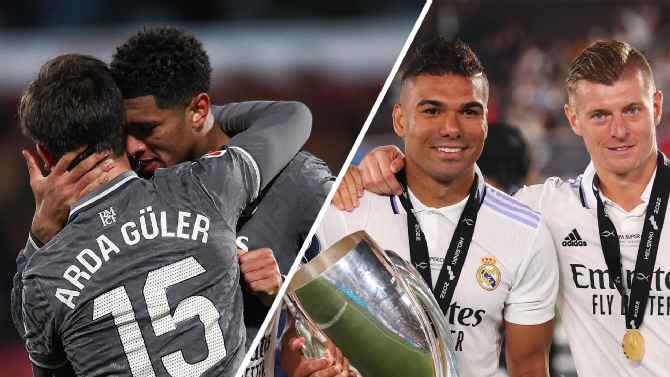
1:26
Burley: Real Madrid’s current midfield is a far cry from what it used to be
As Real Madrid’s 2025-26 season limped to a close without trophies, the club was left desperate in its search for a new coach. The looming World Cup created a tight summer schedule, and their top candidates—former players Alonso and Arbeloa—had been swiftly hired, then dismissed within a single year.
Alonso’s term ended prematurely in January due to a mix of Pérez’s lack of confidence in him and the club’s failure to support him during disputes with prominent players like Vinícius Júnior. Arbeloa was then thrust into the coaching role amidst challenging circumstances, with his inability to manage a divided locker room further highlighted by a public confrontation between Valverde and Tchouameni.
With Alonso and Arbeloa gone, who would Pérez turn to next? This time around, the usual emergency options were unavailable. Ancelotti, whose unexpected return in 2021 after his stint at Everton seemed similarly unorthodox, is currently preparing to lead Brazil in the World Cup, while Zidane, who had returned in 2019 after leaving the club nine months earlier, is currently anticipating his chance to take over France.
Mourinho’s hiring fits a late-stage trend under Pérez of nostalgia-driven reappointments, but it also aligns with his assessment of the club’s challenges. Publicly, he has cited the prior summer’s Club World Cup and calendar issues. “We didn’t have a preseason,” he noted. “That’s why we faced 28 injuries.”
Behind closed doors, there’s worry about ongoing dressing room discord and a determination to remedy it. There’s also a perception that today’s landscape bears some resemblance to the situation when Mourinho first arrived in 2010, with Madrid finding themselves overshadowed by a dominant Barcelona.
Sources have indicated to ESPN that Mourinho may not have been the top choice when the club initially discussed potential candidates. Some key figures at the club were uncertain about his candidacy, and a few entirely dismissed him. While the Madrid landscape has evolved since 2010, Pérez has maintained his fondness for Mourinho. Efforts were made to mend relations with Mourinho’s agent, Jorge Mendes, who had been temporarily sidelined from dealings in Madrid. According to ESPN sources, General Director José Ángel Sánchez played an instrumental role in rebuilding that rapport.
Is Mourinho Still a Top-Tier Coach?
Last season with Benfica, Mourinho’s team went undefeated in Liga Portugal but drew 11 out of 34 matches, securing a third-place finish behind Porto and Sporting CP. Despite drawing strength against Madrid in the Champions League, they fell narrowly in the knockout phase. In his time at Fenerbahçe, he finished second but did not defeat rivals Galatasaray and Besiktas in their encounters. At Roma, he recorded two sixth-place finishes in Serie A and won the 2022 Conference League – his only trophy in the last five years.
While many Madrid fans still hold a strong admiration for Mourinho, sentiments vary, with others reflecting on his Madrid tenure less favorably. “Many people support Mourinho,” noted veteran journalist Santi Segurola on Onda Cero radio recently, “but numerous others see him as a nostalgic reminder from a president [Pérez] who should be proposing something innovative, something different. Instead, he’s offering a coach from 16 years ago.”
A recent social media post from Pérez’s campaign reiterated the rationale behind Mourinho’s return, serving as another nod to nostalgia. “¿Por qué?” it inquired, echoing Mourinho’s memorable outburst during a 2011 press conference following a loss to Barcelona. “Why?”
The video continued, “Because he’s a winner. Because of his competitiveness. Because of his leadership. Because he defended Real Madrid,” drawing on vintage footage of Mourinho on the sidelines.
Some sources at Madrid’s Valdebebas training ground worry about the potential upheaval that could accompany Mourinho’s return, fearing it might exacerbate an already volatile situation. Others argue that this is a different version of Mourinho—a more mature one—who could share similarities with Ancelotti rather than the strident figure he once was.
While nostalgia might sway voters, the question remains: is it truly a formula for success on the field?