



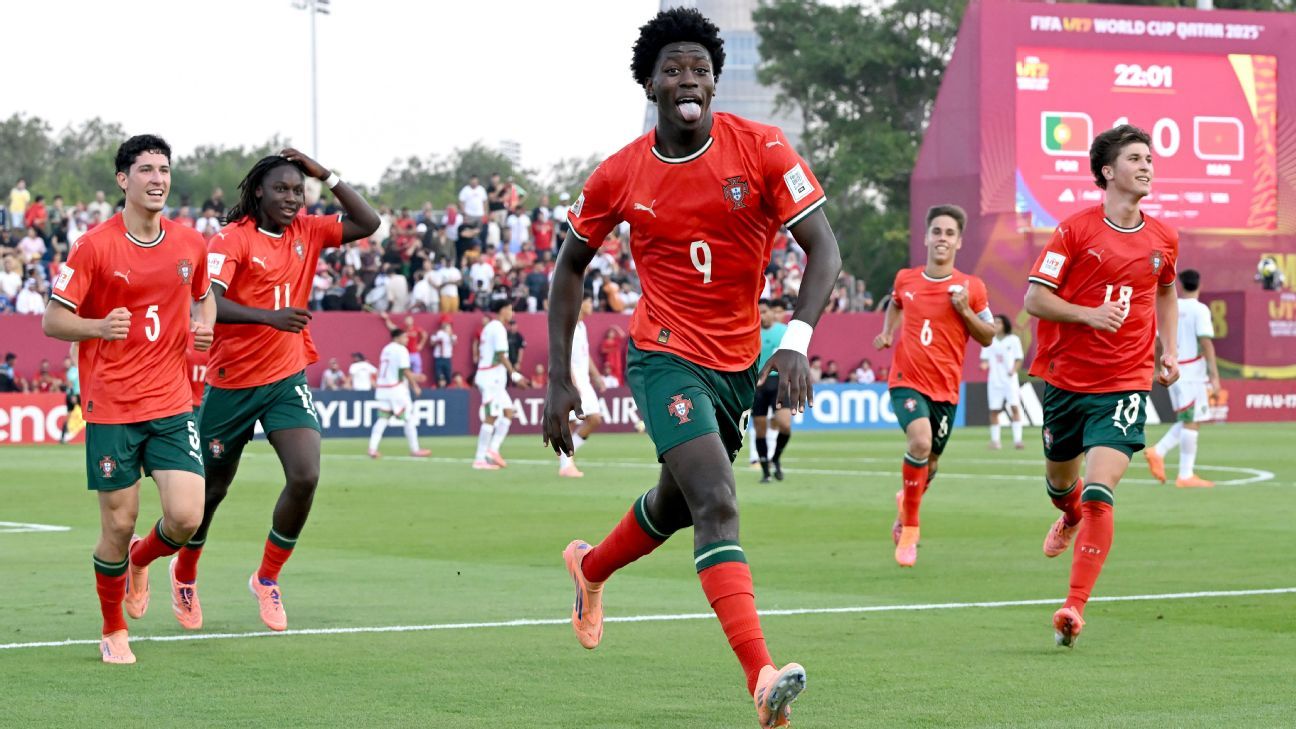
In recent weeks, top under-17 national teams have fiercely competed in the FIFA U-17 World Cup in Qatar, highlighting an impressive array of individual talent.
Ultimately, Portugal claimed the championship, defeating Austria 1-0 in a match that many anticipated when the draw was announced. With roughly 100 scouts from prominent European clubs in attendance, this tournament has effectively served as a live platform showcasing the next generation of football talent.
Among a roster filled with skilled players, prolific scorers, and tactically astute midfielders, several individuals have distinguished themselves through their consistent performances, game-changing abilities, and maturity that belies their age. Here’s a glimpse at eight standout 17-year-old stars on the rise.
– Discover breakout U21 Champions League players you might not know
– Why Lennart Karl, 17, is being hailed as Bayern Munich’s new sensation
– Understanding soccer contracts: salaries, add-ons, transfer fees, and release clauses
Johannes Moser | AM | Liefering (AUT) | Austria
As arguably the standout attacking player of the tournament, Moser propelled Austria to the final with his instinctive finishing, exceptional off-the-ball movement, and poise from the penalty spot, completing three successful penalties including a Panenka. A product of Salzburg’s academy, he has gained experience at their feeder team, Liefering, in Austria’s second tier. Operating mainly as an attacking midfielder or winger, Moser frequently drifts inside from the left to penetrate the box. Leading the tournament in scoring, he netted eight goals, showcasing a variety of finishes: calm one-touch shots from tight angles, powerful long-range strikes, shots with his weaker left foot, and timely runs into the penalty area. His energy, intelligent passing, and work ethic further highlight his maturity in high-pressure situations.
Cabral has been a key figure for Portugal, combining physical strength with precise left-foot finishes and headers. A product of Benfica’s academy, he has yet to debut for the first team but has showcased his potential to become Portugal’s next leading striker. Scoring seven goals in Qatar—including the final’s winning goal—Cabral’s efforts stemmed from intelligent movement and opportunism, demonstrating sharp runs, clever positioning, and crisp finishes. His ability to facilitate play with simple touches while helping set up attacks speaks to his understanding of the game. His combination of physical prowess and technical skills has attracted early interest from foreign clubs.
England’s shining star at the U-17 World Cup, even despite a surprising 4-0 exit to Austria in the round of 16, Heskey played as a right-footed inverted winger on the left side. He consistently demonstrated excellent first touch, explosive speed, and precise shooting skills. Scoring four goals in Qatar, each was noteworthy: a courageous near-post header, a low shot that found the net following a well-timed run, a composed finish through the goalkeeper’s legs, and another cool finish after a 40-meter solo run. The son of former Liverpool and England forward Emile Heskey, he also excelled at linking up play, often receiving the ball on the half-turn and delivering diagonal passes into space (with nine key passes, the highest in the tournament). Despite England’s heavy loss to Austria, he remained their most consistent attacking threat.
With extraordinary technical skills and a sublime touch, Dembélé was pivotal as a creative force throughout the tournament. Playing as a No. 10 or an inverted winger on the right, he orchestrated play in midfield with his low center of gravity, quick footwork, and surprising mid-range strikes. Dembélé started Mali’s tournament strongly, netting against New Zealand with a composed finish following a rapid counter-attack. He excelled at operating in tight spaces, threading passes to runners and executing clever runs to maintain attacking tempo. His ability to retain possession under pressure and his keen vision are additional strengths, marking him as a true orchestrator who made seven key passes across five games.
José Neto | LB | Benfica (POR) | Portugal
A key figure for Portugal in this tournament, Benfica’s full-back measures 184cm (6 feet) and is versatile enough to play as a centre-back. His solid physique allows for powerful strides and effective crossing ability with his left foot. A disciplined and well-trained defender, Neto can hold his own against physical challenges while offering reliable attacking support through his stamina and ball-carrying ability. In this tournament, he showcased his attacking prowess with two goals and two assists in a 6-0 triumph over Morocco, in addition to two assists against both Switzerland and New Caledonia. These included impressive left-foot strikes and headers. An adept player in both offensive and defensive phases, his combination of size, athleticism, and technical proficiency suggests he may soon progress to first-team football.
Now Italy’s primary attacking reference in Qatar, Inácio operates as a second striker or No. 10, continually trying to engage the opposing back line. His precise first touch, industry, and comfort receiving the ball between the lines have made him a pivotal player. Throughout the tournament, he recorded an impressive 39 progressive runs—the highest of any player—highlighting Italy’s reliance on him for advancing the ball. While his finishing is efficient rather than spectacular, his quick, low efforts often catch goalkeepers off guard. However, an unfortunate red card in the semifinal against Austria marred an otherwise stellar tournament for Inácio.
Though not the most naturally gifted player in a somewhat uninspiring Brazil squad, Dell depends on sharp movement, relentless activity in the box, industrious pressing, and an efficient finishing technique. In Qatar, he scored five times mainly through close-range tap-ins from crosses or cutbacks, showcasing his keen sense of opportunism. Dell excels at making explosive short bursts to evade markers and capitalizes on defensive lapses. While he may not often beat opponents one-on-one, his anticipation, intense pressing, and intelligence in the box have garnered reported interest from Manchester City.
Rafael Quintas | DM | Benfica (POR) | Portugal
As the driving force behind Portugal’s midfield, Quintas has established himself by dictating the pace of play and maintaining fluidity as an exceptionally composed deep-lying midfielder. A product of Benfica’s academy, he predominantly functions as a solo No. 6, anchoring possession with quick, vertical passes and an excellent first touch that allows Portugal to evade pressure. Defensively, Quintas utilizes strong positional awareness and timely interceptions to block passing lanes without resorting to reckless tackles. He also contributes to offensive play with timely runs, incisive diagonal passes, and occasionally creative assists for wingers in half-spaces. Measured and reliable, Quintas is essential to Portugal’s rhythm.