



If you’re a soccer enthusiast who craves a little more chaos during matches, then OmegaBall is the ideal sport for you.
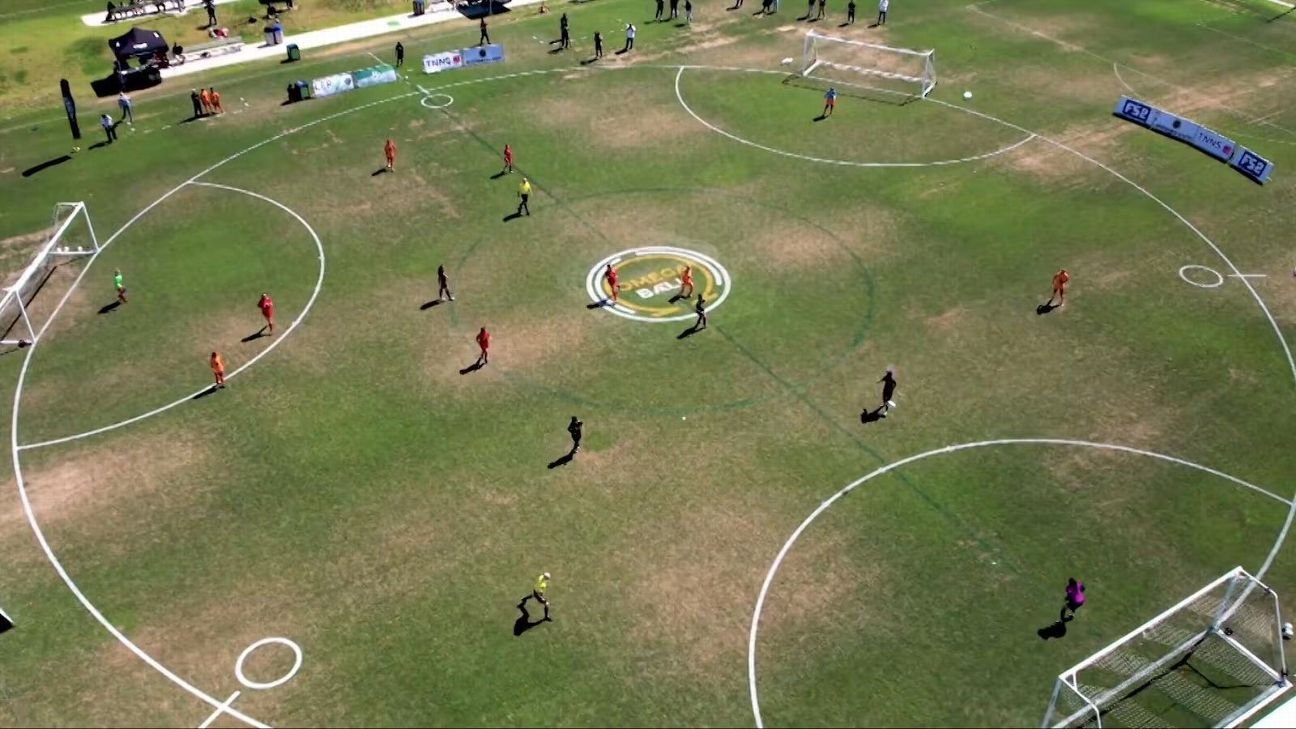
While OmegaBall is reminiscent of traditional soccer, it significantly elevates the excitement by pitting three teams against each other on a dizzying circular field.
Unlike conventional 11-a-side soccer, OmegaBall eliminates offside calls and corner kicks, keeping the gameplay fast-paced. The decision to remove the offside rule was central to the game’s creation.
– ESPN8: The Ocho — 2026 OmegaBall Men’s Championship, 8/8, 4 p.m. ET
– Hate extra time and penalties? Discover a new approach to replace them
– World Cup withdrawal? Explore the best kits in tournament history
“I wondered, ‘What if we eliminated offside?'” shares Anthony Dittmann, one of OmegaBall’s creators. “‘Would it transform the game? Would it enhance the excitement?’ I was naively pondering the rule itself.
“Then I thought, ‘What if the game had a more circular dynamic, rather than a linear one? Would that minimize the need for the offside rule?'”
Understanding Three-Sided Soccer
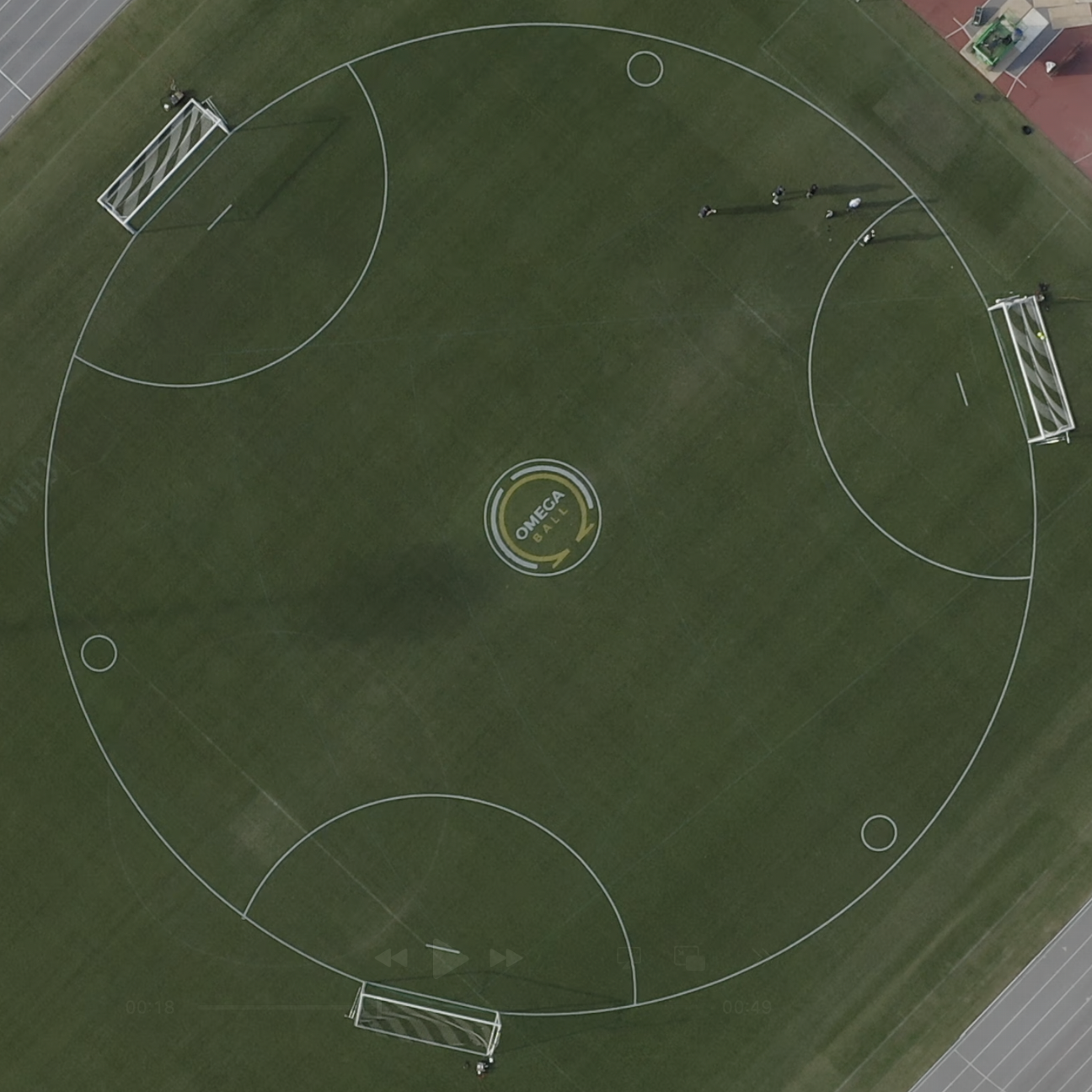
An OmegaBall game features three teams, each consisting of five players (four outfield players and a goalkeeper), competing on a circular field with a diameter of 60 yards. Three goals are located evenly spaced along the circumference of the pitch, approximately 60 yards apart and 30 yards from the center. Each team must defend one goal while attempting to score in the other two.
Teams earn one point for every goal scored against an opponent. However, if a team scores an own goal, they receive a one-point deduction. After a goal, the conceding goalkeeper must resume play within five seconds, often leading to quick counterattacks as teams regroup. There are also “vulture goals,” where one team manages to steal possession and score while another team is distracted.
For strikers, the absence of an offside rule allows for goal-hanging, which is not just allowed but actively encouraged. When the ball goes out of bounds, play restarts with a kick-in from the nearest touchline, known as a “Delta Kick.”
The game continues until the end of the 39-minute duration, broken down into three 13-minute periods, with brief breaks in between.
Most games feature just one referee and one scorekeeper for officiating, although championship matches may involve two referees, one scorekeeper, and three line judges. Given the likelihood of many goals being scored, it’s essential to maintain an accurate tally of the three-way score.
The Inception of OmegaBall
The sport of association football has seen various adaptations since the Laws of the Game were crafted in 1863. Numerous variations have been tried over the years, from five-a-side games to futsal and even swamp football.
While OmegaBall is not the first three-sided soccer variant, earlier iterations were attempted in the 1990s in Glasgow, where students played on a hexagonal pitch. There have also been two Three-Sided Football (3SF) World Cups held in Sweden (2014) and Germany (2017).
On the other side of the Atlantic, OmegaBall gained traction following its first match in Irvine, California, in 2020. The concept was developed by Dittmann along with his friends and former ESPN colleagues Bob Funk and Jamie Hemann.
Under Dittmann’s leadership, initial test games were organized in 2020 in Oklahoma, exploiting a soccer facility owned by Bob that was closed due to the pandemic. With a professional team unable to play, former players and coaches helped beta-test OmegaBall.
“Three months later, we tried it with a college team, and the feedback was overwhelmingly positive,” Dittman reflects. “We had an amazing time, and post-match surveys indicated that everyone enjoyed it.”
As interest grew, OmegaBall began hosting small, televised tournaments at a sports campus in Southern California.
“Our first tournament in Southern California in 2022 brought together a diverse mix of players—former Division I athletes, ex-pros, and even a few national team players returning for fun,” Dittmann recounts. “We held a tournament, and since then, things have really taken off.”
The original intent was to revamp American football, but the trio quickly shifted focus to soccer. Introducing a third team seemed like the perfect way to inject more action and excitement, resulting in the birth of OmegaBall.
Dittmann describes himself as a casual soccer fan, often tuning in occasionally. He began to ponder why soccer wasn’t captivating to him the way it is for others, which led him to consider potential rule changes.
“The offside rule really stood out to me,” he admits. “Soccer has low scoring. From an American viewpoint, that contributes to its appeal challenge.”
With offside eliminated, they explored how to shift the play style from a linear flow typical of traditional soccer to a more fluid, dynamic game. A circular pitch combined with the three-team format aimed to break the confines of the usual “north to south” gameplay.
“Initially, we began with eight players per team and quickly realized that was too many,” Dittmann remembers. “We tried seven, then six, and finally landed on five players per team. That proved to be the right balance.”
The first OmegaBall Championship took place in California in 2022, followed by various invitational competitions featuring both men’s and women’s teams, often with prize money at stake. The most recent event crowned Bumpy Pitch FC as the men’s champion and United City FC as the women’s champion during the March Mayhem tournament at Dignity Health Sports Park in Carson, California.
Today, OmegaBall is making waves internationally, with matches being held in locations across Europe (Spain and Germany), Africa (Nigeria and South Africa), and Asia (India).